A little over a year ago, Google brought apps into advertising through the use of app install and app re-engagement ads, which made their way to Google’s mobile AdMob Network this June. Today, these ads also became available on Google Search and YouTube globally.
If you haven’t gotten familiar with app install and app re-engagement ads, Ginny Marvin gives a great explanation in her article for Marketing Land.
00Taylor Ballhttps://www.tulsamarketingonline.com/wp-content/uploads/2018/07/TMO-Logo.pngTaylor Ball2014-08-20 13:09:272014-08-20 13:09:27Google Brings Advertising For Apps To Search And YouTube
Last week, many webmasters and SEO’s received a scare in the form of extortion emails from a supposed SEO threatening to plague a site with negative SEO if they do not pay a ransom of$1,500.
It seems the emails concerned even the most prominent members of the SEO community such as Dan Petrovic and Steve Webb. Even more interesting, despite assurances from Google that they would investigate the threats, a fair portion of the community appears to be at least moderately troubled by the threats. This gives an indication of just how easy people perceive negative SEO to be.
The email cuts straight to the point opening with, “This is an extortion email.” It then goes on to explain exactly how the individual(s) will enact specific tactics which can hurt a site’s performance in Google and potentially cause a site to be deindexed by the search engine.
The full text of the emails is as follows:
Hello,
Read this email very carefully.
This is an extortion email.
We will do NEGATIVE SEO to your website by giving it 20,000 XRumer forum profile backlinks (permanent & mostly dofollow) pointing directly to your website and hence your website will get penalised & knocked off the Google’s Search Engine Result Pages (SERP) forever, if you do not pay us $1,500.00 (payable by Western Union).
This is no false claim or a hoax, download the following Notepad file containing 20,000 XRumer forum profile backlinks pointing to http://www.negativeseo.cn.pn/ (this is our website and go and see on this website, you will find our email address [email protected] from which this email right now is being sent to you) :
Just reply to this email to let us know if you will pay just $1,500.00 or not for us to refrain or not from ruining your precious website & business permanently. Also if you ignore this email and do not reply to this email within the next 24-48 hours, then we will go ahead and build 20,000 XRumer forum profile backlinks pointing directly to your website.
We are awaiting your wise decision.
RS
Thankfully, it appears the entire situation has been nothing more than empty threats. Despite several credible SEO figures reporting the extortion emails, no one has reported paying the extortion amount and there are no signs that negative SEO is being put into action against these sites.
00Taylor Ballhttps://www.tulsamarketingonline.com/wp-content/uploads/2018/07/TMO-Logo.pngTaylor Ball2014-08-18 13:13:502014-08-18 13:13:50Webmasters and SEOs Receive Widespread Extortion Email, Should You Be Worried?
With its ever decreasing organic reach, Facebook is putting a lot of attention into their paid ad platform, especially the ads shown on mobile devices. Now, the reporting side of Facebook’s paid ad is getting improved to reflect the huge increases in mobile ads in recent times.
One of these improvements is the launch of cross-device reporting for Facebook ads. Now Facebook advertisers are able to see how users move throughout their sales process, even if they move across devices. The announcement described just how advertisers may benefit:
Imagine seeing an ad for a product on your mobile phone while in line at the bank. Do you immediately make a purchase on your phone? Probably not. But perhaps you go back to your office later that day and buy on your desktop computer. Such cross-device conversions are becoming increasingly common as people move between their phones, tablets and desktop computers to interact with businesses.
Cross-device reporting allows advertisers to be able to see which devices ads were viewed on, and on which devices conversions subsequently occurred. That means you can see how many people clicked an ad on iPhone but then later finished their conversion on desktop, and vice-versa.
In a recent analysis of US Facebook campaigns, it was found that of the people who show interest in a mobile Facebook ad before converting, over 32% converted on desktop within 28 days.
You can view the cross-device conversions for campaigns by going to your Facebook Ad Reports, where you will click Edit Columns, and select Cross-Device on the left-hand menu.
00Taylor Ballhttps://www.tulsamarketingonline.com/wp-content/uploads/2018/07/TMO-Logo.pngTaylor Ball2014-08-14 14:06:322014-08-14 14:06:32Facebook’s New Cross-Device Reporting Makes It Easier To Track Conversions
Now that we’ve all hopefully gotten over the “links are dead” hysteria, SEOs and webmasters are beginning to worry about their backlink profiles again. In the past it was easy. You could buy links or make enact one of the many now-banned tactics to try to artificially inflate your backlink profile and it seemed like no one was the wiser.
Of course things have changed quite drastically, as you should know by now. Backlinks need to be earned, and they need to be quality. As many analysts will tell you, building backlinks these days is more about relationship building than it is about farming as many links as possible. But how are you supposed to earn these prized high quality links?
SEOChat asked a long list of SEO experts where their most valuable links came from, and each gives an example of how you can earn links yourself by simply providing a service to your users and important figures related to your industry.
00Taylor Ballhttps://www.tulsamarketingonline.com/wp-content/uploads/2018/07/TMO-Logo.pngTaylor Ball2014-08-12 12:09:302014-08-12 12:09:30How Did The Experts Get Their Best Backlinks?
Countless businesses have 90 days to make significant changes to their Facebook strategies and pages. With an update to its Platform Policy, Facebook killed the so-called “like gate” which required users to Like a Page before they could be gain access to content, apps, rewards, or be eligible for contests.
The new policy is set to take effect on Nov. 5 and any page that doesn’t comply will have the gates disabled. New apps made after the announcement will also be unable to create new like gates.
You must not incentivize people to use social plugins or to like a Page. This includes offering rewards, or gating apps or app content based on whether or not a person has liked a Page. It remains acceptable to incentivize people to login to your app, checkin at a place or enter a promotion on your app’s Page. To ensure quality connections and help businesses reach the people who matter to them, we want people to like Pages because they want to connect and hear from the business, not because of artificial incentives. We believe this update will benefit people and advertisers alike.
Like gating isn’t as popular as it used to be, but it is still a relatively common Facebook fan-building strategy.
It is important to note that it is still acceptable to use incentives. You simply can’t use incentives that require a user to Like a page to gain access to content.
00Taylor Ballhttps://www.tulsamarketingonline.com/wp-content/uploads/2018/07/TMO-Logo.pngTaylor Ball2014-08-11 14:55:222014-08-11 14:55:22Facebook Has Given You 90 Days To Shut Down Your “Like Gate”
As online optimization and marketing become more and more essential to the success of smaller businesses, many small businesses are trying to manage as much online marketing on their own as they can manage with limited time and resources.
Most often, this results in the company taking on relatively small SEO responsibilities which can give a slight boost to their online visibility and performance while missing out on the larger benefits of hiring professionals. With limited resources, this may sometimes be the best option, although it doesn’t pack anywhere near the punch.
One of the biggest problems with trying to pickup SEO as a part-time strategy for your business is that SEO is only a part of the equation. These days online marketing is only truly effective when you use a holistic approach that combines social media marketing, SEO, paid search, and even traditional marketing.
Many smaller businesses employ someone savvy enough to even contribute to social media marketing efforts, but typically the do-it-yourself approach results in paid search getting neglected and you missing out on some of the most successful parts of a successful online marketing strategy.
You don’t have to leave all your pay per click (PPC) efforts to the professionals however. If you can’t afford to hire someone to take on your paid search marketing, you can still gain some humble improvements and increase your conversions with some beginner level SEO. Huffington Post shared a list of 8 things anyone can do to improve your PPC efforts, and you might be surprised at what you can accomplish by just sticking your toes into the pool.
If you are pleased with the results, it might even be the push you need to invest serious resources into a strong online presence in all areas.
00Taylor Ballhttps://www.tulsamarketingonline.com/wp-content/uploads/2018/07/TMO-Logo.pngTaylor Ball2014-08-08 14:03:452020-08-08 22:18:488 Things Anyone Can Do To Improve Your Paid Search Marketing Efforts
In the past, several Google employees have suggested they would like to see site security included as a ranking factor within their search engine. Now, Google has followed through and announced that going HTTPS, or adding a SSL 2048-bit key certificate on your site, can potentially give you a small ranking boost.
Don’t expect to propel yourself to the top of the search results by adding HTTPS, as Google refers to it as “a very lightweight signal” within the larger scheme of things and only affects “fewer than 1% of global queries.” However, it was also implied that the new ranking signal may get beefed up in the future in an attempt to encourage all site owners to increase the security on their sites.
The change should come as little surprise to anyone who heard Matt Cutts, Google’s head of search spam, publicly endorse the idea of making SSL a ranking factor just a few months ago.
Unlike many ranking changes that Google makes, the risk of drawbacks is small. Google has been saying that switching to HTTPS should not have an effect on SEO for years, so long as you take a few steps to guarantee your traffic stays steady. Mostly, such steps relate to communicating to Google so it understands how to read your site.
Google has also said they will be releasing for information and resources for webmasters deciding to adopt HTTPS, but for now all they offer are these tips:
Decide the kind of certificate you need: single, multi-domain, or wildcard certificate
Use 2048-bit key certificates
Use relative URLs for resources that reside on the same secure domain
Use protocol relative URLs for all other domains
Check out our site move article for more guidelines on how to change your website’s address
Don’t block your HTTPS site from crawling using robots.txt
Allow indexing of your pages by search engines where possible. Avoid the noindex robots meta tag.
00Taylor Ballhttps://www.tulsamarketingonline.com/wp-content/uploads/2018/07/TMO-Logo.pngTaylor Ball2014-08-07 13:33:562014-08-07 13:33:56Give Your Rankings a Small Boost By Improving Your Site’s Security
It has been a few weeks since Google caught the search world by surprise with the release of its local search algorithm which has been nicknamed “Pigeon.” Out of all of Google’s search algorithms, Pigeon was likely the most well-received at its initial roll-out, but is that still the same now that some time has passed?
While we at TMO still feel that Pigeon has the potential to help local businesses and searchers improve their local results, it is always good to get the opinions from other experts in the search marketing community. Thankfully, Search Engine Land did just that. They compiled the opinions of several authority figures in search marketing, and needless to say the consensus is mixed.
Much of the criticism is related to buggy issues likely to be resolved in the near future, but there is also plenty worthy of discussing and lots of room for improvement. You can find out exactly what the experts had to say here.
00Taylor Ballhttps://www.tulsamarketingonline.com/wp-content/uploads/2018/07/TMO-Logo.pngTaylor Ball2014-08-05 13:25:472014-08-05 13:25:47What Do The Experts Think of Google’s Latest Algorithm?
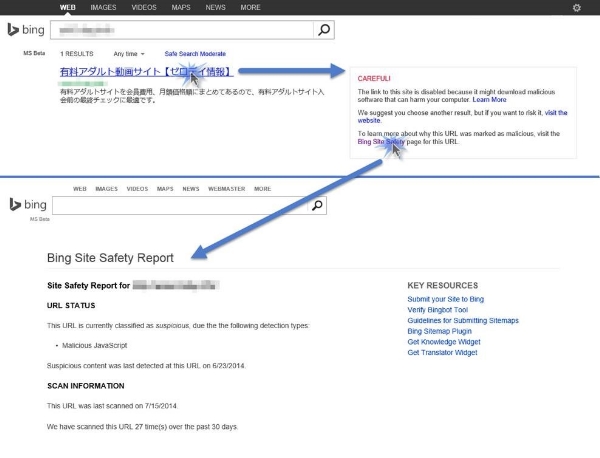
Bing is working hard to improve user safety. But rather than censoring or blocking sites that Bing deems to be a threat, the search engine is offering extra information so that users can make informed decisions and hopefully avoid sites that may have been compromised.
Bing announced the Bing Site Safety Page this week on the Bing Webmaster Blog. The safety page will show up on search results if Bing has identified a specific site as having a potential safety issue. This means users will receive a warning that a site might have problems and the webmasters will have added incentive to resolve the issues quickly.
Below you can see a screen shot of what the alert will look like and what the full Bing Site Safety Page looks like.
The Bing Site Safety Page will include information such as how long the issue has existed and when the last scan took place. Webmasters will also have extended information about how to resolve the security issue within Bing Webmaster Tools.
The Bing Safety Page offers:
The reason the page is being marked as malicious, e.g. Malicious Javascript, DriveBy Attacks, Malware Network References, etc…
The date the infection was first detected
How often the URL has been scanned
The date the infection was most recently detected
Bing also said they planned on expanding the page further in the near future with more data such as:
The total number of URLs detected as malicious on the site
00Taylor Ballhttps://www.tulsamarketingonline.com/wp-content/uploads/2018/07/TMO-Logo.pngTaylor Ball2014-08-01 13:01:132014-08-01 13:01:13Bing Announces New Site Safety Page
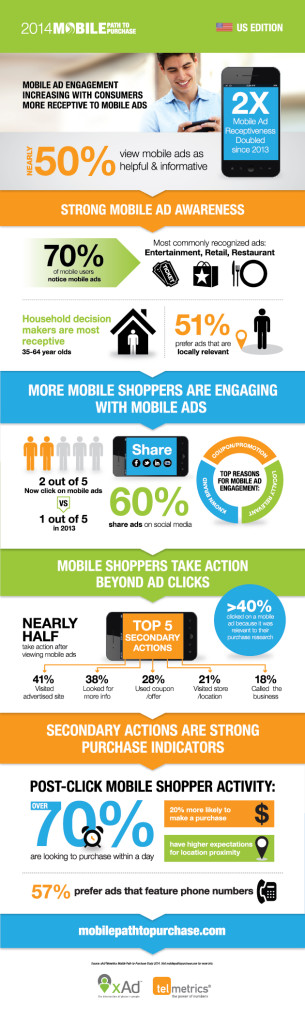
The report from the 3rd Annual U.S. Mobile Path-to-Purchase Study conducted by xAd and Telmetrics shows that as consumers mobile shoppers are increasingly receptive to relevant mobile ads, reflecting the increasing trust in mobile browsing.
The report, published earlier this week, shows that nearly 50 percent of mobile shoppers reported they felt mobile ads are informative or helpful, up 113 percent from 32 percent last year.
Even more, 40 percent of those surveyed said they have clicked on ads and nearly half of those have taken secondary actions such as viewing the referring website and searching for additional product information.
Clearly, mobile advertising is a blossoming target as the internet becomes increasingly mobile. In a market where mobile use has begun outpacing desktop access, it makes sense that users would become equally interested in relevant ads for their mobile devices.
You can get more information in the infographic shared below, or you can view the report in full here.
00Taylor Ballhttps://www.tulsamarketingonline.com/wp-content/uploads/2018/07/TMO-Logo.pngTaylor Ball2014-07-31 14:12:572014-07-31 14:12:57In an Increasingly Mobile World, Consumers are Learning to Trust Mobile Ads

 Last week, many webmasters and SEO’s received a scare in the form of extortion emails from a supposed SEO threatening to plague a site with negative SEO if they do not pay a ransom of$1,500.
 Countless businesses have 90 days to make significant changes to their Facebook strategies and pages. With an update to its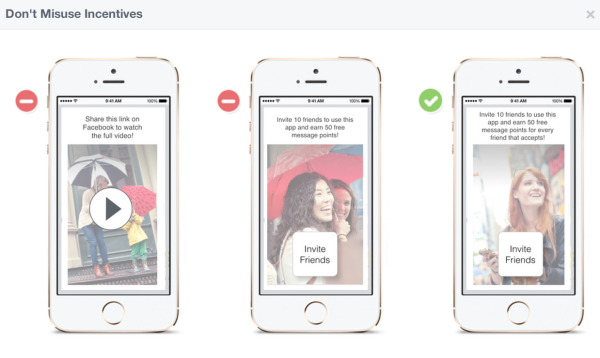
 As online optimization and marketing become more and more essential to the success of smaller businesses, many small businesses are trying to manage as much online marketing on their own as they can manage with limited time and resources.
 In the past, several Google employees have suggested they would like to see site security included as a ranking factor within their search engine. Now, Google has followed through and
  While we at TMO still feel that Pigeon has the potential to help local businesses and searchers improve their local results, it is always good to get the opinions from other experts in the search marketing community. Thankfully, Search Engine Land did just that. They compiled the opinions of several authority figures in search marketing, and needless to say the consensus is mixed.