Pinterest is expanding their platform – directly into Facebook’s. Hoping to create some synergy that will bring in new users, Pinterest is launching new features directly available from Facebook’s Messenger.

The new features, built around a chatbot for Messenger, make it possible to use Pinterest without ever having to actually open Pinterest.

According to Pinterest, the move is actually just capitalizing on the social platform’s already existing presence on the site. Each week, nearly 1 million pins have been shared from Pinterest across Messenger before the launch of the cross-platform features.

Pinterest’s Facebook Chatbot
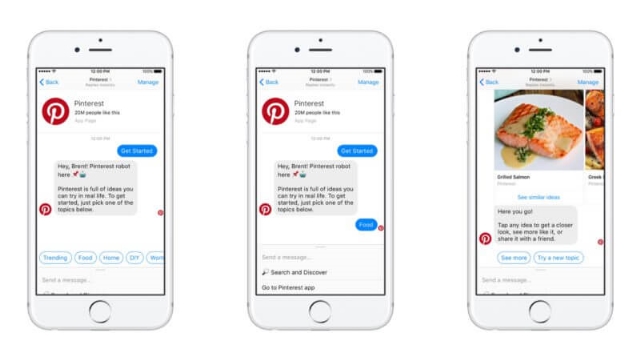
Pinterest’s new chatbot will allow users to browse Pinterest’s site and content with guided advice and recommendations. When you start a conversation with the chatbot, it will ask you to choose from a list of categories – such as “trending,” “food,” and “home.” Based on your choice, the bot will then show you a carousel of pins from that category.

You can also directly search Pinterest with text queries, however, you can not use the platform’s visual search technology by sending in pictures for similar pins.

While users might find this service to be a useful way to quickly find the pins they are most interested in, advertisers might be disgruntled to learn that the Chatbot will not include Promoted Pins.

Native Pins for Messenger
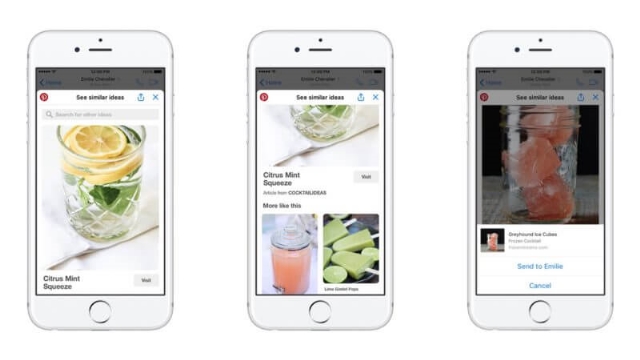
In the past, when you clicked on a pin that was shared on Messenger it would automatically open in Pinterest’s site or app. Now, pins will open within Messenger itself, thanks to the Chat Extensions feature.

Facebook’s Chat Extensions feature is designed to allow users to interact with content from other brand’s sites or apps without leaving messenger, therefore also making it easier to share that content again within Messenger.

Pinterest is using this to deliver Pins directly to users on Messenger, as well as including a gallery of Related Pins and a search bar to find more pins.

With these, users will be able to find and share pins within Messenger without ever having to leave the conversation they are having with their friends.

Interestingly, Facebook is also allowing Pinterest to generate revenue with this chat extensions. If a person’s Facebook account is connected to their Pinterest account, Pinterest will also include Promoted Pins within the Related Pins section and search results shown through the chat extension.

Instagram hasn’t become as synonymous with advertising or online marketing as it’s older sibling, Facebook, has. However, new stats announced by the company show business is booming on the popular social media platform.

Since July, more than 10 million businesses have launched business profiles – Instagram’s version of Facebook’s Pages – totaling over 25 million business profiles.

Instagram’s business profiles rolled out in May of last year and saw an initially slow response. The profiles give brands a more professional appearance on the app, including a “contact us” button and access to analytics features.

The inclusion of these business-oriented features has helped woo more advertisers to the platform, as well. Since the launch of business profiles, Instagram has increased its advertiser base from around 200,000 in February 2016 to more than 2 million in September of this year.

According to Instagram’s statistics, approximately 80 percent of Instagram’s 800 million monthly active users follow a business. Additionally, around 40 percent of the 500 million active daily users view at least one business’s profile each day.

Interestingly, two-thirds of the more than 200 million people that view a business profile each day did not previously follow the brand. That suggests the pages are effectively helping connect businesses with new potential customers and fans.

The Thanksgiving shopping weekend has officially become the biggest social media event of the year, garnering more discussion on Facebook and Instagram than even the most recent Super Bowl.

According to an email from Facebook to Social Pro Daily, more than 130 million people talked about Black Friday, Small Business Saturday, and Cyber Monday this year.

Facebook alone generated more than 226 million interactions from 90 million people about the Thanksgiving shopping weekend, while 52 million talked about the deals and shopping experience on Instagram.

Surprisingly, Black Friday and Cyber Monday weren’t the biggest days of the weekend on social media. Despite being considered the smaller event of the holiday, mentions of Small Business Saturday actually surpassed mentions of Cyber Monday. The day devoted to local small businesses also created two of the top hashtags on Instagram with “ShopSmall and #ShopLocal.

Other notable stats from the weekend according to Facebook:

  • There were more than 450 million views over the weekend on Facebook of videos related to Black Friday and similar topics.
  • Black Friday conversation on Facebook and Instagram was driven by women between 35 and 54.
  • Men between 18 and 34 were more likely to discuss Cyber Monday.
  • More than one-third of Instagram business profiles posted Instagram Stories during the holiday weekend.
  • The top five shopping-related hashtags on Facebook and Instagram over the weekend were: #BlackFriday, #CyberMonday, #SmallBusinessSaturday, #ShopSmall and #ShopLocal.
  • The three most engaged states on Facebook were Kentucky, Indiana, and Tennessee.

Every small business person knows there is no marketing quite as powerful as word-of-mouth. No matter what you promise in your ads, it won’t pack quite the punch as a positive, well-written review for your business. But, what if you could turn your positive reviews into your ads?

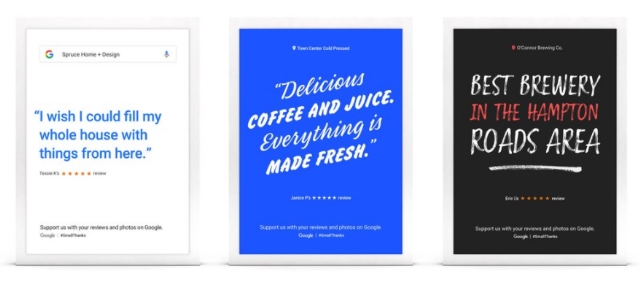
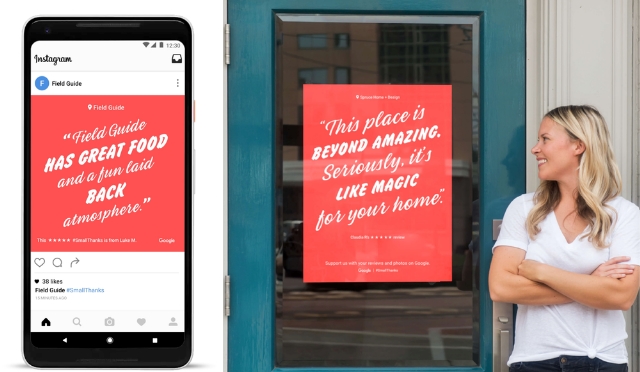
With the help of Google’s #SmallThanks Hub, you can no do just that. The new online resource aims to help small businesses create top-quality digital and printed marketing materials based on your Google reviews.

“Simply search for your business name on the site, and we’ll automatically create posters, social media posts, window clings, stickers and more — based on the reviews and local love from your customers on Google,” writes Google’s vice president of marketing for Ads & Americas, Lisa Gevelber, on The Keyword blog.

The new resource is available to all US businesses with a verified Google listing with an address.

“Reviews from your fans are like digital thank you notes, and they’re one of the first things people notice about your business in search results,” writes Gevelber in the announcement.

In the post, Google also highlighted data indicating that up to 71% of consumers say positive reviews in search results make them more likely to visit that business and that business listings boasting positive reviews receive up to a 360% increase in click-throughs to their website.

As part of the launch of the #SmallThanks Hub, Google also included a few tips for small businesses. These include keeping your Google listings up to date, encouraging customers to share reviews online, and posting “Find us on Google” stickers in their store and across social media.

As Google has continuously demoted their organic listings for search results, local SEO has risen in prominence. Instead of aiming for the top search spot, more and more businesses are prioritizing claiming the top place in Google’s local search results – which typically appear before any organic listings.

Of course, getting the top spot in the local results isn’t much easier than typical SEO work. However, it is a bit different. Google prioritizes different search signals to make sure they are delivering the most valuable businesses for your searches.

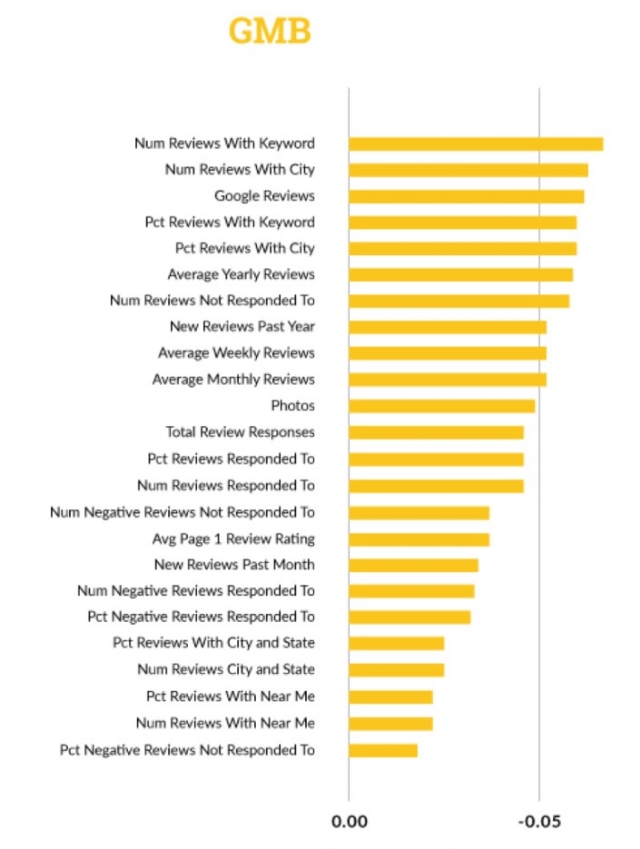
To figure out exactly what search signals matter to Google the most when sorting local results, LocalSEO Guide recently completed an in-depth review of over 200 ranking factors and 100,000 local businesses across 150 cities.

What they found shows that while organic ranking factors like links, keywords, and anchor text are important, rankings reign supreme in local search.

Specifically, “having a keyword you are trying to rank for, and a mention of the city you are working to rank in, in reviews, has a high correlation with high ranking in Google My Business results.”

The findings also indicate that engagement, such as adding photos and hours to your listing, serves as a significant ranking factor. Additionally, “responding to reviews and claiming your profiles are ways to engage with your potential customers and Google’s platform to show then you are invested.”

Elsewhere, the report suggests that traditional SEO factors such as links and on-site optimization still play a significant role in rankings. However, some off-page signals like citations and reviews on third-party sites, are declining in relevance compared to past research.

The full report details more findings and statistics to indicate exactly how those who are crushing local search are doing it. However, it is important to note that these types of studies are based entirely on correlation. We can’t say for sure exactly how Google’s systems rank local results – partially because they won’t tell and partially because they are always changing.

It is official. After over a year experimenting with various types of longer tweets, Twitter is finally letting everyone tweet with 280-characters at a time.

The double-sized tweets are rolling out as the default length limit for users around the world, except Japan and Korea. The iconic 140-character limit will be phased out, although Twitter suggests the change won’t affect most tweets.

According to the blog post announcing the change, most tweets stayed below the old limit even when they had the opportunity to say more. However, “we saw when people needed to use more than 140 characters, they tweeted more easily and more often.”

Twitter also noted that “historically, 9% of tweets in English hit the character limit.” With the new extended length, that number has dropped to only 1% of tweets.

Of course, some on the platform seem to be outraged by the break in tradition. Most, including celebrities, are celebrating the longer tweets with jokes and pointlessly long tweets for fun.

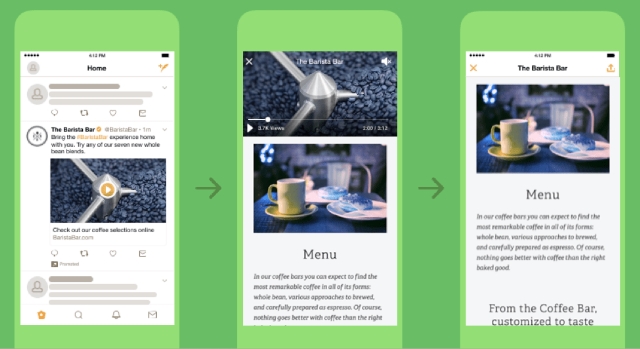
Twitter has released a new type of video ad called the Video Website Card, which is aimed at helping advertisers drive traffic to where they need it most.

Twitter Video Ads

The new ad unit uses a multi-faceted approach to help streamline the process of directing users to your site, mobile app, or any other place you want.

It starts with an auto-playing video ad which Twitter says drove twice the normal engagement of standard mobile video ads in a beta test.

After the video is over, advertisers can include a clear call-to-action to drive viewers to your preferred location. However, if a user taps the ad while the video is still playing, it will continue to play while the website loads. Twitter claims this increases user retention by over 60% because it keeps users engaged while waiting for your site to load.

As you would expect, the ad unit also includes a customizable headline and a destination URL. You can also optimize the Video Website Card for your specific goals, such as video views, website clicks, or awareness.

The ad unit is already available to all Twitter users around the world, so you can start testing the new Video Website Cards today.

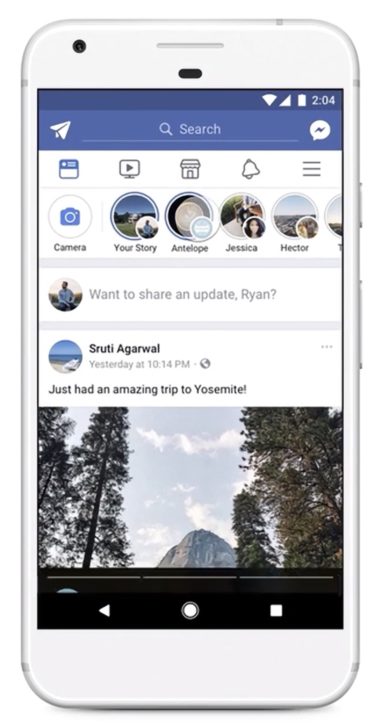
In an attempt to breathe some life into their version of ‘Stories’, Facebook is expanding the feature to all pages – rather than just individual users.

This means brands can now start sharing Stories too all their friends and followers, though it’s unclear whether businesses will take Facebook up on the offer.

Since launching the Snapchat-like feature on Facebook earlier this year, Stories have largely been ignored by most users. Compared to Instagram or Snapchat, Facebook has struggled to find the right place or utility for their own version of the feature and many have forgotten the feature exists at all.

Rather than admitting their failure, the massive social platform is doubling down in hopes that they can encourage more users to share their own stories by letting brands take the lead. Presumably, the hope is that users will follow more influential pages’ leads and boost the number of Stories being shared.

According to Facebook, the expansion has actually been in high-demand recently. Product manager Amy Sun says users have been clamoring for more ways to share and engage in the feature.

”We’ve been listening to our community and working to make it fast, fun and easy for people and Pages to create Stories on Facebook. Over the coming month, Pages will be able to create Stories to share with the people who follow them.”

It is entirely possible that this move will allow Facebook Stories to finally find their audience and take off as a legitimate way to engage with your friends and followers. However, it feels likely that Stories are just not a natural fit for Facebook and may never see similar levels of popularity as on Snapchat, where the idea originated.

It may not come as a surprise that Facebook favors native videos, but a new report shows just how much of a boost videos can get by being uploaded straight to the social media platform.

According to Quintly, native videos on Facebook get up to 530% more comments than videos shared from other sources like YouTube.

The report comes from a study originally published back in March, but which has been recently updated with data collected between January and July of this year.

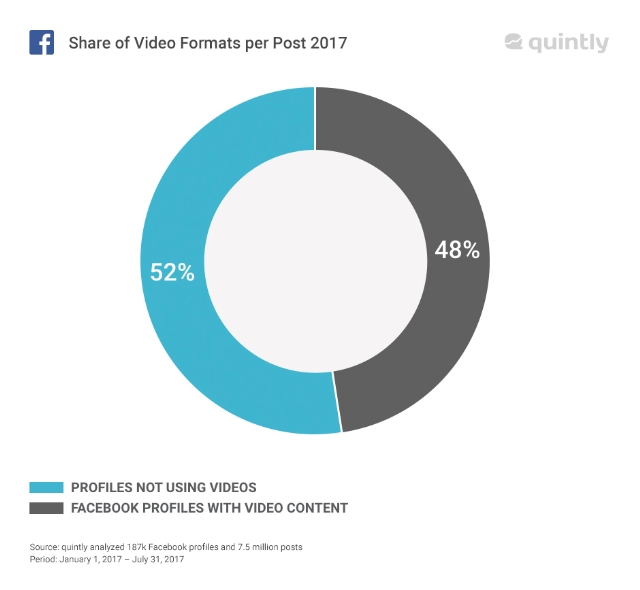
Including the new data, the study analyzed 187,000 Facebook pages and 7.5 million posts. From all this data, Quintly says it deduced that approximately 92% of all videos on Facebook are uploaded natively.

The study also shows how video has grown on Facebook recently. From January to July, almost half (48%) of all pages analyzed uploaded a video to their timeline. Of those, 92% posted at least one Facebook native video or Facebook Live video.

In comparison, only 26% of pages analyzed posted YouTube videos and 7% shared videos from Vimeo or other sources.

Facebook video’s biggest competition still comes from YouTube, but Facebook’s own clips still trounce all others in every metric.

Native Facebook videos received 168% more interactions – reactions, comments, or shares – compared to YouTube videos. They also received eight times more comments and 477% more shares.

It is highly likely that part of Facebook’s domination here is that it owns the platform, and thus, makes the rules. Facebook is almost certainly showing their own videos more prominently, which would lead to more engagement.

However, that is not the whole explanation. Native videos on Facebook’s platform also enjoy several arguably natural benefits that make them more likely to be viewed and engaged with. They can be played seamlessly from your timeline and users can react or comment as they’re watching.

In comparison, videos from other platforms have to be viewed off-site or in a separate pop-up player, and then navigate back to their timeline to like, share, or comment. At that point, they might decide to move on and keep scrolling through their feed.

Whatever the reason for native video’s domination on Facebook may be, it is clear that posting your clips directly to Facebook is the most effective way to get seen and build your brand on social media.

Everyone seems to be ripping off Snapchat’s style these days, whether it’s the spread of vanishing video or “Stories”. Still, it doesn’t seem to be impacting the platform’s popularity with their biggest demographic.

Teens still prefer Snapchat over any other platform – and it’s not even close.

The investment firm Piper Jaffray’s latest annual “Taking Stock With Teens” report surveyed over 6,100 people across 44 states. It specifically asked teens about their social media usage over the past month.

According to their results published on AdWeek, almost half (47%) of all teens said Snapchat is their favorite app. That’s an increase from 35% last year. The closest runner-up was Instagram, which was preferred by 24% of teens. Despite being the biggest social network, Facebook trailed with 9% of the vote. Lastly, Twitter and Pinterest picked up 7% and 1% respectively.

The report also includes a number of other interesting findings about teens’ media and shopping habits, including:

  • 82% of teens say their next phone would be an iPhone
  • 23% of teens prefer to shop at specialty retailers, with 17% saying they like pure-play e-commerce retailers
  • 49% of teens say their favorite website is Amazon, while 6% choose Nike.com and 5% prefer American Eagle’s website.