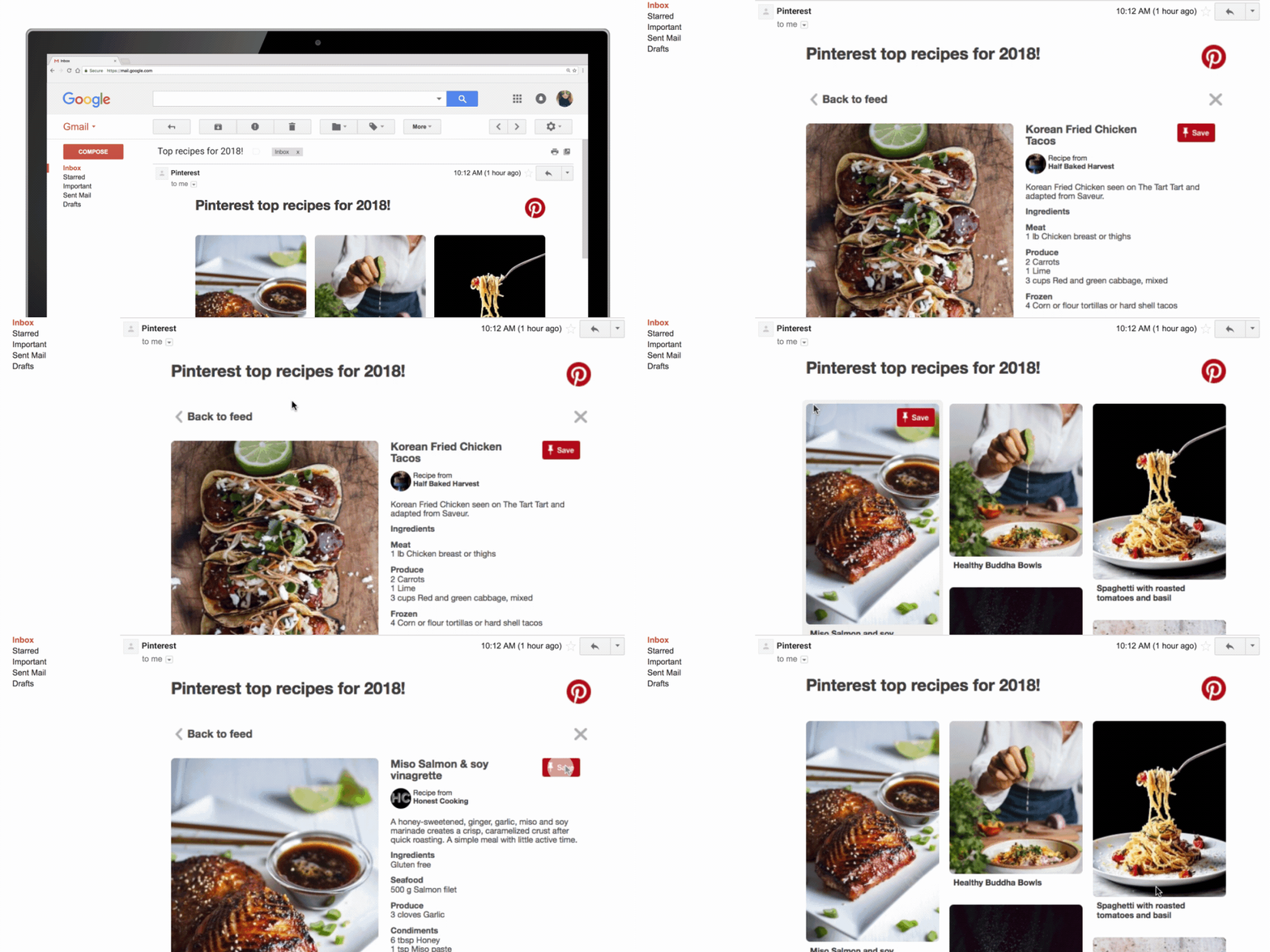
Google is bringing its super-fast Accelerated Mobile Pages to email the company announced this week. During its conference in email, the company unveiled that developers can now take advantage of the mobile-friendly AMP framework when developing emails for Gmail.

The decision gives people the ability to create faster, sleeker emails with a higher level of interaction than typically possible.

Among the many things you can do by incorporating AMP into Gmail, Google recommends:

  • Creating content that is kept up-to-date in real-time
  • The ability for recipients to browse and interact with content
  • Users getting more done in less time without having to leave email.

From the announcement:

For example, say an external contractor wants to schedule a meeting with you but can’t see your calendar, so they send an email to get information on which dates and times you’re available. Within the email is a form to coordinate details. Thanks to AMP for Email, you can respond interactively through the form without having to click a link and redirect to another webpage. AMP for Email could also help you get more done in less time by allowing you to quickly RSVP to events, browse and interact with listings and campaigns, or fill out a questionnaire without ever leaving email.

Google also provided a few examples of what you can accomplish with AMP in Gmail:
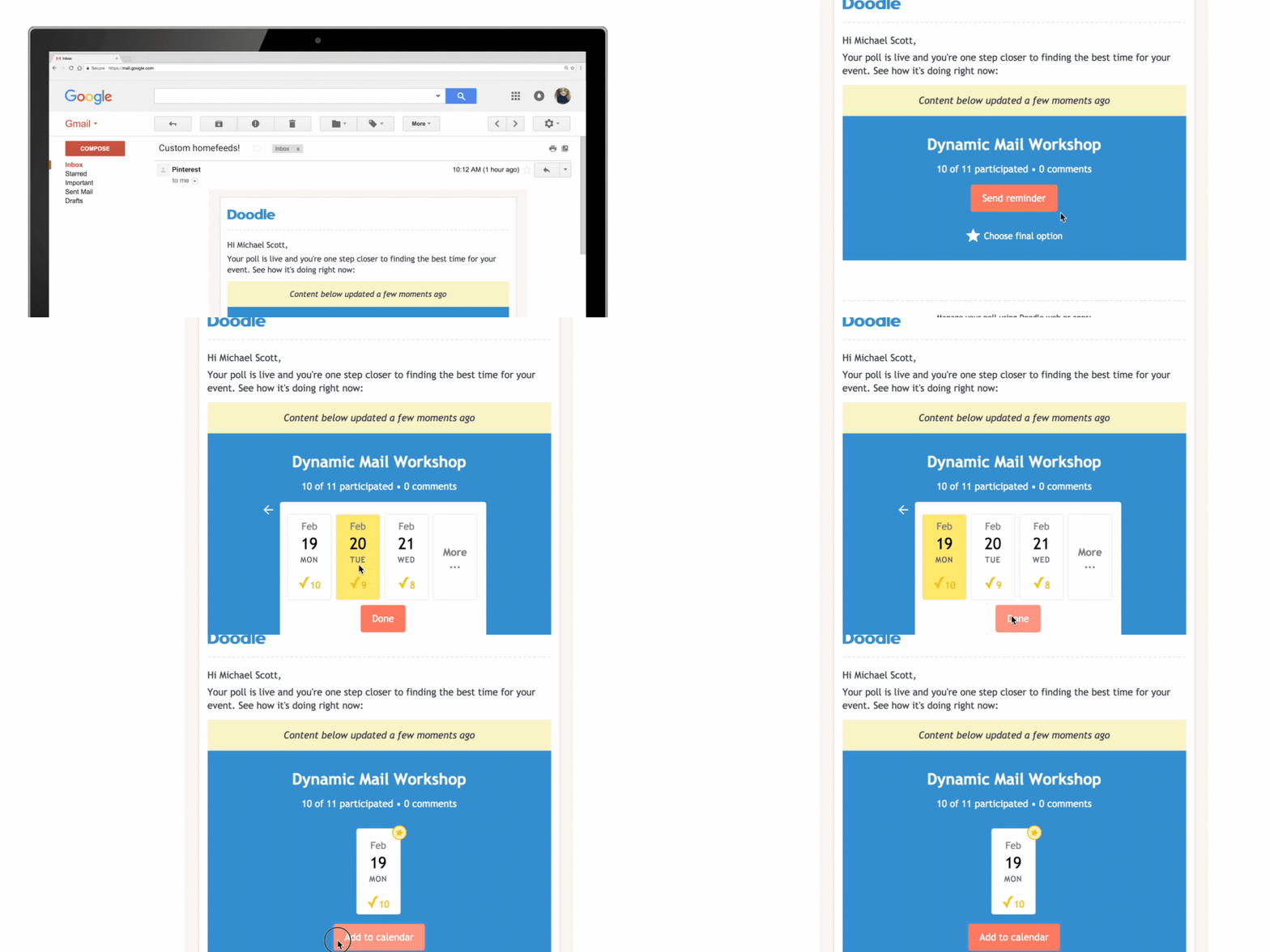
AMP for Email does require a higher level of expertise to use, since it takes knowledge of coding to build emails with. Still, with a bit of work and some knowledge, the incorporation of AMP into email opens the door to many exciting possibilities for email.
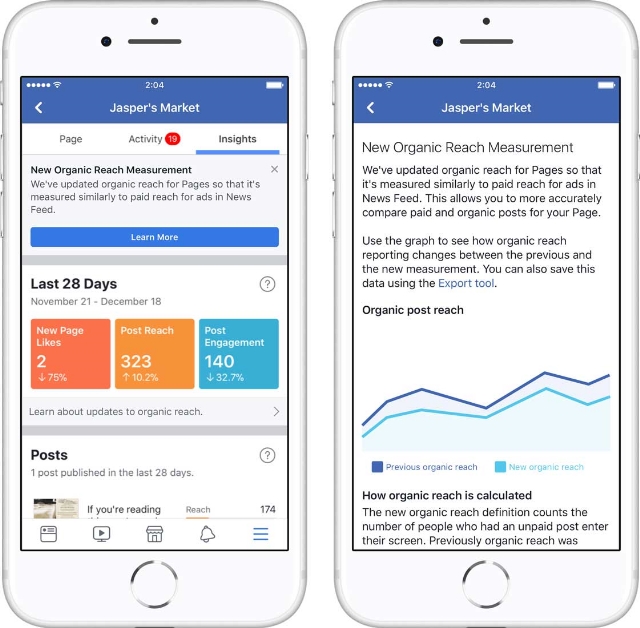
 

Facebook is making some tweaks to Page Insights that might make Page owners a bit frustrated but are actually valuable changes in the long run.

The biggest update is in how Facebook will calculate organic reach for content. In the past, reach has been measured based on how many times a post is loaded by a user’s device. However, this caused an issue where posts were counted as “viewed” despite never actually making it onto a user’s screen.

Now, Facebook has begun calculating reach based specifically on when a post is shown on a person’s screen. That means your view counts are likely to drop in Page Insights, but you’re only losing false-impressions.


The numbers you’re seeing now are a more accurate and consistent measurement of how often your content is being seen.

To help Page owners and administrators get used to the shift, Facebook is still showing the old metric in the Page Insights overview section. It is unclear how long it will remain present there.

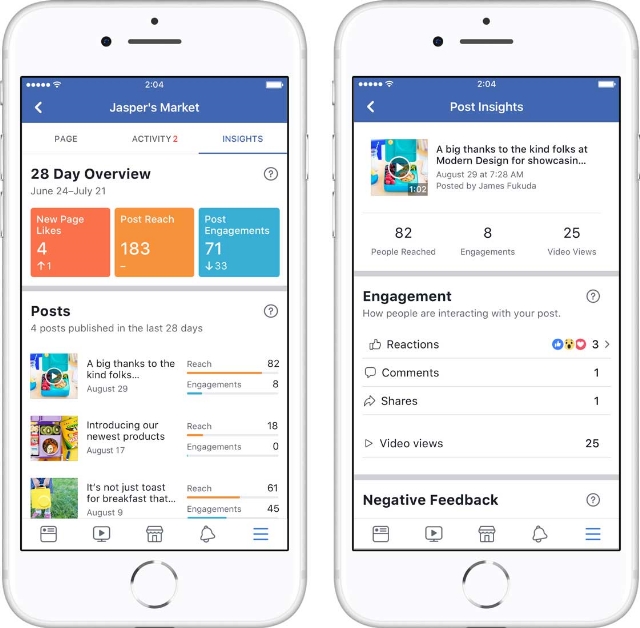
In addition to the change in how Facebook measures organic reach, Facebook is also revamping the Page Insights layout for mobile users. The changes are mostly surface, focusing on adding the most commonly used metrics to the top of the screen, including:

  • General Page diagnostics, such as number of likes, reach and engagement
  • Results of actions recently taken, such as recent post performance
  • Preview of new Page engagement, such as demographic information on new followers

Google Lighthouse SEO Audit Tool

Google has announced a new set of tools for its Chrome Lighthouse developers extension that may finally make the tool relevant for both marketers and business owners

The Lighthouse extension is adding SEO audit metrics that make the tool an easy and fast way to see how Google perceives your website and what needs a tune-up.

The browser plugin already contains audits for things like performance, progressive web apps, accessibility, and Google best practices, but the inclusion of SEO metrics make it an all-in-one way to review your website’s performance.

A small (but revealing) look at your SEO

Of course, Google isn’t giving away everything with their tool. It only contains ten of the estimated hundreds of  ranking factors, which Google seems to view as most-essential for the average webmaster.

“The current list of SEO audits is not an exhaustive list, nor does it make any SEO guarantees for Google websearch or other search engines. The current list of audits was designed to validate and reflect the SEO basics that every site should get right, and provides detailed guidance to developers and SEO practitioners of all skill levels.”

Google notes that they expect to add more metrics in the future.

What is included?

The ten SEO ranking factors measured by Google Chrome’s lighthouse extension are:

  1. Meta Viewport Element
  2. Title Element
  3. Meta Description
  4. Page has successful HTTP status code
  5. Links have descriptive text
  6. Page isn’t blocked from indexing
  7. Document has a valid hreflang
  8. Document has a valid rel=canonical
  9. Document uses legible font sizes
  10. Document avoids browser plugins

Do you need it?

The Lighthouse extension’s SEO audit feature isn’t an elite-level tool that takes hours to learn and understand. It is a quick, brief overview of just a few of your site’s SEO signals that might reveal some of the basic things you’ve been overlooking or neglecting. If you haven’t used it, I strongly recommend giving it a try and checking out your site through Google’s eyes.

Instagram has introduced a new way for brands to tell their Stories, with expanded photo and video carousels.

In the past, brands could only include a single photo or video in their Story ads. Now, a limited number of advertisers can triple that with three consecutive photos or videos, as the company announced today.

For now, the expanded ad unit is only available to 12 brands, such as California Pizza Kitchen, Netflix, and Paramount. However, it is also opening the format, which it is calling “carousel ads for Instagram Stories” to brands buying ads through automated ad-buying firms.

It is unclear when Instagram will be bringing the ad unit to self-serve advertisers, which include the vast majority of small businesses that advertise on the platform.

The expanded format should come as a relief for the advertisers who have access. In the past, the constraints of Instagram’s Story ads forced brands to squeeze in as much as possible within a single image or 15-second video. Now, they have more breathing room to tell actual stories.

The versatility of the new ad unit also offers new creative options for brands who advertise on Instagram.

Because you can mix-and-match, you might start a carousel with a short video showcasing the product, followed by an image highlighting features or details, with a link to your website on the final slide. Or, you might create thematically related short-videos that complement each other. You could also just split a 45-second video ad into three segments across the carousel.

“The goal is really to create ad formats that feel as native as possible to Instagram,” said Susan Rose, director of product marketing for Instagram.

According to Rose, one-third of the most-viewed organic Stories on Instagram are posted by brands, and 60 percent of Instagram’s organic Stories are viewed with the sound on.

While the expanded carousel gives you more room for telling stories with your ads, the individual limitations for each slide remain the same.

The maximum length of each video is 15 seconds, and photos only stay on the screen for up to five seconds. Users can also swipe past the ad to skip it.

To provide better insight into how these carousel ads are performing, Instagram says it will record analytics data for views and swipes on each post in an ad. However, the impressions for the ad will only be counted once when the ad is served.

A recent survey from the United States Chamber of Commerce confirms what many already knew: small businesses across the country are discovering that social media can help find new customers and grow your business. In particular, they see Facebook as a major platform for marketing their business directly to their audience.

The findings of the survey show that more than half (60%) of all small businesses are using Facebook to grow their business, boost sales, find new customer sources, and reach customers they typically would not be able to reach.

Why Facebook?

For many small businesses, establishing a robust online presence seems difficult and costly. Over 50% of survey respondents said the cost of internet services keeps them from developing an online presence. Additionally, 57% of small businesses said digital tools were confusing or challenging.

However, small businesses agreed that Facebook provides an affordable alternative that is easy-to-use and understand.

How are small businesses using Facebook to grow?

According to the survey, 60% of small businesses are using Facebook to achieve a variety of business goals, such as:

  • 32% reported building their business on Facebook.
  •  42% reported hiring more employees since using Facebook
  •  56% said using Facebook as a business tool increased their sales
  •  52% reported that Facebook allowed them to grow their business by allowing them to reach customers outside of their local area, in other cities, states, and countries
  •  70% of small businesses report that using Facebook helps attract new customers
  •  39% of small businesses prefer to send potential customers to their Facebook page than to their own web page.
  •  Over 50% of small businesses reported that Facebook allowed them to take advantage of growing digital sales.

The report also explains:

“In addition to facilitating firms’ successes, over half of small businesses on Facebook reported that the platform as helped them overcome challenges in increasing revenue.”

After a few weeks of testing, Google My Business has officially announced that all business owners can now upload videos to their Google My Business listings.

Business owners can “view videos added by customers and upload videos about their business for customers to view,” said Google’s Allyson Wright.

Videos can be up to 30 seconds in length and may take up to 24 hours to become visible on the business listing in Google Maps and local search results.

Because others like Google’s “Local Guides” can also upload videos to business listings, GMB will also soon give businesses the ability to mark offensive or inappropriate videos on their listings.

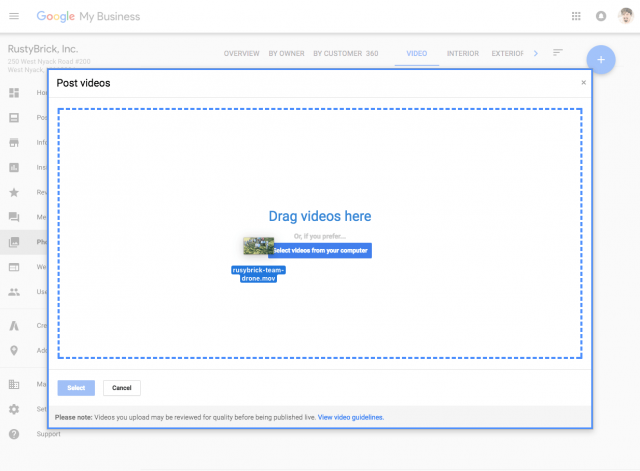
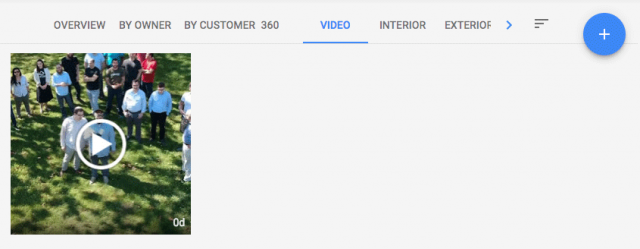
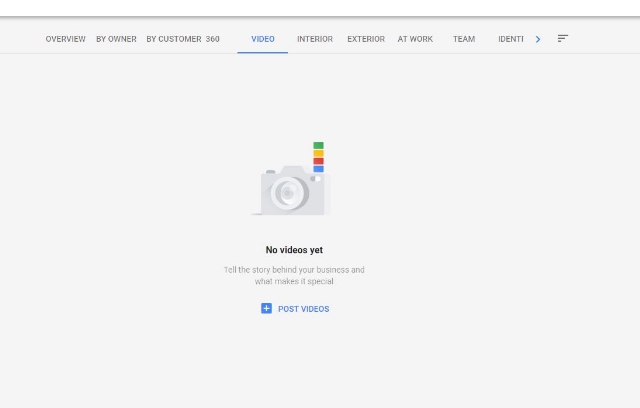
To get started adding videos to your own listings, open your Google My Business Dashboard and click “photos,” followed by the “video” tab at the top of the page. From there, select the option to “Post Videos.”

Just drag and drop your video to the box.

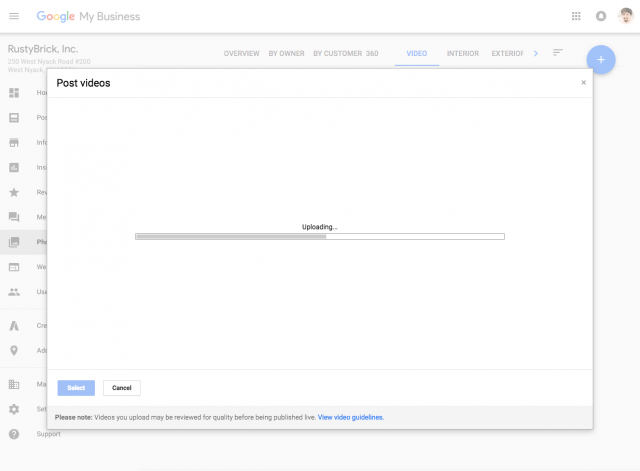
Let it upload.

And wait for it to appear. Within about a day, the video should become visible for you and anyone who sees your listing.

Wright also provided these notes about the new feature:

  • Videos will appear in the overview tab of the Google My Business Dashboard.
  • Customer uploaded videos can be found in the “customer” tab.
  • Merchant uploaded videos can be found in the “by owner” tab.
  • All videos can be viewed together in the “videos” tab.
  • After upload, it could take up to 24 hours for the videos to appear. Once live, they will display where local photos do.

People have been proclaiming that organic reach on Facebook is dead for years, thanks to moves that increasingly prioritize paid ads over regular Page posts. However, now might really be the time to start grieving. Facebook has announced sweeping changes to its News Feed that will make organic Page content even less likely to be seen.

According to Facebook, the change is ostensibly to prioritize the “social” part of their platform by putting posts from friends and family at the top of the News Feed. As this happens, “public content” (or content shared by Pages, rather than individual accounts) will be removed or pushed deeper down the feed.

However, there is a caveat that Page content that “spark conversations” will also be prioritized.

It is unclear exactly how this will be measured or enacted, but it implies that brands or publishers will have a harder time reaching users unless their content regularly receives a large number of comments.

Facebook explains the changes in a blog post, saying:

“Because space in News Feed is limited, showing more posts from friends and family and updates that spark conversation means we’ll show less public content, including videos and other posts from publishers or businesses…Page posts that generate conversation between people will show higher in News Feed. For example, live videos often lead to discussion among viewers on Facebook – in fact, live videos on average get six times as many interactions as regular videos.”

Facebook is largely trying to downplay the impact on businesses or publishers, but Zuckerberg’s own blog post acknowledges that he expects “some measures of engagement will go down” for publishers and small businesses.

Unsurprisingly, this creates more incentive for brands to buy into Facebook’s ad platform to ensure their content actually reaches their audience.

Facebook’s Adam Mosseri recommended several steps small business or brands can take that rely heavily on video content – particularly Facebook Live.

“Page posts that generate conversation between people will show higher in News Feed. For example, live videos often lead to discussion among viewers on Facebook — in fact, live videos on average get six times as many interactions as regular videos. Many creators who post videos on Facebook prompt discussion among their followers, as do posts from celebrities. In Groups, people often interact around public content. Local businesses connect with their communities by posting relevant updates and creating events. And news can help start conversations on important issues.”

These changes and the continually decreasing organic reach across Facebook may make it tempting to try to manipulate or goad users into engaging, but Mosserri says this will get you in even worse trouble.

He says “using engagement-bait to goad people into commenting on posts is not a meaningful interaction, and we will continue to demote these posts in News Feed.”

The popular “Stories” feature that has expanded from its SnapChat origins into Facebook, Instagram, and Twitter has always been known for its short-term lifespan. Stories have always been something that disappears sometime after sharing.

Now, Instagram is changing this with new ways to save and reshare your Stories long-after they’ve vanished from people’s feeds.

Instagram recently launched two updates to its Stories feature that gives users the ability to add Stories to its Archive feature and include Stories in the “Highlights” section of users’ profiles.

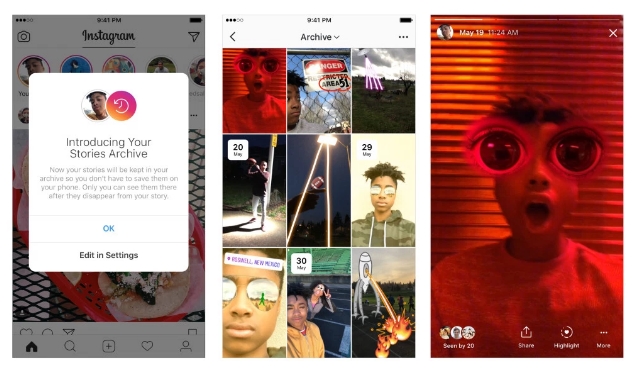
In a blog post, Instagram said that Stories will be automatically saved to users’ private Archives once they expire. From there, you can view or reshare your old Stories as a normal video post or add them to highlights.

The feature is turned on by default, but you can opt to turn off the Archive feature if you like.

Instagram explained, “To access the Stories in your Archive, tap the Archive icon on your profile. From there, you can easily switch between your Posts Archive and your new Stories Archive. In your Stories Archive, your stories will appear in a grid with the most recent Stories at the bottom. The first story from each day will show a date indicator to help you navigate your archive as you scroll. Only you can see your archived stories, and you can choose to turn off auto-archiving at any time in your profile settings.”

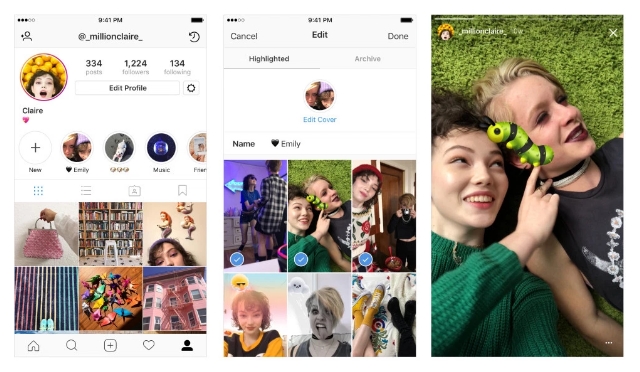
At the same time, Instagram has launched the new Stories Highlights section, where users can add Stories to their profiles.

Stories Highlights can be created by simply tapping on the New circle on the far-left side of the app. After that, just choose which Stories you want from your archives, select a cover for the Highlight, and give it a name.

Once that’s all done, the Highlights will appear as circles on your profile where they can be viewed.

You can add as many Highlights as you want, and they will remain on your profile until you delete them by tapping and holding on the circle.

In the blog post, Instagram said: “Over the past year, Instagram Stories has become a key part of how you express yourself—but there hasn’t been an easy way to keep your Stories around for more than 24 hours. Now you can more fully express your identity by grouping Stories you’ve shared into Highlights and featuring them on your profile. Story Highlights lets you show all of the sides of your personality, and you can make highlights out of anything you’ve shared to your story in the past. From the best moments of your ongoing soccer season to all the stories you capture of your loved ones, the interests and activities that matter most to you have a home right on your profile.”

Brands and marketers will likely find these new features provide a number of ways to make Stories a more powerful marketing tool. In an email to Social Pro Daily, Instagram suggested brands can take advantage of the tools by:

  • Extending campaigns and promotions beyond 24 hours.
  • Showcasing immersive video and behind-the-scenes content on the increasingly significant profile page.
  • Re-engaging people around best-performing Stories content.
  • Sharing customer reviews

Business owners may be able to upload videos to their Google My Business accounts in the near future, based on a new feature popping up for some account owners.

Colan Nielsen from SterlingSky noticed that some of his clients now had access to a new panel for uploading videos showcasing their stores or products.

Several others have since reported seeing the option appearing in their own accounts, however, not everyone says they can use the feature quite yet.

For now, it is unclear whether the feature is just one of the many tests Google runs on a regular basis or a slow rollout of a widely anticipated feature. Google has yet to release a statement on the issue.

It’s worth noting that this isn’t the first time videos have started showing up in GMB accounts. During the earlier years of Google My Business, Google included a similar video upload option. The tool disappeared long ago.

Since then, Google has allowed “Local Guides” – volunteers who help Google gain in-person information about businesses – have been able to upload videos to local listings. Actual business owners or account operators have not been able to until now, though.

While many can already upload videos, few have reported actually seeing their videos show up on their listings yet. When they do appear, videos are likely to be shown under the photos tab, as they do in the listing for Voodoo Doughnut in Portland:

Business owners using GMB have been asking for the ability show videos for years because they can provide a more complete view of both their stores and their products. Hopefully, the appearance of this feature for some is a sign of a much wider roll-out coming soon.

The importance of Google reviews has recently gotten a big boost, as it appears that the number of rankings your business has on Google My Business may play a big role in determining where you appear in the local search results. Thankfully, it appears you won’t have to rely solely on Google for your reviews in the future.

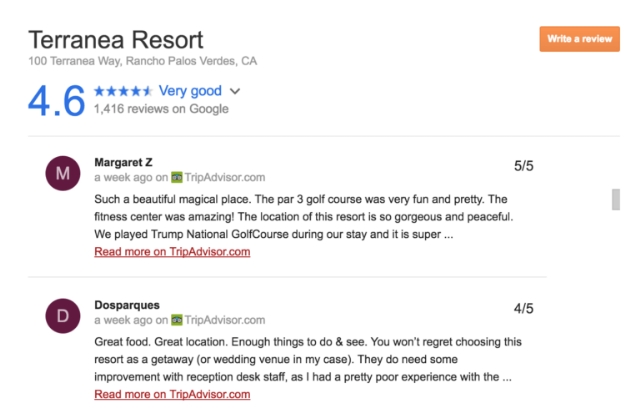
Google has begun integrating reviews from third party sources like Trip Advisor and Booking.com into their Knowledge Graph cards for Google My Business Listings. That means your reviews from these sites will be shown alongside your Google reviews, all in one convenient place for shoppers.

The reviews can also be filtered by source by clicking on the “All reviews” drop-down menu.

Currently, the sites being integrated are most beneficial for hotels and other similar travel-related businesses. It is unclear when or if more review services will be included in the future.

As Search Engine Land notes, this is not Google’s first foray into using third-party review sites directly within their search results. The search engine got into a lengthy legal battle against Yelp for scraping their reviews and displaying them in the search results without permission. The result was that Google agreed to only use third-party reviews in their search results with explicit permission from the publisher.

Based on this, it is all but certain Google is working closely with these outside sites to integrate their reviews.

The biggest question for now is whether these reviews will also be reflected in local optimization. If so, businesses that have been accumulating reviews on third-party sites may expect a big boost to their local rankings in the near future. Only time will tell.