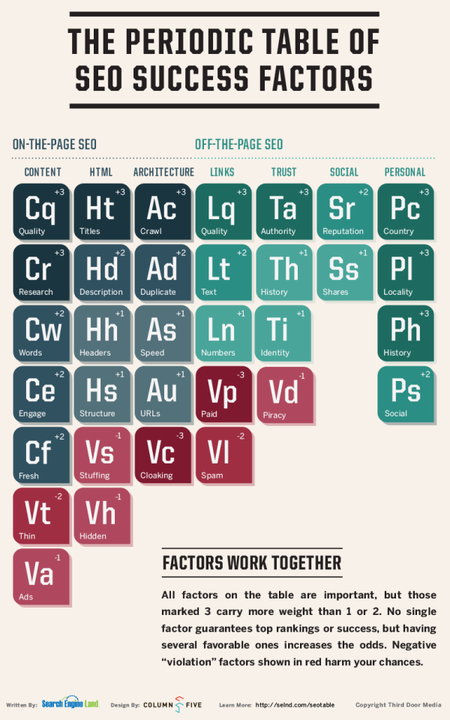
Two years ago, Search Engine Land released their “Periodic Table of SEO Ranking Factors”, but we all know that SEO doesn’t stay the same for that long, especially with the bigger changes that Google has been pushing out lately. That is why the periodic table was recently updated, clarified, and re-branded “The Periodic Table of SEO Success Factors”.
When you hear that Google has over 200 “signals or ranking factors” and over 10,000 “sub-signals” it is easy to get overwhelmed or confused as to where you should focus your efforts. However, those big numbers are usually created by speculation such as whether or not Google pays any attention to Facebook Likes (the truth is, we don’t know).
While there may be a full 200 signals Google uses, there is a hierarchy to how important each signal is, and we have a pretty good idea of the most important ranking factors that Google relies on. These bigger signals are also the most likely to stay stable over time. If we somehow were to find out the current full list of ranking factors, the system would change again by the time you had their weight and function mapped out. Heck, they may have changed while I typed this sentence.
Search Engine Land’s periodic table doesn’t attempt to focus on the small things, but instead shows you the areas that have the biggest impact on rankings and visibility. As the creators see it, the table is a starting point for new SEO and a friendly reminder for the veterans. The simple version of the periodic table is below, but you can find the expanded table as well as the key for understanding the image here.
Over the weekend, I got on a reading kick, but often the biggest challenge in those instances is picking the best book to start up. Of course, you could always try to trudge through A Song of Fire and Ice, or some other fiction, but lately I’ve been hoping to get a little more out of my reading.
Thankfully, there are practically an unlimited number of books for designers and developers that there is no shortage of information or discussion for me to choose from. The best part is, the most recent wave of books have almost entirely been ebooks that cut out all the production costs and are available for free.
You can look into any design topic you want and almost certainly find a book focused on that idea. Whether you want to learn a new coding language, research the latest trends, or learn some historical perspective to inform your designs, there is undoubtedly a book on it. Rather than making you do a lot of Googling and vetting to pick the best book for your interest, Paul Andrews put together a list of 19 free ebooks that cover everything you want to know.
Some of the ebooks are simple guides like Mobile Web Design Best Practicesfrom Mobify which (as the title suggests) walks you through 50 of the best ways to build the best mobile site possible. Similarly, you could check out Web Design and Mobile Trends for 2013from Awwwards if you are looking to catch up on what is all the rage right now.
There are also much more in-depth texts you can dig into such as Learning JavaScript Design Patternsby Addy Osmani. The ebook teaches designers how to write beautiful, organized, and most importantly, maintainable JavaScript through the application of classical and modern design patters to the language.
Whether you’re looking to pick up a new skill or refine and improve your existing ones, there’s an ebook that will take you from start to finish with half the headaches of digging into a myriad of tutorials and online articles from a whole bunch of conflicting sites and writers.
00TMOhttps://www.tulsamarketingonline.com/wp-content/uploads/2018/07/TMO-Logo.pngTMO2013-06-10 11:36:192013-06-10 11:36:19Free eBooks That Teach Old (And New) Designers New Tricks
Everyone makes mistakes. It is a part of life. Sometimes we catch those mistakes before they get out into the public, but sometimes we spend endless time and energy on something and it just doesn’t work out. That happens with our web designs as well. We spend months working on our next big project, putting in research and extra hours until we think it is perfect. Then, it goes live and nothing happens. Months later, and your site may as well be flat-lining.
Just imagining that scenario can make a designer feel sick to their stomach, but you can’t let mistakes like those get you down. Design is very much about trial and error, and sometimes you have to make a lot of errors before it works out. But, there are some things you can do when a site doesn’t work out. Catalin Zorzini recently posted some steps you can take to get your design back on track.
Ask for Opinions – Sometimes we get a little stuck in our own worlds and inspiration that we forget we aren’t designing for ourselves. We are designing for others, and the best way to find out what they think is by asking. If you have people within your friend or co-worker circle that fits the demographic you are looking for, ask them their opinion. They’ll get you out of your own brain and back on track.
Simplify – Sometimes when we get driven to create a truly great site, we go overboard. It can be exhilarating to combine all your skills all into one amazing page, but when you combine graphics, images, videos, text, and animation all onto a page, it can get pretty jumbled and unattractive. Less is more, especially online.
Make Your Call To Action Clear – What do you want people to do when they come to your site? Do you want them to purchase something or subscribe to a newsletter? Either way, make it clear and easy for your potential customer to do what you want from the moment they enter the page. You don’t want to annoy them with it, but you want it to always be more available than not.
Build Your Credibility – The internet has more than its fair share of cons, misrepresentations, and shady dealers. These people create websites every day, and people are always on the lookout for them, so you have to make it clear when they reach your site that you are a reputable member of your community. Whether you join an organization within your physical community or online industry, having others who will back up your credibility will help your potential customers trust you.
Use Social Media More – Social media is a big force online now, and every company needs to have an established social presence. Not only do you gain an easy way to interact with customers and find out what people think about your brand, you also gain credibility by widening your online foundation.
00TMOhttps://www.tulsamarketingonline.com/wp-content/uploads/2018/07/TMO-Logo.pngTMO2013-06-06 13:02:102013-06-06 13:02:10Fixing a Broken Website In Just a Few Steps
One of the biggest mistakes you can make in SEO is optimizing your website at the expense of the audience. While it may help get people onto your page, when visitors are met with a page filled with too much content on a bad design, they leave and you lose a sale.
With Google’s latest emphasis on usability, over optimizing may actually hurt your search engine rankings anyways. Jay Taylor recently shared some tips to make sure you are creating websites that customers and search engines alike will love. If you want to get people to come to your page and stay, follow these important rules.
Understand Your Customer – First and foremost, the internet is now more about the user than it ever has been. Google includes aspects of usability such as speed, design, and content in their algorithms as strong indicators of quality sites. Not only that, but obviously you should be trying to appeal to your actual customers, not just your own tastes. The way you percieve your brand may not be the same as how your customers understand your product, so you want to find out why they choose you over your competitors. Once you know that, you know what to play up when introducing potential customers to your brand.
Websites Don’t Have To Be Beautiful – That’s a bit of an overstatement, but it is far more important for a website to be usable and interesting to your target audience than it is to have a website that looks like a work of art. Use visuals that appeal to your customers in a way that solidifies your credibility and appeal to your customers. You want your website to look professional and be extremely usable, not unapproachably artistic.
Create Great Content With a Purpose – The days of creating content stuffed with keywords solely to appease search engines is long gone. Your content should have a purpose to your reader and be aimed at actually informing your audience rather than rambling with specific words to attract crawlers. Poor grammar, unnecessary vocabulary usage, and awkwardly mechanical text turn people off, and can lose you customers. Instead, make sure your content has a purpose, value to your customer, and inspires action of some sort.
Provide Easy-to-Use Navigation – User-friendly navigation is essential to allowing your customers to quickly and easily find what they’re looking for on your site, but it also allows search engines to more effectively index your site. There should be navigation in the header and footer so that customers always have access to it, and you might consider a drop-down menu in the top navigation if you have a lot of pages.
Measure and Improve – Keep track of your key performance indicators such as conversions, contacts from the website, and possibly purchases to see how any new changes may be affecting your performance. You should also be using Google Analytics to watch where your customers are coming from, and what may be causing you to lose conversions.
https://www.tulsamarketingonline.com/wp-content/uploads/2018/07/TMO-Logo.png00TMOhttps://www.tulsamarketingonline.com/wp-content/uploads/2018/07/TMO-Logo.pngTMO2013-06-06 10:23:152013-06-06 10:23:15How To Please Customers and Search Engines With The Same Website
Let me ask you, did you even know there is a difference between an SEO agency and a content marketing agency? To many, the terms have become synonymous, but the terms actually have different meanings reflecting what you hope to get out of hiring a professional to help you run your web presence. How do you know which agency is the best for you? Amanda DiSilvestro broke down the differences between the two recently, as well as the general pros and cons of both.
SEO agencies tend to be more focused on data and metrics from the search world. While they create content, they are more interested in calculating visibility and traffic and leveraging those with trends in search behavior so that they can create the best content for search engine visibility. Content marketing agencies on the other hand create content based on what what your audience wants most during the current buying cycle. The interest isn’t on search, but rather engaging with the public and achieving a goal.
The biggest differences are where each agencies information is coming from. SEOs use search-driven data and analytics, while content marketing agencies use audience-driven data and general content creation knowledge. Both agencies use data to create excellent content, and in many ways their efforts do overlap, but their methods are different.
What is best for you depends on the needs of your business. DiSilvestro suggests working with a content marketing agency first, so that you understand your audience, buying cycle, and the more broad ideas of creating content before seeking out an SEO company. Once you know how to create great content, an SEO can help you make it visible.
https://www.tulsamarketingonline.com/wp-content/uploads/2018/07/TMO-Logo.png00TMOhttps://www.tulsamarketingonline.com/wp-content/uploads/2018/07/TMO-Logo.pngTMO2013-06-05 14:24:052013-06-05 14:24:05What’s The Difference Between SEO And Content Marketing Agencies?
You’ve no doubt heard about it. All the blogs are talking about it, the big companies are using it, and there has been a visible change on the internet over the past year. Flat design is in, and it appears to be here for the foreseeable future.
Still, unless you’ve been keeping up with the most recent writings about design, it is likely you haven’t even heard of flat design. What does it really mean? Conceptually, the style is all about designing for the screen rather than simulating an increasingly irrelevant physical world.
In the eyes of flat design proponents, skeuomorphism, or design replicating the three dimensional world, was used as a crutch to make computers usable to those unfamiliar with them. At this point, that introductory style design is less needed because children are growing up with technology present in their lives.
Flat design isn’t just a conceptual style though. It has very distinct visual characteristics as well. According to Carrie Cousins, there are five things that make a design “flat.”
No Added Effects – Flat design is so-named because it strives to depict two-dimensionality. This is best achieved through a style that rejects all embellishments that have long been used to replicate three-dimensions such as drop shadows, bevels, embossing, and gradients. In flat design, every elements is crisp and and without shadows or feathered edges that blend it into the page.
Minimalistic Approach – Flat design attempts to be as simple as possible and thus it is usually accompanied with an overall minimalistic approach. The designs don’t use tons of flash animation or any other over the top design elements. Many sites rely almost entirely on color and text, but others include simple high resolution photography to set the mood.
Simple Elements – To create a simple and clear visual hierarchy, flat design uses many simple user interface elements, like buttons and icons. The trend has been using simple shapes such as rectangles, circles, or squares, and allowing each shape to stand on its own. Every UI elements is simple to understand and easy to use, striving for an intuitive experience.
Focus on Typography – Flat design is deliberately simple and crisp, which means the designs rely heavily on typography. Luckily, typographical design is also hugely popular at the moment as the internet has made using creative and interesting text much more possible than it ever was in the past. The typeface should always match the design scheme, but also simple, bold, and worded efficiently. Art or vintage fonts work well as embellishment, but it is important not to go overboard.
Focus on Color – Because of the simple styling, flat design also relies heavily on color. Pastels gave been very popular within the trending style, but most importantly flat design color palettes are more bright and colorful than other design styles. There is also the possibility to use more colors within a design than is usually utilized on a page. Many sites mostly use two to three colors, but flat design palettes can consist of up to eight equally used colors.
Penguin 2.0 only affected 2.3% of search queries, but you would think it did much more from the response online. Ignoring all of the worrying before the release, there have been tons of comments about the first-hand effects it seems many are dealing with in the post-Penguin 2.0 web. Those spurned by the new Penguin algorithm have even accused Google of only releasing the update to increase their profitability.
Matt Cutts, head of Google’s Webspam team, used his recent Webmaster Chat video to attack that idea head on. The main question he was asked is what aspect of Google updates Cutts thinks the SEO industry doesn’t understand. While Matt expresses concern about the amount of people who don’t get the difference between algorithm updates and data refreshes, Cutts’ main focus is the concept that Google is hurting web owners to improve their profits.
Most notably, the algorithm updates simply aren’t profitable. Google experienced decreases in their revenue from almost all their recent updates, but Cutts says that money isn’t the focus. Google is aiming at improving the quality of the internet experience, especially search. While site owners using questionable methods are upset, most searchers will hopefully feel that the updates have improved their experience, which will keep them coming back and using Google.
As far as the misunderstandings between algorithm updates and data refreshes, Cutts has expanded on the problem more elsewhere. The biggest difference is that the algorithm update changes how the system is working while data refreshes do not and only change the information the system is using or seeing.
Cutts was also asked which aspect of SEO that we are spending too much time on, which leads Cutts to one of the main practices that Penguin focuses on: link building. Too many SEOs are still putting too much faith in that single practice though it is being destabilized by other areas that more directly affect the quality of users’ experiences such as creating compelling content. Instead, Matt urges SEOs to pay more attention to design and speed, emphasizing the need to create the best web experience possible.
Cutts’ video is below, but the message is that Google is going to keep growing and evolving, whether you like it or not. If you listen to what they say and tell you about handling your SEO, you may have to give up some of your old habits but you’ll spend much less time worrying about the next algorithm update.
00TMOhttps://www.tulsamarketingonline.com/wp-content/uploads/2018/07/TMO-Logo.pngTMO2013-06-04 10:07:262013-06-04 10:07:26What Do Most SEOs Not Understand About Google Updates?
After all these years and new Adobe programs, Photoshop is still the tool for designers. It is the tool of the trade no matter what style you like, whether you do digital painting, sign style design, or photo manipulation. But, Photoshop is to us like the scalpel is to surgeons; in skilled hands it is a great tool, but it can be dangerous if misused.
Unlike when a surgeon makes a mistake, it can sometimes be hard to tell when you are misusing Photoshop or creating a design others aren’t going to respond to. When you’re learning the program, there is so much at your fingertips it can be tempting to use everything, even when you don’t quite know what it does. It also offers many different solutions to problems – some better than others – so it is easy for the uninitiated to complete the task they wanted without getting the right results.
Jay Adrianna, writer for Onextrapixel, recently wrote about thirteen incredibly common Photoshop mistakes designers and photo editors make, as well as easy ways to fix them. Whether you are a beginner, or someone more used to the program looking to refine your techniques and improve your finished products, it is almost guaranteed there is something you can learn from the tips offered. As always, the key is moderation.
00TMOhttps://www.tulsamarketingonline.com/wp-content/uploads/2018/07/TMO-Logo.pngTMO2013-06-03 13:52:522013-06-03 13:52:52The Most Frequent Mistakes New Photoshop Users Make
Blogs are an important part of marketing and SEO. Publishing content on a regular basis allows you to connect with your audience in more direct ways while also helping establish your brand and it’s value. You can generate leads through your community and demonstrate your own expertise while your at it, which makes it a great multi-faceted positive marketing technique.
While it is great as a general marketing method, blogging also helps your SEO by making search engines value your site more. The more content you are putting out, the more crawling the search engines will do of your site, while Google and Bing also recognize your perceived value within your field from your community. Blogs also allow you to do natural link building without getting into questionable connections to other sites, and you’ll have content that can be easily shared through social media.
Just because blogging is inherently good for SEO, it doesn’t mean your blog is as optimized as it could be. Many companies have blogs that are hardly optimized for search, and because of this they aren’t getting the rewards out of it that they could be.
Optimizing your blog isn’t all that hard, especially if you’re using a popular CMS or publishing platform like WordPress, but you have to be willing to take the time to correct the missteps. Ken Lyons pointed out six common ways that blogs fail to optimize. If you just follow through on his suggestions, you’ll find your blog will start performing beyond your wildest dreams.
Many of the suggestions can be done through simply making some changes to your CMS like adding plugins that establish related posts. Making your content easy to find is crucial to search engines, because they crawl pages by simply following links and mapping out the page. If it takes a dozen clicks to find something, there is less chance the crawlers will ever see it. Adding related posts to the end of blog posts allows readers to more easily find content on the topic they are learning about, without having to go back to the search engine, while also improving the navigation of your site and boosting your SEO value.
Similarly, adding previous or next post links at the end of posts on your blog improves the net style navigation you want on your site while also keeping viewers immersed in content. They don’t have to go back to the list of posts unless they want to, and there are even more ways to access individual posts than before. Rather than isolated points in your site map, your posts become part of a chain or a thread creating a larger net.
You can add some things to your site that don’t affect navigability, but will start bringing in many more eyes than before. Many companies are learning how much social media can help their brands, and there are still many ways for companies to capitalize on social media. The most common way this is done is by adding sharing buttons which allow readers to bring content they find important or interesting to the attention of their friends, family, and peers. If people are sharing your content, it is more easily found, even by search engines.
Lyons had three more ways you can juice up your blogging and get the views your content deserves, but there are many more ways you can make your blog more efficient in SEO terms. Navigation is key, but you also just want to make sure your site is as easy to use as possible and find ways to make people want to stay on the page.
00TMOhttps://www.tulsamarketingonline.com/wp-content/uploads/2018/07/TMO-Logo.pngTMO2013-06-03 11:23:342013-06-03 11:23:34Your Blog On Steroids: Tips For Proper Optimization
It isn’t uncommon for business owners to try to handle at least a portion of their SEO on their own. Some will try to find a balance between working with an SEO company and doing some of it themselves, while others try to go totally independent and see what they can do without paying for the professionals.
Both make complete sense and have positive aspects. You want to have control over your company’s online presence, and it is always important to try to familiarize yourself as much as possible with online marketing and SEO, even if you are working with an SEO agency.
There’s a reason there is professional online marketing help available however, and that is there are many online marketing tasks a company should try to take care of themselves, and then there are the more complex tasks that are best left to the people who work in SEO every day.
Many of the tasks the company can take care of are actually best done before you ever begin working with an SEO agency. If you don’t know what you can do on your own, Search Engine Journal writer Amanda DiSilvestro recently made a checklist of things you should do before you begin looking for professional help. They will let you take the reins on your online presence and make sure it fits the way you want your company to be portrayed, while also creating a foundation that experts will be able to build upon later.
https://www.tulsamarketingonline.com/wp-content/uploads/2018/07/TMO-Logo.png00TMOhttps://www.tulsamarketingonline.com/wp-content/uploads/2018/07/TMO-Logo.pngTMO2013-05-31 11:39:442013-05-31 11:39:44What SEO Tasks Can You Handle On Your Own?