
rsz_1377498_16940838Google has made it very clear that mobile SEO is going to play a big part in their plan moving forward. Last month, Google’s webspam team leader Matt Cutts stated as such during the SMX Advanced Conference in Seattle and Google’s own Webmaster Central Blog confirmed the changes will be here very soon. A recent update told webmasters, “We plan to roll out several ranking changes in the near future that address sites that are misconfigured for smartphone users.”

It isn’t like these changes are coming out of nowhere. Analysts have been encouraging site owners and SEO professionals to pay attention to their mobile sites for years and mobile traffic increases show no signs of slowing down. So, you would think most companies with a fair amount of resources would already be ahead of the curve, but a recent assessment run by mobile marketing agency Pure Oxygen Labs shows that the top 100 companies on the Fortune 500 list are actually in danger of Google penalties in the near future.

Pure Oxygen Labs used their proprietary diagnostic tools to evaluate sites against Google’s best-practice criteria, according to Search Engine Land. They hoped to see how many sites redirected smartphone users to mobile pages, how these redirects are configured, and how widely responsive design was actually being used to reach mobile users.

Only six of the 100 Fortune 500 companies had sites that properly follow Google’s best-practices. The report stated that 11 percent of the sites use responsive design techniques, while only 56 percent of the sites served any sort of content formatted for their mobile users. That means 44 percent had absolutely nothing in the way of mobile optimized sites or content.

The six that actually completely complied with Google’s policies included Google, so it should be noted that means only five outside companies were safe from future penalties at the moment.

There were multiple reasons sites were ill-equipped, but the most common problems were faulty redirects and lack of responsive design, both issues Google has singled out recently as their primary targets for future attacks on poorly configured mobile sites.


Source: Stock.xchangIt took a couple weeks for everything to even back out after the recent Penguin update, and now its time to start looking forward to what is coming up in SEO. It is an especially good time to make predictions for the rest of 2013 as we are just now passing the halfway point in the year and Google has made some of their intentions moving forward very clear.

Google has pulled out the big guns in their fight against spam, and have publicly stated their interests in user experience through site design and quality content. None of that is a surprise, but at the turn of the year none of it had actually been confirmed by people within the search engine juggernaut. A few months later and Matt Cutts basically confirmed everything we assumed before. Focus on the user and don’t try to cheat or loophole your way to the top and you should be fine.

Still, Google isn’t content to simply focus on one or two things at a time, and there are bound to be quite a few other changes in the near future that we haven’t been told about. Jayson DeMers analyzed all of the evidence from Google’s more subtle changes and announcements in the past few months to attempt to make predictions for what we might be seeing in the next year or so in SEO. They are all just guesses from the information available, but it’s always good to stay ahead of the curve and aware of changes that may be on the horizon.

User experience is more important now than ever. A few years ago, visitors would put up with a glitchy or poorly functioning site because the internet as a whole was less developed. Now, if one site doesn’t work well, visitors will simply look for another that was designed properly and responds how they want it to.

Visitors aren’t the only ones who care about user experience, either. Search engines are putting a bigger and bigger emphasis on how much users will enjoy a site instead of focusing on technical things like linkbuilding that visitors won’t ever notice.

Robert Hoekman has been working in the web industry for thirteen years and has first hand seen the changes happening as user experience became one of the most important aspects of running a website. While there are a few dissenters, Hoekman is part of the majority who are happy to see websites being designed for users, not for designers or search engines. However, he knows some designers have had some growing pains during the transition.

To help designers understand the importance of user experience and why it is the key to creating a well ranked and well liked site, Hoekman created a list of 13 tenets of user experience (one for every year he has spent in the business). If you don’t get what the big deal is or why user experience was bound from the beginning to become the most prized aspect of design, his rules should make it all clear.

Source: Steven Depolo

Source: Steven Depolo

Any honest person working in SEO will tell you the industry has its fair share of problems. While many of these problems are a result of less than straight forward information from search engines about how their algorithms actually work, a large amount of the issues within the industry come from bad SEO consultants who will do anything to get a new client.

This isn’t to say that the industry is a scam or that even the majority of SEOs are bad, but there are more than a few SEO consultants who will tell you just about anything to “make the sale.” How do you know who to trust? You can look at what the SEO tells you to start. For example, if any SEO company tells you they can get you the top spot on Google no matter what or improve your rankings immediately, they are likely a bad choice. But, sometimes it is better to look at what they don’t tell you.

Marketers are trained in knowing what to say and what not to say, but that idea should be reserved strictly for the optimization and actual marketing on the pages they run, not meetings with clients. Pratik Dholakiya has been working in SEO for years and has run into his fair share of bad SEO consultants and recently shared a list of things they will try to hide from potential clients. Most consultants will give you a realistic idea what to expect when you’re considering hiring someone to optimize for you, but if they avoid telling you any of the five things on his list, chances are they are hiding much more and you should think twice before signing a contract with them.

When most people think of SEO, they see it as a way to earn the top spot (or close to it) on the search engine result pages (SERPs). Markets can be highly competitive, and if SEO can get you above others in your industry than most companies see the process as being worth their time and money. While that is true in some ways, it is also far from the whole truth.

The wide perception about SEO implies that it is only really important for largely internet based businesses or those in competitive markets. However, SEO can benefit anyone who wants to develop an online presence and make themselves available to the ever-increasing number of consumers who use the internet as their primary shopping tool.

Small or niche businesses with limited resources may ask what the point of investing in SEO could be when there is little to no competition. What is the point when you’ve already earned the top spot, with no signs of losing it in the future? Amanda DiSilvestro has spent quite a lot of time considering this issue (enough for two separate articles across different sites) and the conclusive answer is that SEO can help businesses in niche markets in tons of ways that may not seem apparent at first.

Optimization means improving usability

Between Google’s recent shift of focus from links and keywords to quality usability for users, many aspects of optimization are centered entirely on improving how your site functions for the people that actually use it. SEO can be perceived as a marketing tactic, but it is more importantly a usability tactic. Sites that readers enjoy using are more valuable than those that barely function, and Google recognizes that and ranks sites accordingly.

You’ll have competition eventually

No matter how niche your business is today, eventually the vast majority of companies will see competition. Chances are, if you don’t see competition eventually your niche is in danger of becoming irrelevant. Either way, it is always best to be ahead of any competition that arises, and solid SEO essentially helps you fortify your grasp on the market. Rather than battling a new competitor when they show up, you’ll be prepared and far ahead of their attempts to overthrow you.

You want to be the best, not the only option

Ignoring SEO means your site isn’t living up to its potential. Customers view site usability and professionalism as indicators of the reputability of the company running the page. Because SEO is becoming synonymous with usability, optimizing your site communicates your value to search engines and your users at the same time. If consumers see you as the only option, but think your site and brand look sub par, they will view you as the only option they have rather than the best possible option. That pushes potential customers away and could even cause an enterprising individual who notices your weakness to try to enter your little market.

Conclusion

SEO isn’t immediate. It takes a lot of time to get the results you want. While you may feel comfortably established as the top (or only) option in your niche, things always change eventually. Getting ahead of the curve will save you stress in the long run and make potential customers trust your company more.

For those still pushing backlinks as the golden goose of SEO, a recent revision to Google’s Ranking help guidelines could be potentially frightening. But, if you’ve been watching the changes in SEO over the past few years it shouldn’t come as much of a surprise. Google has become more and more strict about backlink quality and linkbuilding methods, and links were bound to be dethroned.

As reported by Search Engine Watch, it was spotted late last week that Google updated the Ranking help article to say “in general, webmasters can improve the rank of their sites by creating high-quality sites that users will want to use and share.” Before, it told webmasters that they could improve their rank “by increasing the number of high-quality sites that link to their pages.”

There have been countless signs that Google would officially step back from linkbuilding as one of the most important ranking signals. There were widespread complaints for a while about competitors using negative SEO techniques like pointing bad links to websites, and every Penguin iteration that comes out is a significant event in SEO.

To top it all off, when Matt Cutts, the esteemed Google engineer, was asked about the top 5 basic SEO mistakes, he spent a lot of time talking about the misplaced emphasis on link building.

“I wouldn’t put too much of a tunnel vision focus on just links,” Cutts said. “I would try to think instead about what I can do to market my website to make it more well known within my community, or more broadly, without only thinking about search engines.”

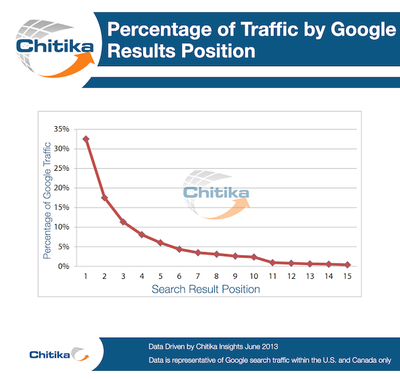
If you’ve ever doubted the importance of SEO and high rankings, a new study from online ad network Chitika shows the higher the rankings, the more traffic sites get. And the differences are drastic. First place rankings pull in 33 percent of the web traffic from search engine results pages. Second place can receive as much as 18 percent of the visitors, and traffic steadily drops off from there.

The recent study has very similar results to one the team ran in 2010, which suggests that there is little expected change in how users are interacting with search engines and highlights the importance of SEO in receiving web traffic.

Chitika Search Analysis


Chitika said in their announcement, “While being the number one result on a Google search results page is obviously important, these numbers show just how big of an advantage websites of this type have over any competitors listed below them. The importance of SEO for online business is seemingly quantified by these latest statistics, which, judging by their similarity to those observed as part of the 2010 study, are not likely to change significantly in the near future.”

Another expected find of the study is the drop off of traffic from Page 1 to Page 2 of results pages. The search engine result page users see gets 92 percent of all traffic, so getting stuck a couple pages back can result in practical invisibility for your site. However, if you aren’t showing up on the first page, it appears gaining the top spot of whatever page you are on will get you higher rankings than the others on that page.

If you’re interested in Chitika’s methodology for the study, you can see their full report, and Jessica Lee provided further analysis over at Search Engine Watch.

Depending on your skill set, a recent Webmaster video may be good or bad news to bloggers and site owners out there. Most people have never considered whether stock photography or original photography has any effect on search engine rankings. As it happens, not even Matt Cutts has thought about it much.

There are tons of writers out there who don’t have the resources or talent with a camera to take pictures for every page or article they put out. Rather than deliver countless walls of text that people don’t like looking at, most of us without the artistic talent instead use stock photos to make the pages less boring and help our readers understand us more. For now, we have nothing to worry about.

Cutts, the head of Google’s Webspam team, used his latest Webmaster Chat to address this issue, and he says that to the best of his knowledge, original vs. stock photography has no impact on how your pages rank. However, he won’t rule it out for the future.

“But you know what that is a great suggestion for a future signal that we could look at in terms of search quality. Who knows, maybe original image sites might be higher quality, whereas a site that just repeat the same stock photos over and over again might not be nearly as high quality. But to the best of my knowledge, we don’t use that directly in our algorithmic ranking right now.”

Logically, I would say that if Google does decide to start consideration photo originality on web pages, Cutts appears to be more worried about sites that use the same images “over and over” rather than those who search for relevant and unique stock images for articles. Penalizing every website owner without a hired photographer to continuously produce images for every new page would seem a bit overkill.

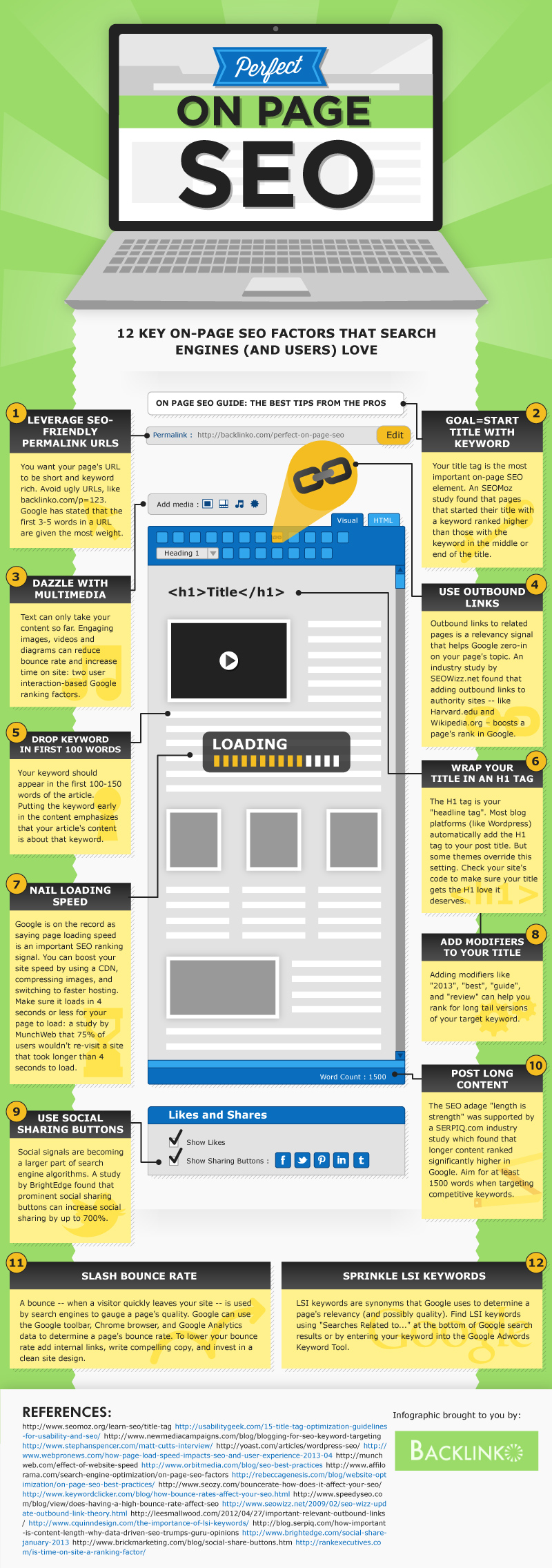
Every time I read something about on-page SEO, it seems like the authors are always just beating a dead horse, or at least trying to teach that dead horse about meta tags and keyword density.

Any SEO who has been around a little while knows there is much more to on-page optimization than just keywords and meta tags. There are plenty of advanced SEO strategies that improve your site, not only in the eyes of the search engines, but also from your visitors’ perspective.

Rather than drown you in another simple list of tips and charts that you’ll find most places, the folks at Backlinko decided to create an infographic, which you can see below, that you can turn to if you want to move your on-page SEO past the very basics. As a bonus, they even included the tips and charts on their page, for those of you who prefer the traditional style.

On-Page SEO Infrographic

Source: Backlinko

Many small business owners are hesitant to really put an effort into SEO or their online presence because they feel like the web is already conquered by big companies they can’t compete with. It is common to feel like you don’t have the resources, time, or manpower to achieve any sort of success on search result pages, but local businesses actually have a much larger opportunity than they usually think.

Search engines provide a more leveled playing field when it comes to corporations and local businesses. All you have to do for efficient SEO is know where to invest your limited resources to get the most return, and show your value to the search engines. Nick Stamoulis recently discussed three main ways you can achieve SEO success, even with the limited means of a local business.

1) Build links naturally, one quality link at a time

While links have lost some of their influence in SEO, they are still a serious consideration to search engines. Google’s latest updates have many business owners scared of link building, but the truth is it will always be an important part of SEO and you can’t ignore it. The key to link building is to ensure that you are building quality links from various sources, which is best done by focusing on one at a time. This keeps your linking pattern looking natural and stays away from any gray areas.

Some will try to set link building goals or try to take short cuts, but Google has made it clear that if you don’t get penalized for your cheap tricks now, you will eventually. Arbitrary quotas only inspire efforts to get bulk links when your self-imposed deadline approaches, and easy links come with a big target on their backs.

2) Create Content For Your Audience

Content marketing is a buzzword for SEO at the moment, but some have already lost the real reason content has come to have such impact on SEO. Quality content has been favored by search engines because that is what audiences and customers want, and it inspires interaction between businesses and their customers. One of the things lost in the feeding frenzy of tasty blog posts, infographics, and ebooks is that those methods aren’t relevant for many smaller businesses.

Small businesses often offer services that draw customers not looking to spend a lot of time reading or watching videos. Instead, they want to be able to see what businesses have been doing, and what value they are contributing to the community. This can be as easy as semi-frequent announcements or updates on G+ or pictures and status updates on Facebook. Just focus on providing the information customers will want. Answer their questions, direct them to solutions, and provide something of value to those who find you online.

3) Find Your Niche

It is true that if you run a small flower shop you won’t have the same online presence that a national brand like 1-800-Flowers does. However, your smaller local net can catch better fish than a large net a national brand uses. You can establish yourself in your small market by pinpointing a variety of different ways your service can be used. That theoretical florist, for example, can cater wedding parties and high-end hotels, educate gardening enthusiasts, and help decorate local restaurants. Find what small markets aren’t cornered in your local area, and make your place.

Remember, national brands may have more money and people available to use for SEO, but value is what matters to the search engines. Ask yourself why customers keep coming to your local business rather than those corporate giants, and adapt it to the internet. If your site is worth visiting, the search engine results will reflect your worth.