
 Think Google’s attack on unnatural links and link spammers is limited just to the US? Think again. Google has made it clear they are targeting spammy practices from around the world, by attacking Polish and German link spammers over the past month, and now Matt Cutts has announced Spanish and Italian webmasters breaking guidelines will be the next to get taken down. For more information, you can check out the report from Search Engine Land.
 Google has been bringing down the hammer on spammy websites quite a bit recently with more specific penalties for sites that aren’t following guidelines. There have been several high-profile cases such as the Rap Genius penalty, and several attacks on entire spammy industries. But, if you are responsible for sites with spammy habits, a single manual action can hurt more than just one site.
It has been suggested that Google may look at your other sites when they issue manual actions, and Matt Cutts has all but confirmed that happens at least some of the time.
Marie Haynes reached out to Cutts for help dealing with a spammy client, and his responses make it clear that the client appears to be linked to “several” spammy sites. Over the course of three tweets, Cutts makes it obvious that he has checked out many of the spammer’s sites, not just the one who has received a manual action, and he even tells one way Google can tell the sites are associated.
@Marie_Haynes e.g. notice that http://t.co/7wcwQVKaH1 has the same address and the same company registration number.
— Matt Cutts (@mattcutts) March 7, 2014
@Marie_Haynes and make sure to press your client about exactly how many "quick case" sites they own, because it appears to be several.
— Matt Cutts (@mattcutts) March 7, 2014
@Marie_Haynes so I worry that you haven't truly gotten through to your client, who shows signs of long-standing, mass, deliberate spam 🙁
— Matt Cutts (@mattcutts) March 7, 2014
Of course, Google probably doesn’t review every site penalized webmasters operate, but it shows they definitely do when the situation calls for it. If your spammy efforts are caught on one site, chances are you are making the same mistakes on almost every site you operate and they are all susceptible to being penalized. In the case of this client, it seems playing against the rules has created a pretty serious web of trouble.
 There is no escaping a Google penalty without following the rules and doing the hard work to clear your name. It is old news that if you have suffered a penalty on your site and you moveto a new domain and redirect the URLs to that new domain, the penalty stays around thanks to the redirects.
However, some SEO’s may attempt to escape the penalty by moving their site to a new domain without redirecting the URLs. That way, theoretically Google can’t follow you and put the penalty on your moved site too. Unfortunately, Google’s John Mueller has quashed the notion pretty thoroughly.
In a recent Google Webmaster Hangout, Mueller explained that even if you move the site and don’t redirect, Google may still find you and apply the penalty again. Roughly 23 minutes into the video below, John answers Barry Schwartz’s question on the topic by explaining that if you just copy and paste the pages onto a new site without many changes, Google may still be able to pick up on the site move. Even if you do not set up 301 redirects or use the change address tool in Google Webmaster Tools, Google could potentially still know you moved domains and pass along the penalty.
John does explicitly explain in the video that Google doesn’t rely on their signals alone to pass along the penalty. But, if they receive signs that you are trying to hide the same site elsewhere under a new URL without fixing the core issues with your site, they will investigate and likely apply the penalty.
In the end, you will have to do the hard work you are avoiding to ever get rid of the penalty completely. It may sometimes be better to completely tear down a site and start from scratch to fix the issues that earned you the penalty to begin with, but you can’t just run away from it forever.
You can view the video below or here.
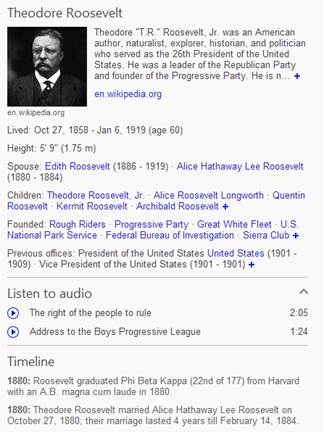 Bing is quickly expanding their new timeline feature for celebrities and historical figures. Just a few weeks after premiering the feature for athletes participating in the Sochi Olympics, Bing has added the feature to searches for about half a million famous people.
If you haven’t seen the timeline feature, it is similar to Google’s Knowledge Graph, as both highlight important information on figures in a concise column. For example, the column includes standard information such as height, spouse, children, and parents. But, with the timeline feature, Bing also includes a chronological list of important events or dates in the life of the figure you searched for.
The timeline includes footnotes for all the major events, as well as listing the year they occurred. But, don’t expect to get those results for every celebrity. Bing says that in some cases where “you would be more interested in another type of information” about the celebrity, the timeline information won’t be shown in favor of more relevant data.
Search Engine Watch points out that this is most true for actors and singers. When you search for Prince, you won’t be shown a timeline. Instead, you will be shown information about his most popular sings, albums, and even romantic interests.
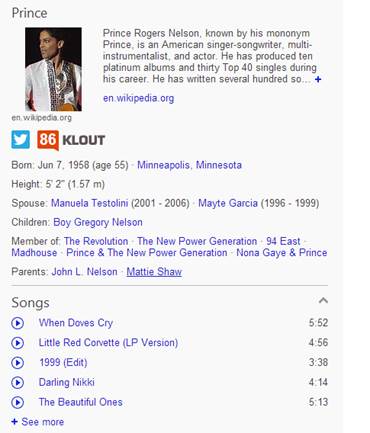
If you use Bing and haven’t run into one of these timelines yet, just keep searching for celebrities or historically important people. Bing has made it clear the half a million celebrities with timeline featured are just the start of an even more robust search result system.
The biggest question this raises is whether the timeline will always be exclusive to celebrities, or whether Bing’s relationship with Klout may indicate an intention to expand their Klout-verified snapshots with features similar to timeline. Would you want searchers to be able to automatically see a timeline for you in a search engine?
 Pretty much anything Google’s most popular engineer Matt Cutts says makes headlines in the SEO community, but often his Webmaster Chat videos and advice aren’t mind-blowing by any stretch of the imagination. For instance, we recently covered a video where Cutts explained that bad grammar in the comment section most likely won’t hurt your ranking (unless you allow spam to run rampant).
For content creators, it was a legitimate concern that poorly written contents might negate the hard work putting into writing legible and well-constructed content. However, many used this to run headlines that Google doesn’t care about grammar, which is not even close to being confirmed.
As Search Engine Land points out, way back in 2011, Cutts publicly stated that there is a correlation between spelling and PageRank, but Google does not use grammar as a “direct signal.” But, in his latest statement on the issue Cutts specifies that you don’t need to worry about the grammar in your comments “as long as the grammar on your own page is fine.” This suggests Google does in fact care about the level of writing you are publishing.
It is unclear exactly where the line is for Google at the moment, as they imply that grammar within your content does matter, but they have never stated it is a ranking signal. Chances are a typo or two won’t hurt you, but it is likely Google may punish pages with rampant errors and legibility issues.
On the other hand, Bing has recently made it pretty clear that they do care about technical quality in content as part of their ranking factors. Duane Forrester shared a blog post on the Bing Webmaster Blog which states, “just as you’re judging others’ writing, so the engines judge yours.”
Duane continues, “if you [as a human] struggle to get past typos, why would an engine show a page of content with errors higher in the rankings when other pages of error free content exist to serve the searcher?”
In the end, it all comes down to search engines trying to provide the best quality content they can. The search engines don’t want to direct users to content that will be hard to make sense of, and technical errors can severely impact a well thought-out argument.
As always, the best way to approach the issue is to simply write content for your readers. If your content can communicate clearly to your audience, the search engines shouldn’t have any problems with it. But, if a real person has trouble understanding you, the search engines aren’t going to do you any favors.
 Google isn’t the only search engine waging a war on black hat or manipulative SEO. Every major search engine has been adapting their services to fight against those trying to cheat their way to the top of the rankings. This week, Bing made their latest move against devious optimizers by amending their Webmaster Guidelines to include a stern warning against using keyword stuffing to try to rank highly.
The warning cuts the cheating SEOs no slack, cautioning that Bing may demote or entirely delist sites caught using keyword stuffing. The change wasn’t officially announced, but Barry Schwartz says it appeared in the guidelines sometimes yesterday.
The new section on keyword stuffing reads:
When creating content, make sure to create your content for real users and readers, not to entice search engines to rank your content better. Stuffing your content with specific keywords with the sole intent of artificially inflating the probability of ranking for specific search terms is in violation of our guidelines and can lead to demotion or even the delisting of your website from our search results.
Internet commenters aren’t quite known for their excellent grammar or insightful conversation. While there are plenty who contribute and expand on content with helpful information in the comments, there are also more than a few who struggle with language or actively try to troll other users with garbled borderline nonsense.
For most users, these types of commenters are a simple annoyance at most. But, for those who spend long hours crafting grammatically correct and easily-readable content, the less readable comments can cause some worry. While quality content is most important for users, content creators also aim for high legibility because it can affect rankings.
It is no secret that nonsensical or poorly written content doesn’t tend to perform well on search engines, but what about those comments that aren’t so carefully put together? Can comments with bad grammar or readability hurt your content’s rankings? According to Matt Cutts, Google’s most popular spokesperson, the answer is not really.
“I wouldn’t worry about the grammar in your comments. As long as the grammar on your own page is fine … there are people on the Internet and they write things and it doesn’t always make sense,” Cutts said in a recent Webmaster Chat video. “You can see nonsense comments on YouTube and other large properties and that doesn’t mean that YouTube video will be able to rank.”
The primary exception to this rule is spam comments. While nonsense comments or poorly written comments aren’t much of a problem for you, spam comments should still be removed to protect your SEO and generally improve user experience and site quality.
“Just make sure that your own content is high-quality. You might want to make sure that people aren’t leaving spam comments, if you’ve got a bot, then they might leave bad grammar,” Cutts said. “But if it’s a real person and they are leaving a comment and the grammar is not slightly perfect, that usually reflects more on them than it does on your sites, so I wouldn’t stress out about that.”
So breathe easy content creators of the internet; so long as you keep putting effort into making great content, you should be safe from any trouble with Google.
Looking for your favorite music video? Since MTV hasn’t shown music videos for the past 20 years, you will probably turn to Google. Now, Google is making it easier to find the videos your searching for by giving more prominence to the top playable music video result. So, if you’re searching for “Get Lucky” by Daft Punk, it will be hard to miss the official version of the video at the top of the page.
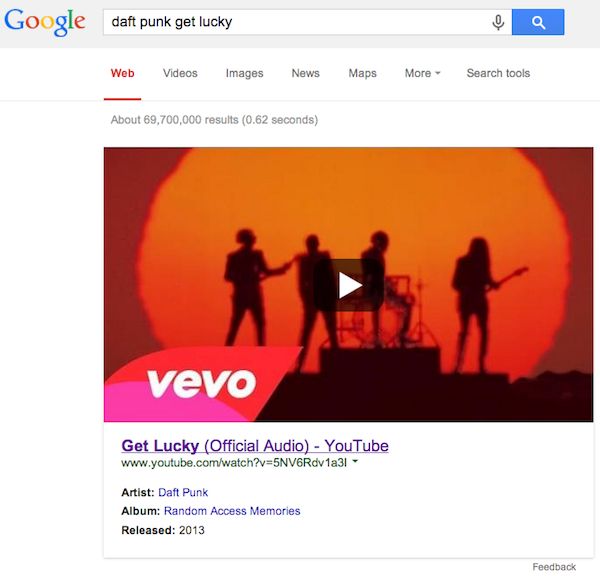
The thumbnail images for the videos look like they would be playable on the page, but in actuality they link back to the page for the video. It’s possible they play icon on the image might hint towards future usability for YouTube videos, or it might just be a little misleading.
Of course, the tool isn’t perfect, and you shouldn’t expect to get the “official” video or a video from the artist’s official account every time. For example, Search Engine Watch highlights a case where searching for “Let Me Ride” by Dr. Dre doesn’t pull up a video from the DrDreVEVO account, because that video hasn’t been uploaded to the official account.
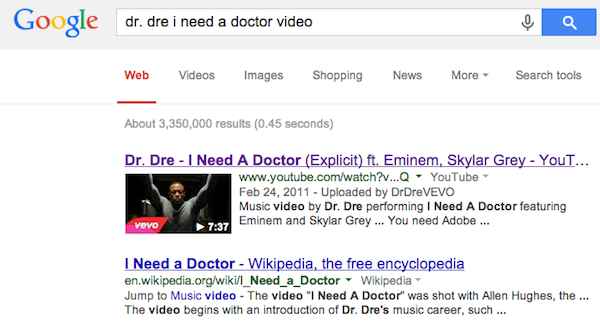
Similarly, searching for “I Need a Doctor” by Dr. Dre doesn’t trigger the new large YouTube thumbnails, even though there is an official video uploaded to the account.
“This was already available in September 2013 when you searched for an artist and then clicked on a song – you’d see a preview of the music video if it was available to display,” said a Google spokesperson. “Yesterday we made it easier to get to – you can now just search for a song directly and see the video screenshot right away.”
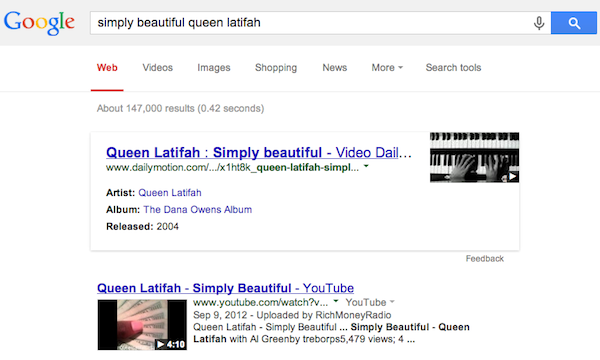
It is notable that the huge thumbnail appears to be exclusive to YouTube. When Google pulls from other sources like Dailymotion, it shows the smaller thumbnail and link layout. For example, the video for “Simply Beautiful” by Queen Latifah looks like this:
No one is calling a clear winner for the Big Game Sunday Night. As numerous sports analysts have pointed out, it is rare that both of the best teams from the past season actually make it to the Super Bowl, but this year the Seattle Seahawks and Denver Broncos match-up should make for a truly exciting game.
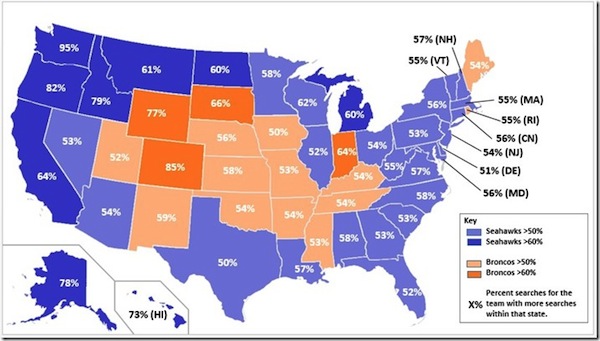
While the game will likely be close, Bing says the Seahawks have already been dominating the Broncos online. Bing examined U.S. search volume for both NFL teams, and the Seattle team has taken the lead in 33 states.
Obviously, the Seattle Seahawks absolutely dominated searches from The Evergreen State (95 percent), but they also have a clear lead in Oregon (82 percent), Idaho (79 percent), Alaska (78 percent), Hawaii (73 percent), and California (64 percent).
Of the 17 states where the Broncos held the most search volume, they had a less significant lead. Their home state of Colorado had the most significant difference with 85 percent of searches, while neighboring Wyoming had (77 percent). South Dakota and Indiana brought up the lead with 66 and 64 percent respectively.
In total, Bing users searched for the Seahawks 26 percent more often than the Broncos.
Of course, outside factors could explain the differences in search volume.
As Search Engine Watch points out, searches for the Seahawks spiked across the nation immediately following Seahawks cornerback Richard Sherman’s infamous post-game interview. The controversy and excitement surrounding the over-the-top interview made the Seahawks’ search volume jump over 80 percent.
http://youtu.be/PPD_Lgq7IyI
The Broncos have had their own moment of viral fame, with tons of clips compiling Peyton Manning yelling “Omaha”, but the larger focus after the Championship games two weeks ago was easily favoring Sherman. Without his spectacular outburst, search volume would likely have been more even across the country.
http://youtu.be/hBqwWe0S8jw
What are you thoughts? Who are you favoring in Super Bowl 48?
With Google’s constant updates, it is easy to miss some of the new features they roll out with less publicity than their biggest products receive. However, even the smaller revisions to Google Search make a huge affect on how we search and use the internet in general. Jessica Lee recently rounded up some of the less talked about changes Google has been making so you can be sure you haven’t missed anything lately.
1) Date Selector in Hotel Carousel Search Results
The Carousel results box at the top of localized searches for hotels and restaurants has only been around for a few months now, and Google is already making regular updates to the function. While most of the work has gone into normalizing what queries get carousel results.
But, they’ve also implemented some new, interesting features such as a date selector for hotel searches. Now, you can easily weed out hotels that aren’t available on the days you will need lodging.
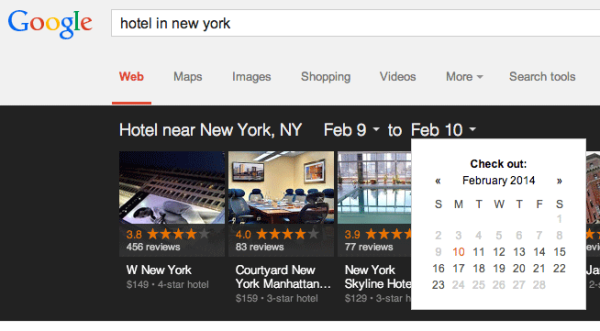
In a statement to Search Engine Land, Google said:
We’re always adding features to search to help people find what they need and get things done faster — you can now more easily research hotels when planning a trip and filter by user ratings and hotel class, as well as select specific dates.
2) Cards for Local Results
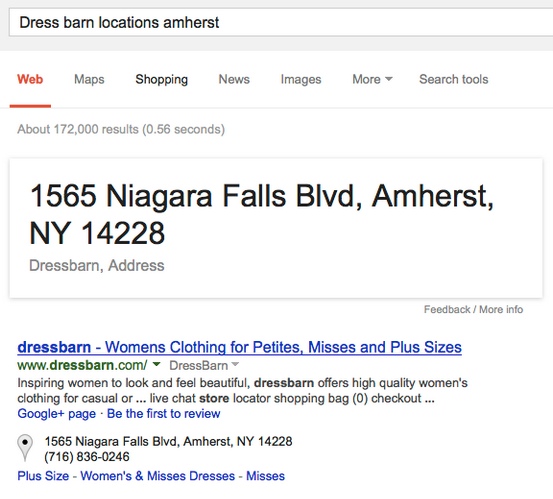
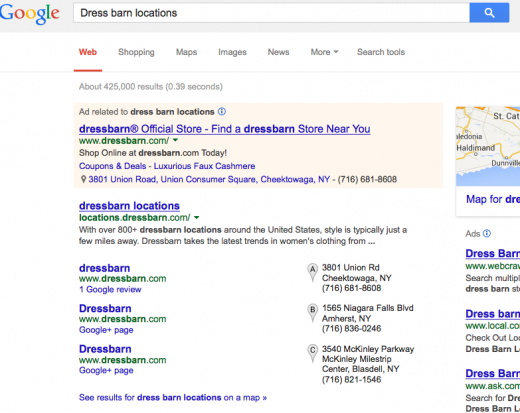
“Answer Cards” have slowly been spreading across Google’s platform for a while, but they were largely reserved for specific questions or brands. You needed a specific and targeted search to wind up with the convenient card at the top of the search results. But, lately the cards have begun to deliver more detailed answers such as the address of a nearby retailer. Mike Blumenthal highlighted the change with an example of searching for a brand name + location (Dress Barn locations Amherst):
But, queries with multiple results still get the traditional pack results:
3) Answers to Complex Questions
The answer cards have also gotten better at providing answers for trickier questions in general. The people running the Google Operating System spent a good amount of time trying to stump Google’s answer feature, but they’ve found the task has gotten much harder as the feature has been improved.
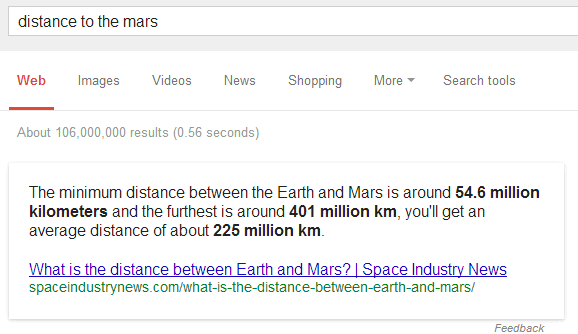
Google used to only answer simple questions like “who’s the prime minister of Canada?” or “what’s the population of China?” Thanks to the Knowledge Graph project, Google can answer more complicated questions like “who played Batman?”, “what’s the latest album of Celine Dion?”, “what are the main attractions in Spain?”.
To test this out, one of the authors asked Google a question without a definitive answer: what is the “distance to Mars”.
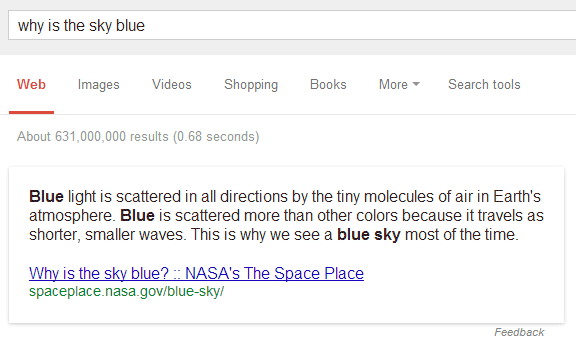
Google can even tell you why the sky is blue.
4) Distance Results
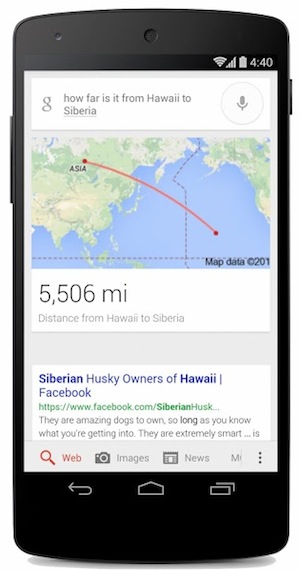
Google is able to tell the distance from most locations other than planets. In fact, Google announced on Google+ that users can now get the distance from any two locations on earth, no matter how far apart they are. The example Google offered was the “distance between Siberia and Hawaii.”
5) Streamlined Search Options
The Google Operating System blog explained how they have updated search options to be more responsive to your individual search query:
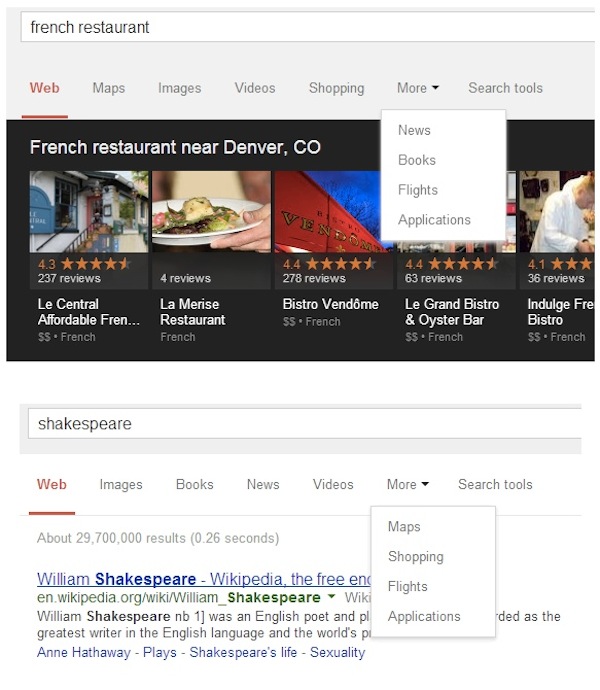
Google removed a few specialized search options that were usually displayed in the “more” drop-down: recipes, patents, discussions, blogs, places. The list of links to services like Maps, Images, News, Flights, Shopping is reordered based on your query. This isn’t a new idea, it was implemented a long time ago by Google, but now it’s used more often.
From Our Blog
 Gen Z May Be Pulling Away From Using TikTok Over Google SearchFebruary 27, 2026 - 4:43 am
- Google Experts Share The Two Most Common Crawling IssuesFebruary 10, 2026 - 10:37 pm