
Google has already begun rolling out its mobile-first index to some users, but there are still a lot of questions about how exactly the search engine’s new separate index actually functions.

One such question got a surprising answer yesterday during the Google State of Search conference, as Maile Ohye told the audience that Google won’t index the AMP version of your page in the mobile search index – even when you don’t have a mobile-friendly alternative.

Google’s Gary Illyes also confirmed the news on Twitter after the conference:

That means if you’ve been using AMP pages as an alternative to making your website mobile-friendly, the search engine will skip over indexing your AMP pages in the mobile-friendly search index. Instead, it will by default choose to index the desktop version within its older index.

There is a way to force Google to index your AMP pages in this situation using a rel alternate attribute, but otherwise Google’s index will default to your desktop versions of pages.

This is particularly surprising because Google has pushed AMP as the ultimate way to deliver content to mobile users quickly and without losing ad revenue. But, in this case it seems the streamlined design of AMP pages leaves something to be desired. It may be the lack of site navigation options is what made Google decide to favor desktop over AMP in their index.

This change will most likely only affect a very small number of websites, but it is an odd choice for the search engine. The vast majority of websites who have adopted AMP also maintain a mobile version of their site.

As announced last month, Google is officially making its first step towards the launch of mobile-first indexing with the test of its mobile-first search index.

The company confirmed the testing has officially started via its company blog:

“Although our search index will continue to be a single index of websites and apps, our algorithms will eventually primarily use the mobile version of a site’s content to rank pages from that site, to understand structured data, and to show snippets from those pages in our results. Of course, while our index will be built from mobile documents, we’re going to continue to build a great search experience for all users, whether they come from mobile or desktop devices.”

This means in the future Google will increasingly prioritize crawling the mobile versions of a site’s content, rather than treating desktop as the “main” version of your site.

The company also gave some quick tips to help you make the most of this change as it is happening:

  • If you have a responsive site with identical content across mobile and desktop, you shouldn’t have to change anything.
  • If you have a site where the primary content and markup is not identical across mobile and desktop, you should consider making some changes to your site.
  • Make sure to serve structured markup for both the desktop and mobile version.
  • Google recommends using the Structured Data Testing Tool to verify the equivalence of structured markup across desktop and mobile by typing the URLs of both versions into the Structured Data Testing Tool and comparing the output.
  • When adding structured data to a mobile site, avoid adding large amounts of markup that isn’t relevant to the specific information content of each document.
  • Use the robots.txt testing tool to verify that your mobile version is accessible to Googlebot.
  • Sites do not have to make changes to their canonical links.
  • If you are a site owner who has only verified their desktop site in Search Console, please add and verify your mobile version.
  • If you only have a desktop site, Google will continue to index your desktop site just fine.
  • If you are building a mobile version of your site, do not launch it until it’s ready. Google says: “a functional desktop-oriented site can be better than a broken or incomplete mobile version of the site.”

Mobile Internet Usage

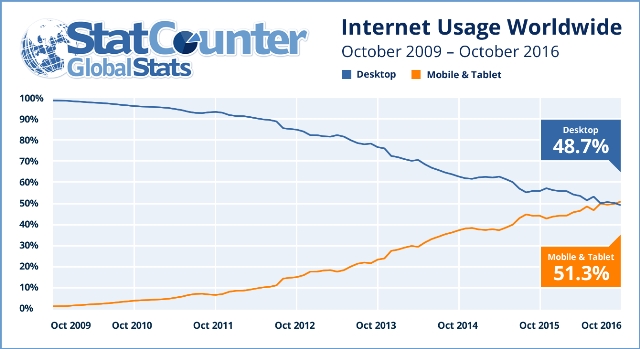
Mobile internet usage has been steadily gaining ground for years, and just last month it hit another milestone. According to a press release issued yesterday from StatCounter, mobile and tablet internet usage has finally exceeded total desktop usage for the first time ever.

Last month, mobile and tablet devices made up 51.3% of total internet usage compared to 48.7% by desktop. This is the first time worldwide monthly mobile internet usage has overtaken desktop according to StatCounter’s measure.

mobileusage

It is almost guaranteed this trend will continue in the long-term, but the short-term gains may not hold up. Mobile web usage has historically increased leading up to the holiday season and may deflate in the first part of next year. Even if this happens, the new milestone shows mobile usage is still consistently growing and will likely be the dominant way to access the web in the coming years.

Aodhan Cullen, CEO of StatCounter, says the new numbers should show businesses how important it is to make mobile a priority now, rather than later:

“This should be a wake up call especially for small businesses, sole traders and professionals to make sure that their websites are mobile friendly. Many older websites are not.”

Of course, mobile usage varies by country. While major markets like the US and the UK still primarily rely on desktop computers. Emerging markets like India overwhelmingly use mobile devices for internet usage and show no signs of slowing down.

social-media-adventure-1

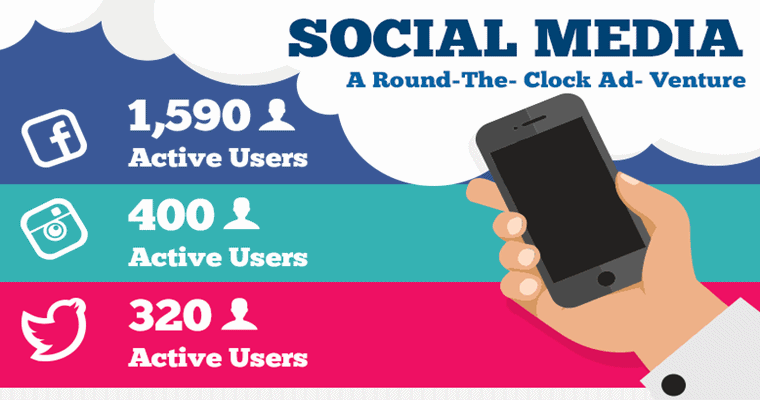
Want to get the most out of your social media efforts? There is no one-size-fits-all method that is guaranteed to give you success across every platform like Instagram, Facebook, and Twitter. Each platform has its own demographics and user behavior that means you must adapt to make sure you are striking when the iron is at its hottest.

Matt Booth from AddPeople made that easy to do with a simple infographic breaking down the demographics, user behavior, and best times to post for the biggest platforms you might be marketing on:

social-media-adventure

vinelogo

Not all that long ago, Vine was one of the fastest growing social apps on the market. The app made its name with short looping videos and a large community that took advantage of the medium to create comedy and even frights.

Since being acquired by Twitter, however, the app has gradually lost its place in the social world as other platforms like Instagram and Snapchat have incorporated their own video features. So, perhaps it is unsurprising that Vine has announced it will be ceasing operations and shutting down in the near future.

According to a post shared on Medium, the website and app for vine will remain online so that users will have time to download their Vines and mourn the loss of the app as a community.

The statement didn’t give any firm timeline of when Vine will fully shut its doors, or any explanation as to why Twitter has decided to shutter the app. It is possible Twitter could possibly choose to integrate the app capabilities entirely within its own platform, but so far the company hasn’t made any indication that it plans to do so.

Back in 2012, shortly after it was bought out by Twitter, Vine was sitting as the number 1 app on the iTunes app store and had a consistent 200 million active users. However, the rise of live video and new video features on competing platforms have pushed Vine out of the crowd. According to data from App Annie, Vine is currently sitting at number 284 in the iTunes app store charts for free apps.

Analysis also suggests year-over-year worldwide downloads of the Vine app have been consistently declining across both the Apple App Store and Google Play.

For what it’s worth, Vine co-founder Rus Yusupov only tweet in the wake of the news suggests he regrets letting Twitter take over the company.

christmas-desk

A new study published by ad tech company Fluent shows the holiday season is looking to be more mobile than ever.

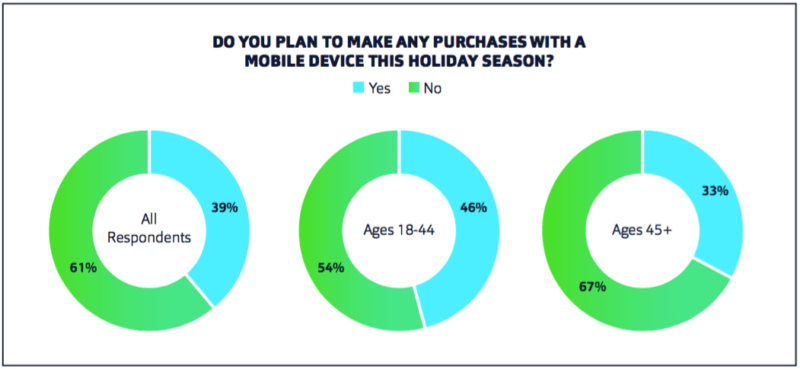
According to the report, nearly 40% of all US consumers are already planning to make at least one purchase this holiday season from a mobile device. Unsurprisingly, younger consumers appear to be more likely to make purchases from mobile devices compared to older individuals.

fluent-3-800x369

For the survey, the company asked almost 2,000 US consumers questions about their holiday shopping plans in late September. The responses showed 39% plan to make at least one purchase on a mobile device, with younger shoppers being increasingly likely to go mobile.

Just less than half of consumers between the ages of 18-44 say they plan to shop on mobile devices, compared to 33% of those 45-years-old or older.

fluent-1-800x363

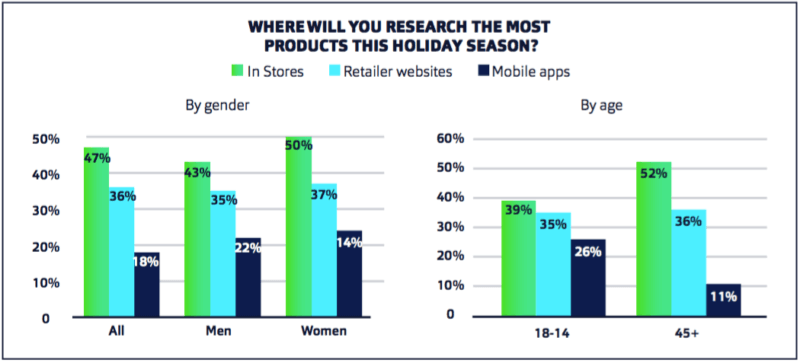
The survey also provides insight into how consumers will be researching their purchases ahead of time, both online and offline. In total, approximately 54% will do the majority of their research online, while 47% will continue to do their research in traditional physical stores.

fluent-2-800x349

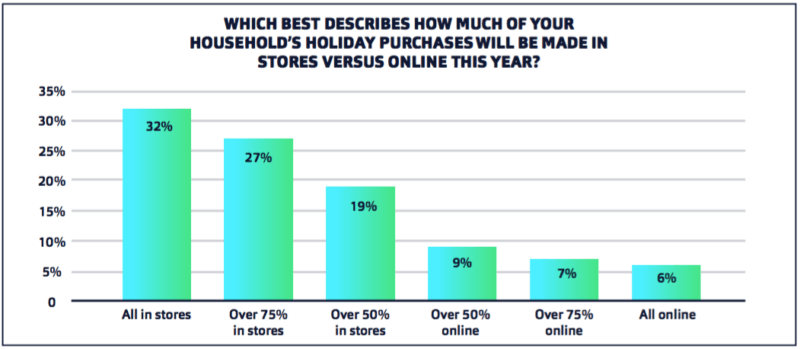
While online research is becoming a big part of the holiday season, brick-and-mortar stores will still be where shoppers are spending the majority of their money. The survey results show 78% of consumers will do at least half their shopping in stores, while 22 percent said they will do at least half their shopping online.

The survey shows a small discrepancy between genders, as well. Fluent says men are slightly more likely to research products online compared to women.

pintereststats

Just last year, Pinterest announced it had reached over 100 million active monthly users – a huge milestone for one of the fastest growing social platforms around.

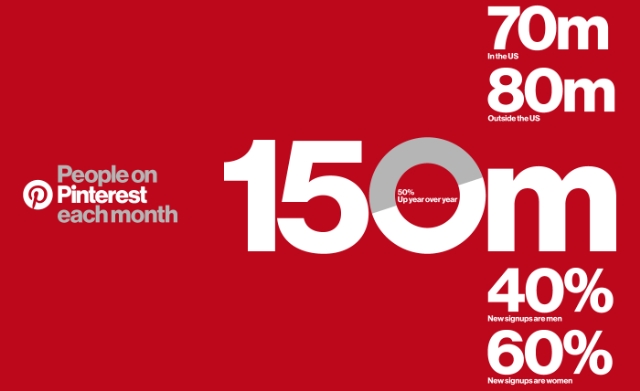
Since then, Pinterest has grown its user base by over 50 percent, reaching 150 million active monthly users, according to a recent announcement.

The new numbers show Pinterest is maintaining its rapid growth by expanding internationally, as well as reaching out to new demographics at home.

According to Pinterest’s announcement, approximately 80 million of the company’s active users live outside the U.S. and 75% of new signups are coming from users outside the country.

The platform has also made gains with men, who have long been the minority on Pinterest. The company notes 40% of new users are men, an increase of 70% from last year.

Lastly, the statement shows Pinterest is still maintaining a strong hold on millennials. The company says over half of all U.S. millennials are now active users on the site.

Overall, the numbers show Pinterest is still drawing a huge audience of people interested in finding and engaging with products, food, and designs that help them live the lifestyle they dream of.

To find out more about Pinterest’s current user statistics, check out the announcement here.

mobileonly

It is no secret that the majority of people online change devices several times a day, but new research from Google shows that a growing number of users are adopting a “mobile only” lifestyle.

The new “cross-device” research shows that while plenty of people still move from desktop to mobile to tablet as they need to throughout the day, but almost 40% of searchers have dropped desktop devices from their online search process entirely.

Google says the study is based on “behavioral measurement of a convenience sample of 11,964 opt-in Google users between January 1, 2016 and March 31, 2016,” and that the data was “calibrated to reflect a U.S. demographic of 18 to 49-year-old cross-device users.”

screen-shot-2016-10-06-at-2-43-45-pm-800x558

According to the findings, the average user spends 170 minutes on their smartphone every day, compared to 120 minutes on PC’s and approximately 75 minutes on tablets (that user owns a tablet). They most often use their smartphones at four physical locations:

  1. Home
  2. Work
  3. Stores
  4. Restaurants and Bars

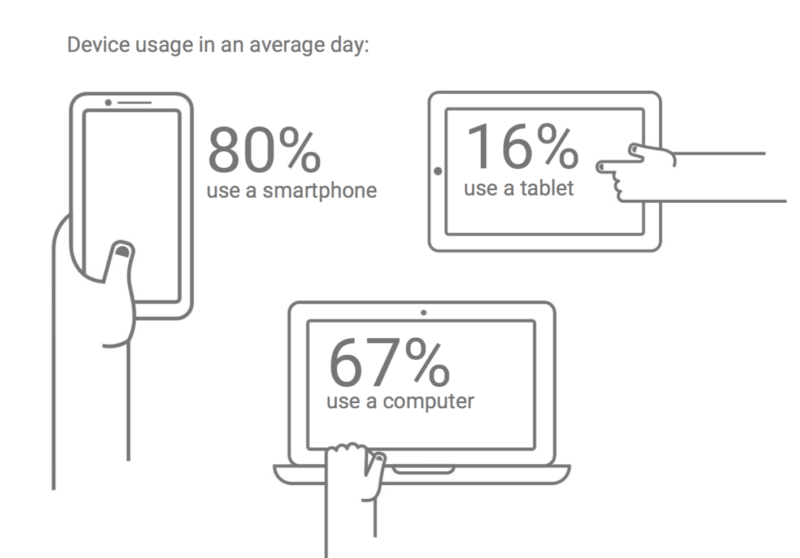
Every day, approximately 80% of users search the internet on their smartphones, while 67% use PC’s. Over half (57%) move between devices throughout the day and 21% are likely to use more than one device simultaneously.

But, perhaps the most surprising finding of the study is that approximately 39% of people who conduct searches on an average day use only smartphones, compared to 32% who search only on PC. When measuring all internet use, rather than just searches, 27% of users are smartphone-only.

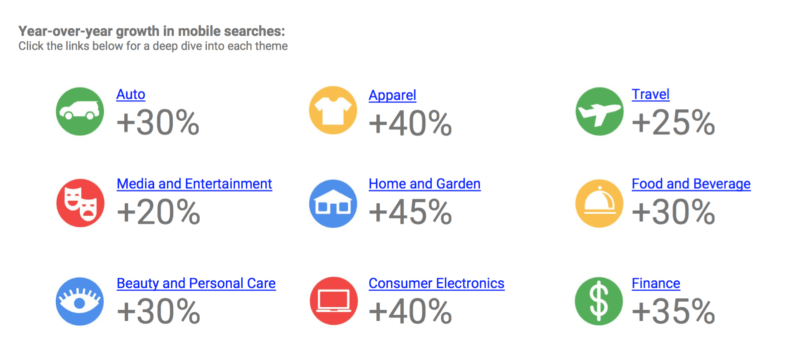
The report shows mobile usage varies by industry with year-over-year growth of mobile search for different markets.

screen-shot-2016-10-06-at-4-05-36-pm-800x353

If you want to find out more, check out the full report here.

Google is increasing its efforts to combat fraud on its search network with new verification processes aimed at weeding out scammers and con artists.

According to an email sent to several of Google’s biggest contributors, the company is testing an advanced verification process in San Diego aimed at stomping out a growing scheme in the locksmith and plumbing industries.

All locksmiths and plumbers currently verified on Google will have to go through the new verification process. If you don’t do so before November, Google will un-verify your listing and remove you from Google Maps.

New applicants hoping to be verified on Google will also have to go through the process, which Google promises is simple. Companies will go through a series of questions from Google and complete an application with a third-party verification company. In total, the entire process should take approximately two weeks to get verified.

You can find out more about the new advanced verification process being tested for locksmiths and plumbers around San Diego in the new Google My Business help article.

Now, you might be wondering why Google is targeting locksmiths and plumbers when there are so many fraudulent businesses online. This is because one of the quickest growing online scams is being conducted by people presenting themselves as locksmiths.

The scam goes like this:

  • A person is locked out of their home and turns to Google to look up local locksmiths
  • They are shown AdWords ads and Google My Business listings for businesses promising cheap and reliable services.
  • When they call one of these ads or listings, they are actually directed to an offshore call center who dispatches a local representative to your home.
  • The “locksmith” arrives and immediately chooses to drill open the lock, leaving the person with a huge bill.
  • Instead of a cheap service you are stuck with excessive costs and a busted lock.

The scam has gotten so prevalent it has even been detailed in the New York Times. A simple search for “locksmith scam” shows just how many people have already been affected by it. Similar scams have since started popping up in other home improvement sectors like plumbing and roofing, which is likely why the new process is extended to plumbers in San Diego as well.

Google is hoping the new verification process should weed out the fraudulent actors populating its search results. Currently, it is hard to predict just how effective it will be. But, if Google sees positive results you can expect to see the system roll-out to the rest of the country in the not-too-distant future.

verifiedtwitter

Do you want the most coveted Twitter feature limited to only the biggest names online? You can have it with just a few simple steps.

I’m not talking about a new way to share your tweets, but this one small feature will immediately establish you as an authority across all of Twitter. That’s right, I’m talking about the famous blue checkmark showing that your account is “verified”.

Until recently, Twitter has limited verification checkmarks to specifically selected accounts of well-known actors, athletes, business personalities, artists, and authors. But, as of July, anyone can now apply to receive the lusted after sign of influence by going through Twitter’s verification application process.

It might seem like a small thing, but the checkmark is more than just a blue badge next to your name. It immediately shows that you are an established figure likely tied to a reputable organization. It grants weight to your opinions and encourages other users to follow you as an authority in your field.

If you want to get a fancy blue checkmark of your own and get your site verified, just follow the process detailed in the infographic below from SurePayroll and Ghergich & Co:

verified-twitter-03