Starting on Monday of this week, small business owners in the UK became eligible for Google’s newest service, AdWords Business Credit. Essentially, Google created a credit card that can only be used for paying for a businesses AdWords account.

As Ingrid Lunden reports for TechCrunch, the program launched in beta 1400 U.S. companies last year and nearly three-quarters of those companies now use AdWords Business Credit as their “primary form of payment.”

Now, Google shifts its focus to the UK, where revenue in the 2nd quarter made up about 11-percent of the companies total revenue.

The card will carry an 11.9-percent APR in the UK, which is up from 8.99-percent in the U.S. during the pilot program. No annual fees will be included. You may note that this is lower than major credit cards. This is likely because Google intends to make an increase in profits by driving more businesses to AdWords and increasing the investment their, not from interest rates.

It is way too common for people in SEO to forget to align their SEO strategy with social media activity. Often, the two teams work completely disconnected from the other. This is in no way a comprehensive, efficient marketing plan.

SEO must be integrated into social media activity. Here are some suggestions for specific strategies you can take to bump up the effect your social media activites have on SEO performance.

1) Using Social Media for Link Development – Since search engines have begun incorporating social signals into their ranking algorithm, it has become essential for SEOs to pay attention to social media. Now Google+ has become a part of Google search, and Bing uses Facebook data to personalize what people see in their search results.

While all of that is practically common knowledge, Ray Comstock at Search Engine Watch believes “link development is the most important benefit that social media can bring to the SEO table.” Google’s Panda and Penguin updates has made using social media to foster relevant link connectivity has become as important as they could be. The most effective way to market content online is through social media.

It is critical for SEO professionals take advantage of the activities of their social media team to gain relevant links through marketing quality content.

2) Aligning You Blog for SEO and Social Media – If you can create consistently quality content, blogging is easily one of the more efficient ways to build links and authority. It attracts links within your industry, but it also becomes keyword focused content that tends to rank highly in the long-term. Most often, bloggers forget to create relating internal links from a company’s blog to their main website content. Blog posts are an opportunity to direct people to other relevant content, especially your own.

3) Aligning Your Blogging Team for SEO & Social Media – Blogging is an important part of an SEO strategy, so you want to make sure your blogging team is trained on the best SEO policies and practices, as well as giving them the most important keywords and landing pages on your site. If you do that, your team will be more likely to create content based around those keywords, and creating internal links within the blog assists with your SEO goals. Plus, it is always nice for visitors to be able to find more content on your site.

Bloggers should also be interacting with the authoritative blogs in your area of expertise by contributing in intelligent and thoughtful ways which will build relationships with other experts in your field. It builds your reputation as well as making valuable connections that can lead to guest blogging.

By making sure your SEO and social media efforts are alligned, you both streamline the process in an effective way, as well as boosting SEO performance from a link building perspective.


Bad URL structure is far too common of an issue in SEO. It can drag down your rankings, keep your pages from appearing in search engine indexes and destroy ranking authority from any other pages and websites you are a part of.

This is sometimes the fault of content management systems who can build poor URL structures within the websites. Elsewhere, some platforms devise URLs with illegal characters.

Search engines do try to read and index even the most poorly made URLs, but paying attention to your URL management and optimization has its own set of benefits. It’s about time you made sure you are doing your part.

It isn’t difficult to diagnose URL based issues, however. You can check for errors and warnings that suggest URLs are causing the issues, and you can audit all of your URLs for proper syntax.

Google and Bing Webmaster Tools also have reports that reveal duplicate content. From there, you can examine the webpages themselves and their locations. Google and Bing aren’t even the only ones with these types of tools. Plenty of third-party SEO tools can help identify these types of issues. Also make sure to check for unsafe characters.

Tom Schmitz from Search Engine Land has charts to help make clear what characters you should be using and when. He also has many other suggestions on how to solve issues with poor URL structures.


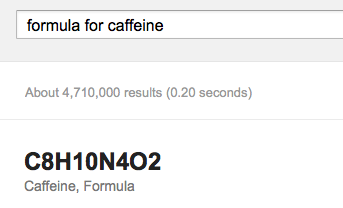
Google seems to keep adding more details to their SERPs. The newest one is finding formulas for various chemical compounds.


Just do a search for “formula for” and follow it with your compound name and it will display the chemical formula in most cases. I can see this coming in handy for students wanting shortcuts for their chemistry assignments. Whether or not that’s good is a bit more subjective.

Google Remarketing was recently updated to make it easier to set-up and easier to use. In case you aren’t familiar, Google Remarketing allows you to present users, who were previously on your site, with relevant ads as they continue browsing the web.

Marc Weisinger, of Search Engine Watch, has three key reasons you should be using one of the most powerful tools available to online marketers.

1. It’s Simple and Easy

Previously, implementing the remarketing code was a several step process. Now, you install one simple code in the footer of each page of your site and get on with your day. You can’t get much easier than one step.

2. The Possibilities are Endless

With the universal tag in place, you can use the Adwords interface to target specific groups. How specific? Well, that is up to you.

Want to target only those users who landed on a promotion page? Done.

Want to target only users who added a product to their cart, but didn’t end up buying? Done.

Plus, each new target group you set up gets the benefit of the cookies already stored by your universal tag.

3. Target Positive or Negative Audience

Before starting your next email marketing campaign, use the Adwords interface to target users who click through from your email to your site.

Alternatively, you can instead choose to exclude those users because, afterall, they sound pretty loyal and engaged already. That way, you don’t bombard them with your ads and are sure to instead target those users that may have seen your email but weren’t convinced right away.

Want to know how to evaluate your buisiness’s performance in social media? Is your time and effort getting acceptable returns? Andrew K. Kirk, of Social Media Examiner, has 4 goals you should be tracking to ensure a positive social media ROI.

1. Brand Recognition

Obviously, you need people to be aware of your business. But the more people know, the more likely they will become active members of your online community.

Track your growing popularity with Klout, which gives you a social influence score based on your performance across multiple social media sites. Log your score each month and think about what actions you took during that time frame. Soon, you should be able to pinpoint what positively and negatively affects you online presence.

2. Traffic

Just as people need to be aware of your business, people also need to visit your website. Visitors will likely learn more about your business directly from your site than from anywhere else.

With Google Analytics, you can easily track visits and discover what is affecting those.

3. Repeat Business

Any business needs repeat customers to thrive. For your online presence to thrive, you need visitors to return to your site and stay longer.

To track loyalty, you can customize Google Analytics and then do a little math. Well worth it in the end.

4. Conversions

The previous steps don’t necessarily translate into an improvement in your bottom line. Afterall, the effort you put into your online presence better be worth it. You should know the ratio of overall visitors to your site to conversions. You should also know the correlation of social media activity to conversions and the source for the majority of your traffic that converts.

Again, Google Analytics has you covered. By setting up some goals and tinkering a bit, you’ll soon have all the data you need to measure your goals and get the most out of your time on social media.

Google’s algorithm changes over the last decade have really made huge shifts in the way we search things. They also really help developers stay on their toes.

Initially, the SEO business was all about rankings. You told your client how you would get their keywords to the top of the search, and then showed them how high they were coming up in searches. Of course, it took a while to get their site to the top, but once you did, they were content.

Now, thanks mostly to Search+, it is the job of SEOs to get their clients to stop thinking about ratings. What Search+ has done is customize the results for every search you make based on search history, location, social media usage, and other criteria. That means everyone gets results catered to them, but it also results in your client’s site not appearing high in the rankings for some people.

Sujan Patel offers some other methods of tracking how your websites are performing, all of which can be found in Webmaster Tools and Google Analytics.

There are simple reports like “visitor growth” that show how your site is trending quickly and clearly, as well as old metrics that have risen in popularity. Such measurement tools like Impressions give you ideas of how your pages are appearing for similar search terms.

Another old metric that has become much more useful is your site’s average ranking. In January, Google announced changes to how they score site’s average rankings and now it gives a much closer average of “how a link’s position in Google search results should be important.”

While the older ways of Google made it easier for you to see how your site is performing, the changes in recent months have actually been an improvement for marketing towards target demographics. Unfortunately, this means improving your analytic skills is essential if you want to succeed. You may not be able to give your client keywords to search to see their performance, but if you know your analytic tools, you can still quickly show them how your SEO path is helping them grow their business.


Google has made five recent SEO changes that will make most content marketers, writers, and bloggers quite happy. They play to your strengths. Some users may be less happy about these changes, however.

The changes were mostly made to keep more people on Google products, which isn’t a bad idea from a business perspective, but some may find the changes effect searching negatively.

The good news is, the changes were also made so that your results would be more personal by monopolizing on the fact that people are more likely to purchase something if they know their friend also likes it.

The even better news is these changes are great for anyone who makes content for a living. I will walk you through all of the changes and help you to take advantage of them.

1) Optimize personalized search – One of the biggest changes Google has made completely changed SEO by making search results personal. The results you get for a search will be different than mine, based on factors like your browsing history, the content you create and content shared by your social circles. People are finding their content more and more through social media networks and searching less.

So how can you optimize your content for personalized search? One option is you can increase your Google+ circles. Google is actively trying to get people to sign up for Google+, and in this instance, using Google+ and connecting with more people on there helps improve your search. The more people you have in your circles, the higher relevant content will show up in your searches. This also means that your circles can see your content when they search.

2) Increase social sharing – As a content creator, getting shares on social media is a great way to get your content high in the search rankings. According to a study by branded3, the more tweets leading to a URL you can get, the higher you will appear in rankings. For example, anyone that gets over 7,500 tweets (not an easy task) will appear in the top five results almost always. This type of logic most likely also works for Facebook.

As a content creator, capitalize on social sharing and you can beat your competition in the rankings. Just make sure to make the social sharing buttons obvious so that readers can find them, encourage your readers to share and try to court others with influence in your target social circles. Interview them or offer to do guest posts. Anything to establish a connection.

3) Employ semantic keyword research – Google is improving at segmenting search results, which gives you an opportunity to rank higher in verticals. This is a surefire way to get higher conversion rates because your prospective visitors are better targeted.

To take advantage of this, you’ll need to look for “advanced search” keywords. When you search, there is a way to refine results with a tool hidden in “show search tools”. Within this advanced search tool, you can look at “related searches”. Now you have semantic options you can test for the highest search volumes. There are also ways to improve your keyword list such as Google Insights for Search, which lets you narrow keywords down via categories.

4) Play with the Panda update – Google’s Panda update finally made life hard for spammers and content farms by harshly punishing sites with low quality content. This is good for all of the content creators who put hard work into long blog posts with useful content. Google even offered questions to determine the value of your content.

5) Implement the Google Authorship Mark-up – A search marketing firm proved rich snippet will increase SERP CTR and traffic. It’s that simple. Their analytics show a 150% increase when rich snippet was implemented. You might not get results quite that good, but it’s almost certain you will benefit if you implement the Google’s authorship snippet. It can be complicated, and it is slow to show results, but if you invest now you’ll see results in the not too distant future.

All of these Google changes have radically changed the SEO game, but they have made it a wonderful moment to be a content marketer. Those that put out shoddy content are being penalized, and there are all sorts of opportunities to really get your content out there.


For a more in depth look at author rank, read Neil Patel’s article at Quick Sprout.

If you’re using AdWords to advertise your business online, you’ll definitely want to look into their newest option, Shared Budgets, which was announced Monday on the Adwords blog.

Shared Budgets is exactly what it sounds like. Adwords let’s you set a daily allowance for how much you’d like to spend across any number of campaigns. Let’s say $100 total. You can then allocate a portion of that to each campaign. With Shared Budgets, any money that one campaign doesn’t use in a day gets automatically reallocated to another campaign that is seeing increased use. This way, you get the most out of the campaign that’s currently getting the most attention without having to constantly tinker with the budget allocation yourself.

Google’s changes to their SEO policies have made optimization more and more difficult over the past few years. Chris Crum at WebProNews suggests that a new study from the world’s largest search marketing-specific nonprofit trade organization SEMPO reports that SEO spending is still going strong in spite of all of the free information available on the Internet.

The 72-page report, published by Econsultancy, looked at almost 900 companies and agencies and found that, “overall, the report depicts a stable industry, without making dramatic changes.” Despite significant changes in practices through the inclusion of new tools and algorithms, the survey reports that SEO has “very much the same goals in place.”

Most survey respondents increased their SEO budgets over recent years, and as low as 2% of those responding said they did not spend money on SEO. Meanwhile, the amount of agency billing for SEO services is on the rise. SEMPCO says “a significant rise in those spending less than $100k corresponds to higher numbers across the board, with the greatest increase in the $1 to $5 million range.”

One change that is particularly interesting is the statement by SEMPCO that “survey responses show a drop in the blunt objectives of driving traffic.” However, the amount of agencies citing brand reputation as their primary objective has consistently doubled annually. This is especially clear in the paid side of the industry.

What can’t be denied after the report is the value of the search marketing industry is only rising, even when faced by the rise in popularity of social media and Google algorithm updates that force sites to be less reliant on Google.

The report makes clear the “changes to the Google algorithm affects a large percent of marketers, or at least has them concerned,” and SEMPCO also notes “87% call the updates of the last 12-18 months ‘significant or highly significant'”. Most find the changes to be positive, but some legitimate brands have felt the backlash of the hunt for spam sites. Meanwhile, there are rumors of more Google updates in the future.

Thankfully, Google offers some advice on SEO, especially when beginning to look at hiring someone: “Deciding to hire an SEO is a big decision that can potentially improve your site and save time, but you can also risk damage to your site and reputation. Make sure to research the potential advantages as well as the damage that an irresponsible SEO can do to your site.”

Google does emphasize the benefits SEO agencies can provide, such as technical advice on website development, content development, keyword research, and expertise in specific markets and geographies.

They advise “before beginning your search for an SEO, it’s a great idea to become an educated consumer and get familiar with how search engines work.” Of course, they recommend their Webmaster Guidelines and Google 101: How Google crawls, indexes and serves the web as starting points. Google also recommends hiring an SEO early in the development process. They even offer a list of questions you can ask SEOs during your hiring process.

Google’s assistance with SEO doesn’t come without it’s warnings, however. “While SEOs can provide clients with valuable services, some unethical SEO’s have given the industry a black eye through their overly aggressive marketing efforts and their attempts to manipulate search engine results in unfair ways.”

It’s Google’s suggestion to be nervous of any SEO firms or agencies that contact you out of the blue, or one that asks you to link to them. “You should never have to link to an SEO.” They also warn that no firm can guarantee you a #1 ranking.

And if Google hasn’t already made you worn out from lists of recommendations, they also offer a list of deal-breakers when investigating an SEO, such as if the SEO owns shadow domains, puts links to their other clients on doorway pages or offers to sell keywords in the address bar.

Just because Google offers lots of advice, doesn’t mean they are making it easy to get on the first page of test results. But, they are offering resources to give your site its best shot and SEO doesn’t look to be going anywhere.