
instagramlive

Instagram’s live video feature is officially available to all 70 million US users. After announcing the feature in late November, the social imaging platform has announced the feature is available across America and will be rolling out globally over the next few weeks.

While it may be tempting to compare Instagram’s live video streaming to Facebook’s growing live feature, it is actually more similar to the live options available through Snapchat.

With Instagram’s live video, users can broadcast to followers in real time through Instagram Stories. However, once the stream is over it is completely gone. There is no saving or replaying old broadcasts. They disappear as soon as you end the broadcast.

How To Get Started Broadcasting

To get started streaming, you just have to follow a couple easy steps.

  • Tap the camera icon in the top left of the screen or swipe right from the Feed to open your camera.
  • Tap the new Live icon at the bottom of the screen.
  • Tap Start Live Video.
  • Once you are ready to end your stream, just tap End in the top right.

Broadcasts can last up to one hour and you can choose to notify your followers when you go live. The number in the top right corner of the screen shows just how many followers are watching, and you can pin or share comments to others by tapping and holding it. You can also turn off comments entirely if you desire.

Marketing with Instagram Live Video

The idea of marketing your business through live video that immediately disappears may seem unattractive at first. Why bother with vanishing video when you can spend time crafting marketing campaigns that last, right?

However, live video can actually be a great way to make followers feel like they are in on exclusive events and information. The function is especially great for letting your customers and fans see special engagements like product launches or milestones for your business.

You can also use live video to engage your audience in new ways with impromptu interviews or Q&A sessions that help your followers learn more about who you are and why they should be invested in your brand.

For more info on Instagram’s live video feature, check out the video below:

yahoo_logo_detail

It’s that time of year again. The ‘best of’ and ‘year in review’ lists are rolling out as we near the new year. The first search engine to get in on the fun is Yahoo, who revealed its year in review for 2016, including search data from sister companies Polyvore, Tumblr, and Flickr.

As you can expect, the election and other major current events dominated much of the search results for the year. But, you can also see other trends that show exactly what people were interested in, like the top companies and lifestyle searches for 2016.

Yahoo’s overall top searches include:

  1. 2016 Election
  2. Donald Trump
  3. Roblox
  4. Gwen Stefani
  5. 2016 Olympics
  6. Khloe Kardashian
  7. Megyn Kelly
  8. Jodie Sweetin
  9. Kim Kardashian-West
  10. Hillary Clinton

Yahoo’s top news stories, according to Yahoo News, include:

  1. Election Day
  2. Prince Dies
  3. Pulse Nightclub Massacre
  4. Deadly Attack in Istanbul
  5. Hurricane Matthew
  6. Baton Rouge Police Shooting
  7. EgyptAir Flight 804 Located
  8. Trump Protests
  9. Clinton Emails
  10. Presidential Debates

Perhaps the most surprising part of Yahoo’s list isn’t who appears, but who is omitted. Google is conspicuously absent in the list of top companies from Yahoo Finance. Considering the list is based on the top-read stories rather than top searches, it is rather strange to see Google entirely absent.

Yahoo’s list of top companies, according to Yahoo Finance, include:

  1. Apple
  2. Facebook
  3. Twitter
  4. Bank of America
  5. Amazon
  6. Tesla
  7. Alibaba
  8. Valeant Pharmaceuticals
  9. Ford
  10. Wells Fargo

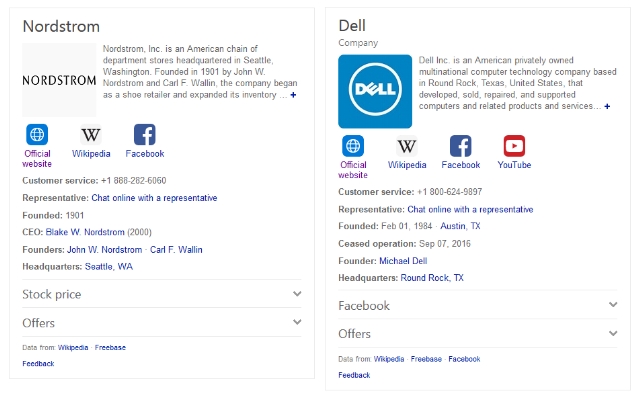
Bing is launching a new feature specifically for local businesses to make it easier for customers to reach you at any time. With the new chat feature, users can click a link to “chat online with a representative” directly from the search engine.

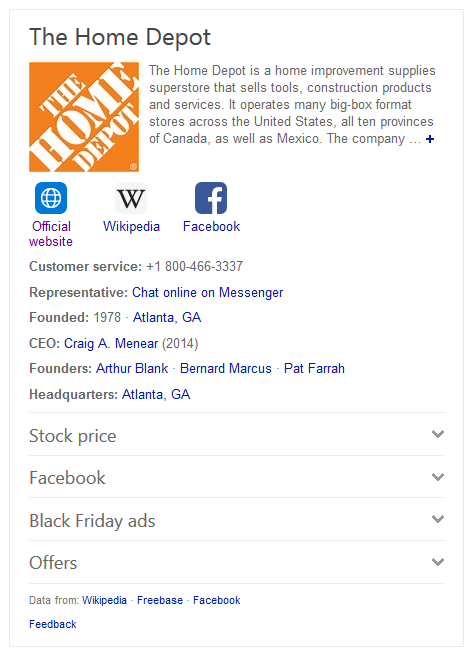
After clicking the link, you are immediately connected to the business through their primary chat program. That could be a native chat service or other options like Facebook Messenger.

You can see what it looks below:

bingchat

In this case, Bing links to Facebook Messenger:

bing-kp-chat-online-messenger

The new feature makes it easier than ever for searchers to contact your business for questions and concerns. It also makes it more important than ever to make sure your business is taking advantage of online chat services to provide customer service.

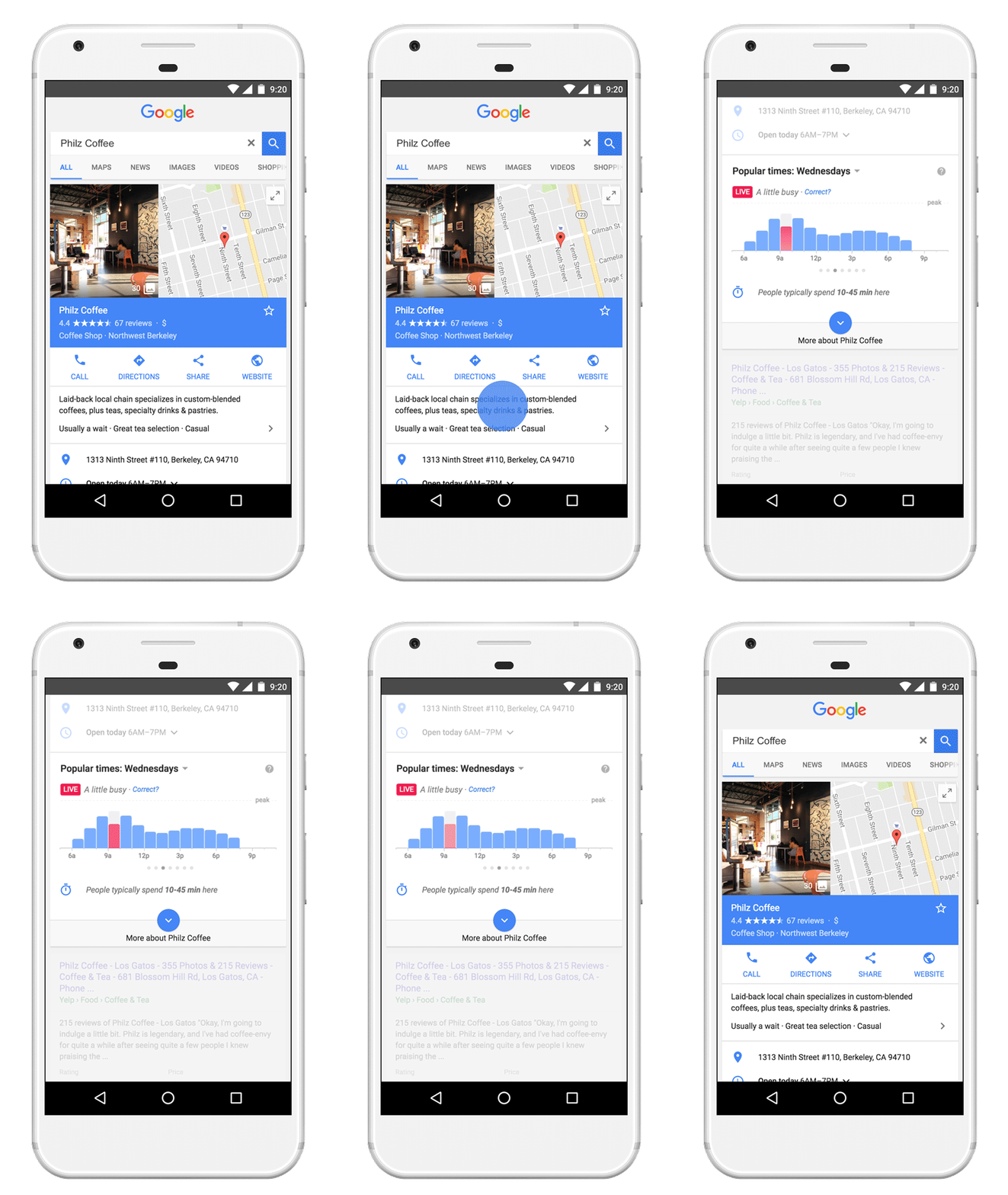
Last year, Google gave businesses the ability to list their busiest hours on Google Maps listings so that customers can better plan their shopping during the holiday season. Now, they are taking it a step further.

live-ptindevice-sf_hlgrny7

Instead of relying on businesses to update their Popular Times listings, Google Maps will use real-time data to predict just how busy a location is right now.

”Whether you’re rushing to pick up a last minute gift or seeking a lively bar for some festive spirit, check Popular Times for a sneak preview of what to expect when you arrive.”

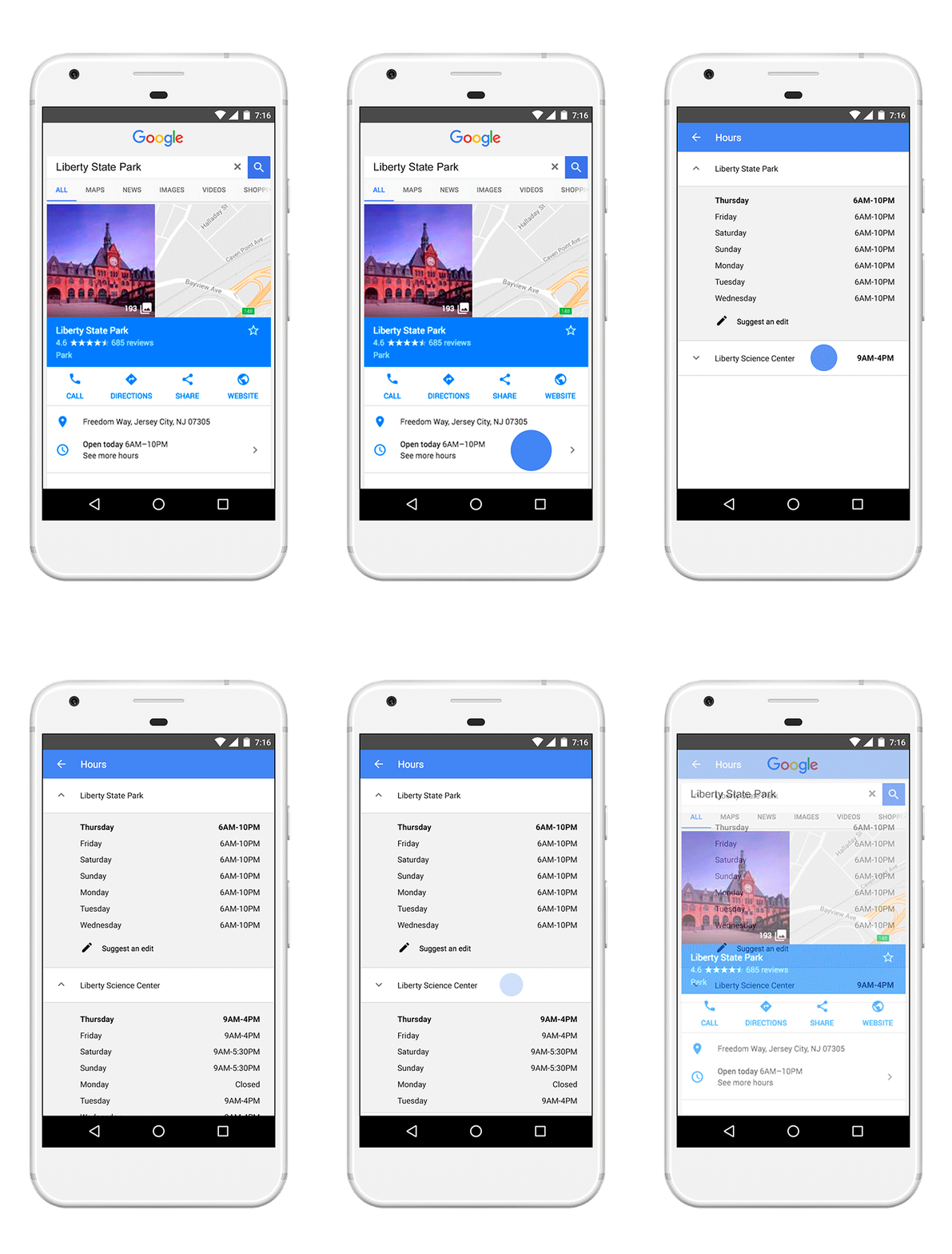
In addition to this new feature, Google is giving more flexibility to stores that operate separate departments with differing business hours. Businesses can now list separate departments and service hours in their Search and Maps listings.

servicehours-indevice-02

This new feature could be particularly useful for department stores or retail stores with pharmacy, supermarket, or automotive departments.

Google is also providing shoppers with shopping behavior data like how long people tend to spend in a store so they can make the most of their time during the holiday shopping season. Along with listing your business’s busiest hours, the search engine is also rolling out a feature that lets you tell shoppers how long the average person spends in your store.

All three new features rolled out this morning and should be live on Google Maps and Search for all users.

Google has already begun rolling out its mobile-first index to some users, but there are still a lot of questions about how exactly the search engine’s new separate index actually functions.

One such question got a surprising answer yesterday during the Google State of Search conference, as Maile Ohye told the audience that Google won’t index the AMP version of your page in the mobile search index – even when you don’t have a mobile-friendly alternative.

Google’s Gary Illyes also confirmed the news on Twitter after the conference:

That means if you’ve been using AMP pages as an alternative to making your website mobile-friendly, the search engine will skip over indexing your AMP pages in the mobile-friendly search index. Instead, it will by default choose to index the desktop version within its older index.

There is a way to force Google to index your AMP pages in this situation using a rel alternate attribute, but otherwise Google’s index will default to your desktop versions of pages.

This is particularly surprising because Google has pushed AMP as the ultimate way to deliver content to mobile users quickly and without losing ad revenue. But, in this case it seems the streamlined design of AMP pages leaves something to be desired. It may be the lack of site navigation options is what made Google decide to favor desktop over AMP in their index.

This change will most likely only affect a very small number of websites, but it is an odd choice for the search engine. The vast majority of websites who have adopted AMP also maintain a mobile version of their site.

accelerated-mobile-pages

The Accelerated Mobile Pages project says it has made its stripped-down superfast mobile pages even more versatile with the ability to support forms in AMP HTML.

AMP uses a simplified version of HTML to provide pages faster than usually possible on mobile devices – where speed matters most to users. However, the format offers limited features compared to full-fledged web pages. Until now, one of those limitations was the lack of ability to include forms.

Now, AMP users can include everything from the standard e-mail address capture form to more complex forms or even interactive polls. In addition to making it easier to communicate or gain information from your visitors, the support for forms can help with allowing customers to select colors or other details on e-commerce product pages.

form-error

As the AMP project says in its announcement, support for forms “enables building experiences ranging from a product color picker on an e-commerce detail page to an email field to capture newsletter signups to an interactive poll to engage readers within an article.”

If you want to start running your own AMP pages to deliver content faster to on-the-go users or you want to start adding forms to your already existing accelerated mobile pages, check out the AMP project’s official guides and documentation.

You can also see live examples of what the forms may look like on your site at AMP by Example.

The AMP project says it plans to continue to expand the functionality of AMP pages and AMP forms based on user feedback, but the overall focus is still on providing functional and engaging web pages to users as fast as possible.

Mobile Internet Usage

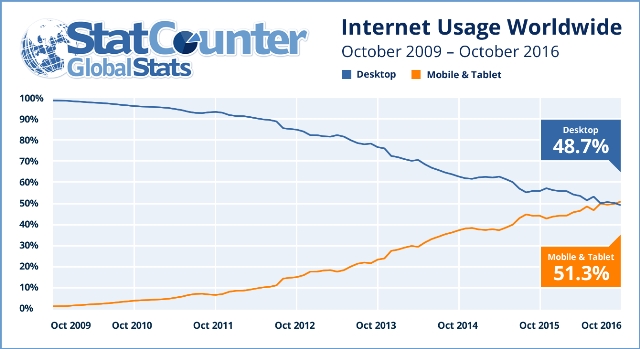
Mobile internet usage has been steadily gaining ground for years, and just last month it hit another milestone. According to a press release issued yesterday from StatCounter, mobile and tablet internet usage has finally exceeded total desktop usage for the first time ever.

Last month, mobile and tablet devices made up 51.3% of total internet usage compared to 48.7% by desktop. This is the first time worldwide monthly mobile internet usage has overtaken desktop according to StatCounter’s measure.

mobileusage

It is almost guaranteed this trend will continue in the long-term, but the short-term gains may not hold up. Mobile web usage has historically increased leading up to the holiday season and may deflate in the first part of next year. Even if this happens, the new milestone shows mobile usage is still consistently growing and will likely be the dominant way to access the web in the coming years.

Aodhan Cullen, CEO of StatCounter, says the new numbers should show businesses how important it is to make mobile a priority now, rather than later:

“This should be a wake up call especially for small businesses, sole traders and professionals to make sure that their websites are mobile friendly. Many older websites are not.”

Of course, mobile usage varies by country. While major markets like the US and the UK still primarily rely on desktop computers. Emerging markets like India overwhelmingly use mobile devices for internet usage and show no signs of slowing down.

social-media-adventure-1

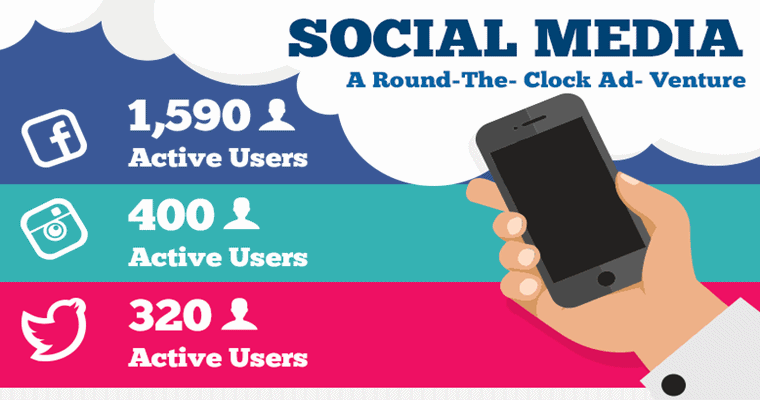
Want to get the most out of your social media efforts? There is no one-size-fits-all method that is guaranteed to give you success across every platform like Instagram, Facebook, and Twitter. Each platform has its own demographics and user behavior that means you must adapt to make sure you are striking when the iron is at its hottest.

Matt Booth from AddPeople made that easy to do with a simple infographic breaking down the demographics, user behavior, and best times to post for the biggest platforms you might be marketing on:

social-media-adventure

christmas-desk

A new study published by ad tech company Fluent shows the holiday season is looking to be more mobile than ever.

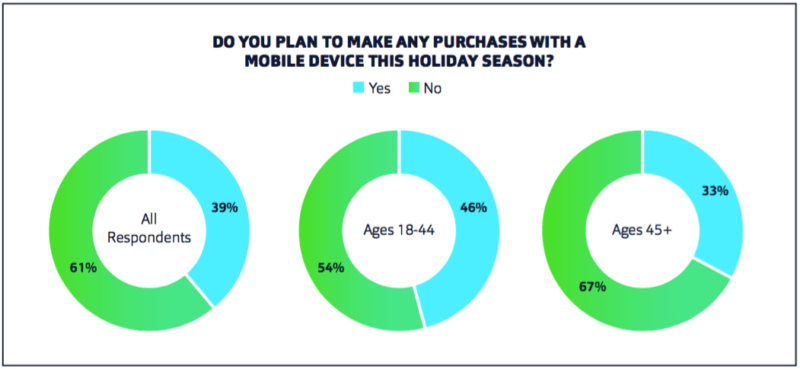
According to the report, nearly 40% of all US consumers are already planning to make at least one purchase this holiday season from a mobile device. Unsurprisingly, younger consumers appear to be more likely to make purchases from mobile devices compared to older individuals.

fluent-3-800x369

For the survey, the company asked almost 2,000 US consumers questions about their holiday shopping plans in late September. The responses showed 39% plan to make at least one purchase on a mobile device, with younger shoppers being increasingly likely to go mobile.

Just less than half of consumers between the ages of 18-44 say they plan to shop on mobile devices, compared to 33% of those 45-years-old or older.

fluent-1-800x363

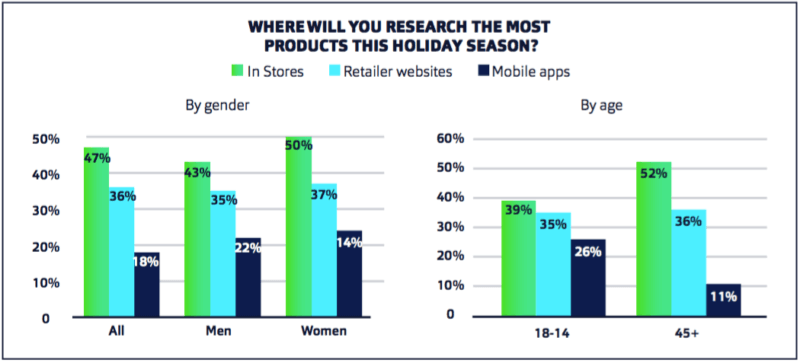
The survey also provides insight into how consumers will be researching their purchases ahead of time, both online and offline. In total, approximately 54% will do the majority of their research online, while 47% will continue to do their research in traditional physical stores.

fluent-2-800x349

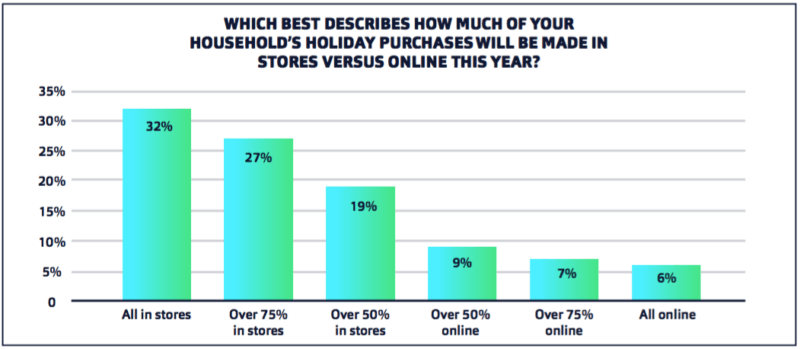
While online research is becoming a big part of the holiday season, brick-and-mortar stores will still be where shoppers are spending the majority of their money. The survey results show 78% of consumers will do at least half their shopping in stores, while 22 percent said they will do at least half their shopping online.

The survey shows a small discrepancy between genders, as well. Fluent says men are slightly more likely to research products online compared to women.

pintereststats

Just last year, Pinterest announced it had reached over 100 million active monthly users – a huge milestone for one of the fastest growing social platforms around.

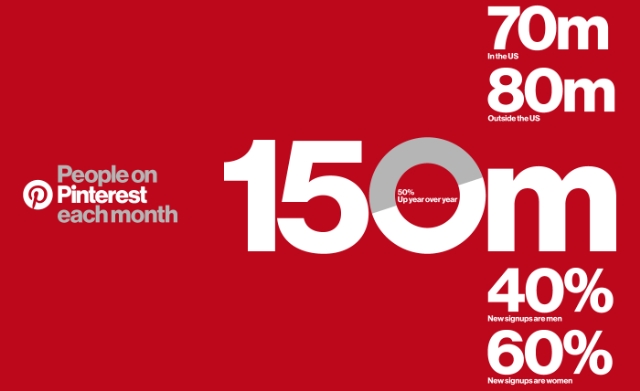
Since then, Pinterest has grown its user base by over 50 percent, reaching 150 million active monthly users, according to a recent announcement.

The new numbers show Pinterest is maintaining its rapid growth by expanding internationally, as well as reaching out to new demographics at home.

According to Pinterest’s announcement, approximately 80 million of the company’s active users live outside the U.S. and 75% of new signups are coming from users outside the country.

The platform has also made gains with men, who have long been the minority on Pinterest. The company notes 40% of new users are men, an increase of 70% from last year.

Lastly, the statement shows Pinterest is still maintaining a strong hold on millennials. The company says over half of all U.S. millennials are now active users on the site.

Overall, the numbers show Pinterest is still drawing a huge audience of people interested in finding and engaging with products, food, and designs that help them live the lifestyle they dream of.

To find out more about Pinterest’s current user statistics, check out the announcement here.