After an… interesting rollout, Bing is making some changes to its much-talked-about AI chatbot. As the company announced yesterday afternoon, Bing will limit users to 50 questions per day and 5 questions per session to rein in the new system. 

Since its rollout, users have been sharing examples of the chatbot, created in a partnership with OpenAI, getting up to all sorts of bad behavior. Some of the most notable include gaslighting users about the year, committing accidental racism, and even trying to blackmail a user by threatening to release personal information.

Early AI Chatbots “Somewhat Broken”

Addressing the situation in a tweet thread, OpenAI CEO Sam Altman admitted that the current AI tools are “somewhat broken” but stressed the importance of letting the world see and influence these early stages to help “get it right” down the line. 

“We think showing these tools to the world early, while still somewhat broken, is critical if we are going to have sufficient input and repeated efforts to get it right. the level of individual empowerment coming is wonderful, but not without serious challenges.”

At the same time, Altman says it is important to regulate these tools while they are more bark than bite, saying “we are potentially not that far away from potentially scary ones.”

What Bing Is Changing

Bing is limiting chat sessions to 50 chat “turns” or questions a day, with each session being limited to 5 “turns”. Specifically, Microsoft defined a turn as a complete exchange including a question from a user and a reply. 

“Our data has shown that the vast majority of you find the answers you’re looking for within 5 turns and that only ~1% of chat conversations have 50+ messages. After a chat session hits 5 turns, you will be prompted to start a new topic. At the end of each chat session, context needs to be cleared so the model won’t get confused. Just click on the broom icon to the left of the search box for a fresh start.”

For more, read the announcement from Bing here

Having a robust backlink profile remains one of the most crucial factors for ranking a webpage highly in search, so it is always big news when Google actually tells us what it looks for in quality links. 

Yesterday, the search engine published a new set of guidelines and best practices for building backlinks, detailing how to make your links crawlable, how to craft well-ranking anchor text, and how to best establish internal links on your site. 

Below, we will cover all the new guidelines and best SEO practices for links on your website according to Google:

Crawlable Links

As the page Google updated was originally dedicated to specifically making links crawlable, this section remains largely unchanged. It reads, “Generally, Google can only crawl your link if it’s an <a> HTML element (also known as anchor element) with an href attribute. Most links in other formats won’t be parsed and extracted by Google’s crawlers. Google can’t reliably extract URLs from <a> elements that don’t have an href attribute or other tags that perform as links because of script events.”

Anchor Text Placement 

The best practice for placing anchor text for links reads: “Anchor text (also known as link text) is the visible text of a link. This text tells people and Google something about the page you’re linking to. Place anchor text between <a> elements that Google can crawl.”

Writing Anchor Text

As for the anchor text itself, Google encourages you to balance descriptiveness with brevity: “Good anchor text is descriptive, reasonably concise, and relevant to the page that it’s on and to the page it links to. It provides context for the link, and sets the expectation for your readers. The better your anchor text, the easier it is for people to navigate your site and for Google to understand what the page you’re linking to is about.”

Internal Links 

While Google emphasizes the importance of internal links on your website, it also states that the search engine doesn’t look for a target number of links.

“You may usually think about linking in terms of pointing to external websites, but paying more attention to the anchor text used for internal links can help both people and Google make sense of your site more easily and find other pages on your site. Every page you care about should have a link from at least one other page on your site. Think about what other resources on your site could help your readers understand a given page on your site, and link to those pages in context.”

External Links

When it comes to external links, Google has advice for creating powerful links that don’t come off as spam: “Linking to other sites isn’t something to be scared of; in fact, using external links can help establish trustworthiness (for example, citing your sources). Link out to external sites when it makes sense, and provide context to your readers about what they can expect.”

TikTok is expanding the ways brands can turn their TikTok content into ads with new targeting and boosting features for promoting posts.

Promoting content is a way for those unable to use TikTok’s more complex advertising options to improve their reach, boost awareness of their profiles, and drive new leads – similar to the limited “Promote” features on YouTube and Facebook.

Below, we’ll get into the details of the new targeting and boosting options available on TikTok and how they may help your business:

New Options For Promoted TikTok Posts

More Profile Views

As the name suggests, this option helps drive traffic directly to TikTok profiles through a unique call to action on your brand’s story or highlighted product post.

Promote For Others

The idea of buying ads to promote someone else may seem weird but can be very useful for those who share content collaborations, those who partner with influencers, or partner brands. Additionally, this option allows the promotion of a specific creator’s videos or LIVE content.

Location Targeting

If you’re a local business that only services a particular area, location targeting can allow you to restrict your ad reach to exclusively target those in that service area. 

More Messages

The new “more messages” advertising option is a powerful tool for those who typically rely on their sales team to drive sales from leads. With this option, you’ll drive users directly to messaging your TikTok account where your experienced sales team can take over and close the deal.

Brands are likely feeling conflicted about TikTok ever since it was revealed that the company regularly uses internal tools to bypass its ranking algorithm and promote content or profiles across the platform. With these new options for promoting posts, you can take the power back into your hands to ensure your posts are being seen by the users who matter most to you.

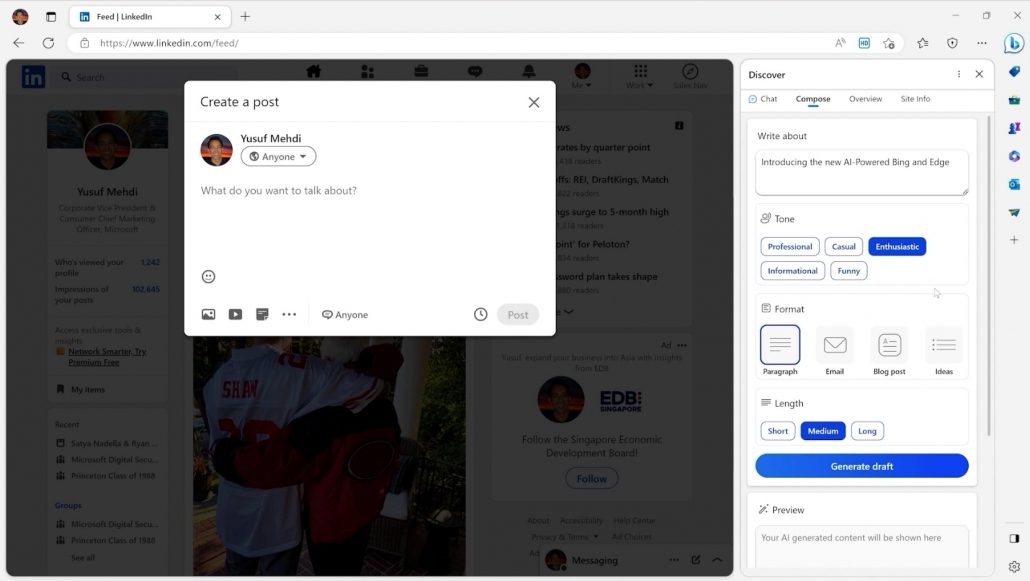
In a closed-door presentation at the Microsoft offices, the company revealed it would be integrating ChatGPT’s AI capabilities into Bing and Microsoft web browsers. 

Introducing the new feature, Microsoft CEO reportedly told event attendees that “this technology is going to reshape pretty much every software category.”

Billed as “your AI-powered copilot for the web”, the new feature unites information from Bing with capabilities from Edge web browser and artificial intelligence. Together, users can turn to AI features to get direct answers to questions, find information in more effective ways, and recontextualize the content they find.

According to Nadella, search engines currently fail to deliver the most efficient experience up to 40% of the time, causing users to click on search results and immediately click back to search results. 

With these new capabilities, Microsoft hopes to change that radically.

How It Works

The new AI-powered Bing uses a next-generation language model from OpenAI (the creators of ChatGPT) which is reportedly even more powerful than ChatGPT.

Additionally, Microsoft is using a new model to improve the relevance of answers and keep them up to date. 

Nadella says this AI model has already been applied to Bing’s core search algorithm, causing the biggest jump in search relevance ever. 

The centerpiece of the new experience is an expanded search box that allows users to input up to 1,000 characters and a chatbot that allows users to interact with Bing in conversational language. 

Notably, this means the search engine will be able to easily follow up on previous searches and provide greater context or translate information into more understandable formats.

For example, the company demonstrated the AI’s capabilities by quickly summarizing a 15-page PDF with a single click or translating a piece of code into another programming language.

Try It Yourself

The new search experience is seeing a limited preview release on desktop devices. Starting today, anyone can try out the new experience by visiting Bing.com and conducting a series of sample searches. 

However, the feature is expected to see a complete release and mobile version soon. 

If you’re still unclear on how Google thinks about marketing agencies that offer negative SEO linkbuilding services or link disavowal services, the latest comments from John Mueller should help clarify the company’s stance. 

In a conversation that popped up on Twitter between Mueller and several marketing experts, Mueller clearly and definitively slammed companies offering these types of services by saying that they are “just making stuff up and cashing in from those who don’t know better.”

This is particularly notable as some have accused Google of being unclear on their handling of link disavowal using their tools

The post that started it all came from Twitter user @RyanJones who said, “I’m still shocked at how many seos regularly disavow links. Why? Unless you spammed them or have a manual action you’re probably doing more harm than good.”

In response, one user began talking about negative SEO which caught the attention of Mueller. The user mentioned that “agencies know what kind of links hurt the website because they have been doing this for a long time. It’s only hard to down for very trusted sites. Even some agencies provide a money back guarantee as well. They will provide you examples as well with proper insights.”

In response, Mueller gave what is possibly his clearest statement on this type of “service” yet:

“That’s all made up & irrelevant. These agencies (both those creating, and those disavowing) are just making stuff up, and cashing in from those who don’t know better.”

Instead of spending time and effort on any of this, Mueller instead recommended something simple:

“Don’t waste your time on it; do things that build up your site instead.”

A new report from Forbes confirms that TikTok employees can and do promote specific videos across the platform – effectively deciding what goes viral.

Several current and former employees reported that some employees have access to this ability via a “heating” button which overrides the platform’s usual algorithm to ensure as many users can see content as possible.

What Is “Heating”?

An internal TikTok document called the “MINT Heating Playbook, “The heating feature refers to boosting videos into the For You feed through operation intervention to achieve a certain number of video views.”. 

According to the company, this heating button is intended to boost videos that will “introduce celebrities and emerging creators of the TikTok community.”

Though it was never explicitly stated that every video in the For You feed was selected and placed using the algorithm, that has always been the public understanding of how the feed works. Behind closed doors, it appears things have been a little different.

TikTok Used Heating To Encourage Partnerships

The social network doesn’t altruistically use this algorithm to promote creators who show promise.

Several former employees said the company uses the process regularly to help attract businesses and influencers.

In response, TikTok spokesperson Jamie Favazza didn’t dispute the nature of heating, but downplayed how often it is used:

“We promote some videos to help diversify the content experience and introduce celebrities and emerging creators to the TikTok community,” TikTok spokesperson Jamie Favazza told Forbes. “Only a few people, based in the U.S., have the ability to approve content for promotion in the U.S., and that content makes up approximately .002% of videos in For You feeds.”

What Favazza doesn’t mention is that heated videos make up 1-2% of daily video views according to the MINT Heating Playbook.

Do Other Social Networks Boost Videos?

It has long been suspected that most social networks manipulate their feeds to encourage partnerships with brands or content creators. However, TikTok is the only one so far to have a practice like this confirmed. 

Google is encouraging brands to ensure content is properly dated in search engines by using multiple date indicators on each page. 

The recommendation came in the wake of an issue with Google News where the wrong dates were being shown.

In the response, Google’s Search Liaison, Danny Sullivan, emphasized that while many factors may have contributed in this specific situation, the lack of proper date signals made it difficult to show correct info in the search results. 

“That page is a particular challenge since the main story lacks a visible date (it only has a time), and the page contains multiple stories which do contain full dates. Our guidance warns about this.”

To prevent situations like this from arising, Sullivan says it is important to use several signals to clarify the date content is published:

“Understand that ideally, the meta data alone would seem to some to be enough, and we’ll keep working to improve. But there are good reasons why we like multiple date signals present.”

Why Does This Matter?

It may not seem like a big deal for the wrong date to occasionally get shown with content in the search results. However, these can undermine your authority, lead to confusion, and create a poor user experience. All of these can lead to decreased page performance and even demotions in Google’s search results.

On the other hand, situations like this also highlight the need for Google to deliver more consistent ways to signal a page’s publishing date. 

For now, the best recommendation Google has is to use a scattershot approach for the best chance of having your page correctly dated:

“Google doesn’t depend on a single date factor because all factors can be prone to issues. That’s why our systems look at several factors to determine our best estimate of when a page was published or significantly updated.”

Since the much-publicized takeover by Elon Musk, Twitter has seen its daily revenue plummet by up to 40%. While Musk has been widely criticized for his behavior as CEO and management of the company in recent months, this info, reported by The Information, indicates things are also falling apart behind the scenes. 

Much of the lost revenue is attributed to recent news that more than 500 of Twitter’s top advertisers cut or entirely stopped advertising on the platform since Elon Musk’s takeover. 

Why Are Advertisers Pulling Away From Twitter?

The main issue raised by most major advertisers is Musk’s approach to content moderation. Musk has claimed to be a proponent of free speech online, indicating that content moderation should be handled with a light hand – if at all. 

As such, Musk has reinstated many previously banned accounts – including those of avowed white supremacists – and dismissed most of the staff responsible for content moderation on the platform. 

Understandably, this has made many large advertisers wary of how safe the platform is for their advertising. 

At the same time, Musk has also terminated much of Twitter’s sales teams, including those in charge of accounts with the company’s biggest advertisers. Similarly, engineers and data scientists who were working to improve the advertising service on Twitter have been dismissed. 

What This Means For Twitter’s Future

Unless Musk finds a way to reverse course and satisfy previous advertisers’ concerns, this could bode poorly for the company’s future. Users have already expressed frustration with having new features locked behind a paywall as part of Twitter Blue, indicating the premium service will not be able to make up for lost ad revenue. Meanwhile, Musk’s slashing of staff will make it difficult for the company to engineer new tools or services that generate revenue. 

With all this in mind, advertisers have every right to approach the platform with caution.

Google continues to be relatively tight-lipped about its stance on AI-generated content, but a new statement from Google’s Danny Sullivan suggests the search engine may not be a fan.

Artificial Intelligence has become a hot-button issue over the past year, as AI tools have become more complex and widely available. In particular, the use of AI to generate everything from highly-detailed paintings to articles posted online has raised questions about the viability of AI content.

In the world of SEO, the biggest question about AI-generated content has been how Google would react to content written by AI systems.

Now, we have a bit of insight into how the search engine’s stance on AI-created content – as well as any content created solely for the purpose of ranking in search results.

In a Twitter thread, Google Search Liaison, Danny Sullivan, addressed AI-generated content, saying:

“Content created primarily for search engines, however it is done, is against our guidance. If content is helpful & created for people first, that’s not an issue.”

“Our spam policies also address spammy automatically-generated content, where we will take action if content is “generated through automated processes without regard for quality or user experience.”

Lastly, Sullivan says:

“For anyone who uses *any method* to generate a lot of content primarily for search rankings, our core systems look at many signals to reward content clea/rly demonstrating E-E-A-T (experience, expertise, authoritativeness, and trustworthiness).”

In other words, while it is possible to use AI to create your content and get Google’s stamp of approval, you are walking a very thin line. In most cases, having content produced by experts with experience providing useful information to those who want it will continue to be the best option for content marketing – no matter how smart the AI tool is.

If your site gets hit with an algorithmic penalty from Google, you’ll likely be eager to fix the issue and improve your rankings again. However, Google’s top experts say it can take quite some time to recover if they believe your site is spammy.

In a recent Google SEO Office Hours session, representatives were asked how long it can take to recover from an algorithm penalty related to content quality problems. 

While many details about the question remain unclear – such as how significant the penalty is – the search engine’s spokespeople encouraged site owners to be proactive. Otherwise, it may be months before they regain ground in the search results.

Specifically, the question posed in the video is:

“If a website gets algorithmically penalized for thin content, how much of the website’s content do you have to update before the penalty is lifted?”

There are a few ways the question could be read, so in this case, the experts kept it simple and straight to the point:

“Well, it’s generally a good idea to clean up low-quality content or spammy content that you may have created in the past.

For algorithmic actions, it can take us months to reevaluate your site again to determine that it’s no longer spammy.”

In other words, it is always better to share high-quality original content than to risk being labeled as spam. Once that happens, you’ll likely be in the doghouse for at least a few months.

To hear the answer, check out the video below beginning at 24:24.