Anyone that has built a website from scratch knows how much effort it takes to build an audience, raise your traffic and generally get your site known about. So, what happens if suddenly all that traffic disappears? All of that work can be undone in a single moment. Why does this happen? Usually it is because of mistakes you never knew you were making. Here are 7 common mistakes that could make your website fail.

  1. Pointing All of Your Backlinks Into Your Home Page – Link building is an essential part of any website’s SEO and doing it well means improving your search engine performance. The most common mistake with backlinking is directing all of your links back to your home page. Search engines think it is strange if all of your backlinks point to your homepage and will penalize your search rankings and your traffic. Instead, spread your link distribution and point backlinks to different pages within your website.
  2. Unnecessary Clutter – If you’re getting a lot of traffic, it’s natural to want to maximize your profit by monetizing your website. But be careful if you try to do this. Many add unnecessary clutter to their page while trying to monetize content, which changes your pages appearance and the way the public interacts with it. Too many advertisements and other clutter, will soon send the public elsewhere.
  3. Giving Too Much Content at Once – Content may be what the public is seeking on the Internet, but giving them too much of it in one place can be a bad thing. You want to keep your audience comfortable. Don’t make them feel overwhelmed by putting too much information in a single page. If you are going to be giving lots of content at once, split it across several pages so you will keep visitors’ interests.
  4. Amateurish Design – If you want your website to be respected, don’t put the design in unexperienced hands, even if they are your own. No matter how good your content is, if the design is off putting, you still won’t get visitors. It’s easy to find good website templates for cheap and there are always designers for hire. Don’t risk your reputation on a shoddy design.
  5. Being Disorganized – Visitors will always want their experience with your website to be as easy as possible. This seems simple, yet many still provide confusing and disorienting sites that frustrate their visitors. Those visitors won’t care about what content you are offering if they can’t find it easily.
  6. Trying to Advertise Before Your Content is Finished – Search engines will notice if you try to push for traffic before your website content is finished. Search engines favor content that is geared towards their audience and no audiences favor unfinished content. It seems amateurish, and you are focusing on the popularity and money before you have a proper product to offer. Instead, get some great content before you start trying to attract the public.
  7. Going Plain Text – It’s simple: people get bored quickly. Failing to add graphics, means your audience will get bored almost immediately. Give your visitors something to catch their eye everywhere you can. Keep them interested.

These ideas may seem like common sense, but websites continue to make these mistakes every day. Avoid them or one day you may notice your traffic has gone somewhere else.


For some other more information on how to keep your website running smoothly, go to Sathishkumar Varatharajan’s article at designrhub.

The combined search marketplace between Yahoo! and Bing got a new name this week, the Yahoo! Bing Network. It may lack creativity, but at least it’s sensical. 

Along with this announcement, Microsoft included the news that their search ad network, formerly Microsoft adCenter, has been renamed as Bing Ads. The network and the functionality of it appears to be the same, however.  

Barry Schwartz broke this news on Search Engine Land and you can go directly to the source, the Bing Ads blog, for more information.  


So you’ve been having steady traffic on your website for a while now. You are eyeing expansion and everything seems fine. Suddenly, your traffic nose-dives. There are a few reasons this can happen.  Some are very easy to fix, while others are more problematic. Here is a six question checklist to help identify what is causing the issue and how to solve the problem. Before going through the checklist, please make sure this is actually a search issue. If you go to Google Analytics and go to Traffic Sources->Sources->Search->Organic and select a range of a few months, you will see an image depicting your traffic with the sudden drop. If there is a drop in traffic on this chart, you likely have a serious search issue.

  1. Has the Analytics Tool Been Removed or Altered? – This tiny issue is by far the easiest to fix. It can happen frighteningly easy and frequently, but use an Analytics checker/debugger tool, and you can quickly find and fix this issue.
  2. Have There Been Any Significant Website Changes? – Sometimes just redesigning your website can shatter your rankings. Even removing content or restructuring what order your content appears in can have big effects on your site. Usually, this issue can be solved by using an Analytics tool to see if there were any changes right before the drop in traffic.
  3. Have You Been Hacked? – It is not as easy to know when you’ve been hacked as movies might make you think. There are spam attacks that don’t affect Active pages, but instead create new directories with spam content. This makes the hack harder to find. If a search engine picks up on it, the website is often penalized. Google and Bing Webmaster Tools can help you quickly find out if you are vulnerable to hackers. You can also do a manual search of “links:[your URL here]” to search for meta descriptions that look like spam. The solutions to being hacked vary but once you’ve uncovered the issue, you can look for specific solutions. Usually, it will involve loading a clean backup and changing all passwords.
  4. Has There Been a Major Algorithm Update? – If none of the above questions have helped, it’s quite possible your traffic issues are being caused by an update. Look through available and reputable resources to see if other websites are dealing with similar issues. If your problems are caused by algorithmic changes, it is time to seek professional help. Changing code won’t fix the problem. Instead, you will likely have to make large shifts in company practices, strategies, content and link building.
  5. Has the Site Been Hit With a Ranking Penalty? – If an algorithmic update isn’t your problem, chances are your Web site has been penalized. If you have incurred penalties, it means there has been a sudden spike in bad links or spam content. You should audit who is in charge of making sure your site is following SEO policies and make sure they are up to date with the best practices.
  6. Are You The Victim of Negative SEO? – Negative SEO happens when a competitor manages to automate spammy links at your Web site, causing site wide ranking drops. Bing Webmaster Tools has a Disavow Links Tool but unless you’ve seen a sudden rise in spam content or bad links, you can ignore this tool.

These steps can help you fix sudden traffic drops but you may have to hire professional assistance if the first two questions didn’t help. Luckily, these problems are fixable and soon your site will be back up to its steady flow of traffic.

You can read more about identifying search traffic drops in John Lynch’s article over at Search Engine Watch.


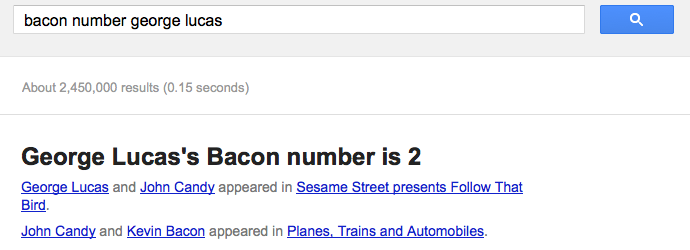
Someone at Google has had a bit of free time. Most people know about the famous “six degrees of separation” and how it applies to actors and Kevin Bacon. Well now you can worry no more about calculating that value yourself! Simply go to Google and type in “bacon number” followed by a celebrity’s name and you’ll get the full path to the person.

I had to try it myself and put in the following:

Now it’s not perfect, no results showed up for “Dalai Lama” or “Adolf Hitler”, but this is still something to use if you’re in a rush in a trivia game.


While building links is a common strategy for gaining exposure, focusing less on link building can actually earn you more links. Content marketing produces links, but it also improves your brand image and can make key connections that will net you more exposure than before.

These four content marketing advantages all naturally make links, which means less time focusing on link acquisition.

  1. Creating Large Amounts of Targeted Traffic: Producing great content that gets posted to popular websites gets you a large amount of traffic and exposure, but what good is exposure when it’s aimed at the wrong people? Since Google Penguin, the links of real value are those that make you visible to your market demographic. You can do this by understanding what trustable websites look like, considering audiences when evaluating a Web site, working with publishers before creating content and working with the most influential contributors to a site.
  2. Engaging Social Media: Sharing your content on social media sites helps you gain wide exposure as well as allowing you to fit your product to the needs of niche audiences. If you can get your content repeatedly shared, you can help establish your brand and its value. This can be achieved by optimizing your content for social media.  Allow visitors to link to social media sites with appropriate but non-distracting buttons on your content. Consider how the content will look when shared, and use eye-catching images. You may even consider buying ads on social media sites where your target audiences gather.
  3. Create Immediate Conversion Opportunities: By distributing content with positive brand information, you can create easy opportunities for conversions. Remember, all content you create draws people closer to your brand. Be sure to make it easy to subscribe to your RSS feed or email list and collect email addresses by making users give them to receive more content.
  4. Encourage Brand Advocacy: All content creates an opportunity to connect with your audience. The larger the audience you get, the more people you need to share your content. By getting people to repeatedly share your content, they are improving your brand’s reputation. This leads to more potential customers, which in turn leads to more potential advocates. Create advocates by always responding to feedback – positive or negative. Make it easy for people to get involved. Allow the community to help create content. If they believe in the content on your site, they will share it.

Content marketing is a sustainable strategy with long-term rewards. You always want to stand out. Unique, valuable and exciting content helps distinguish a brand in a way linking campaigns can’t.

To read more about content marketing, look at Loren Baker’s article at Search Engine Watch

Google announced last week that AdWords scripts, a project initally launched as a limited release in June, is now availble to all advertisers across the globe.  They’ve also taken feedback from early users and added frequently requested features.  

Adwords scripts allows users to make changes to their AdWords account using simple JavaScript programs.  Those who take advantage of this new tool are able to update keywords and ad copy or output account statistics.  

With the updates, Adwords scripts are capable of more complex script executions. Google also added support for Ad Parameters and the ability to schedule scripts to run only once, daily, weekly or monthly. 

On September 13, Google will host a webinar to help new users learn about and get the most out of AdWords scripts.  


Many startup companies make the same mistakes when conducting their sales campaign. We’re here to help you avoid them. Here are the seven most common mistakes for startups. While some of these may sound like common sense, knowing these ahead of time and knowing how to fix them can save your company a lot of trouble.

  1. Not Understanding Your Customer: Treating all clients as the same is a huge mistake many startups make. It is easy to make assumptions about what your customers will want but they will all have unique concerns and problems that have to be dealt with in a personalized way. Not every customer responds to the same sales pitch. Asking questions early on will allow you to answer their questions and sell them on your service.
  2. Not Selling: Rather than focusing on the extras and luxuries of your product, pinpoint the ways it will solve that specific client’s problems. This means asking the questions that will tell you what the customer needs. Showing a few ways your product will directly benefit a potential client goes a lot further than telling them about what you plan to put into the product later.
  3. Being Absent: Failing to meet potential customers in real life to close the sale means missing two of the most essential experiences for a startup. Not meeting in person hinders the ability to directly connect with clients and build long term relationships. It also means not hearing the specific concerns of the customer, which is easily the best way to improve what you are selling.
  4. Failing to Follow Up: After you give your pitch, follow up. While it seems that giving your pitch and traveling onto the next potential client increases prospective customers, moving on actually makes the clients forget about you. Don’t harass your leads, but keeping your product fresh in their memory until they make up their mind never hurts.
  5. No Process: Tracking basic information such as phone calls and emails, connections to decision makers, closed deals and deal values is an essential activity for startups, but many forget to do it. Having a process in place means knowing where you stand with all potential customers.
  6. Charging the Wrong Amount: While skewing prices cheaper seems like it would make your product more attractive, it can sometimes make customers question its value. Don’t undercharge. Set your price at one that will allow for a sustainable business and reflects the value of your product. Attract customers with what your product does, not how cheap it is.
  7. Not Asking For a Sale: If you have been in contact with a potential client for a relatively long period of time, don’t be afraid to ask for the sale. If you’ve put effort into establishing a relationship with the potential client, they should be happy to close the deal.

While startup founders come from all walks of life, knowing how to be an effective sales person is required to make a product succeed. Even if you’ve already made one of these mistakes, they are easily fixable. With these problems solved, you’ll be well on your way to making your service a reality.


You can read more in Steli Efti’s article at TechCrunch

The good people at Twitter announced last week that they now offer a tool to allow interactive timelines to be easily embedded to a Web site.  

These timelines are fully functional.  Users can interact with them the same way they do their own, personal timeline on Twitter.com.  

The really exciting aspect, and the one that has a number of real world applications, is the ability to customize each timeline to only show tweets relevant to your site, or even a single article.  For example, you could include your own Twitter account’s tweets and conversations in the timeline on your blog.  Or, include only tweets with a specific hashtag to a relevant article.  Be creative and these timelines could be a real asset.

By this fall, you can officially say good-bye to Google Product Search and hello to Google Shopping.  The new name brings with it a particularly noticeable change, Product Listing Ads.  Simply put, merchants will now have to pay to be listed on Google Shopping.  

It’s not all bad news.  Having to pay your way in could actually open the door for small businesses to compete with the large online retailers like Amazon that previously dominated the market.  If small business owners are discerning about where they spend their ad budget, they could see unprecedented returns.  

Google Shopping, along with the already included in searches Adwords, will also support images to help attract potential customers.  This, however, means that about two-thirds of Google’s search results pages will be filled with paid content designed to steer users away from the organic search results.  

For business owners counting on users to find their way to their site through Google, this new shift in online retail could affect their bottom line.  Could it be time to look into Bing?  

Ariel Rosenstein has more in her article on MultiChannel Merchant

While infographics are often a great way to attract attention, there are times when they are not the proper solution for a client. Here are six instances where infographics don’t provide a good return of investment for the client and shouldn’t be used.

  1. Sites with Questionable Links – All SEO experts know about the huge shift created by Google’s Penguin and Penguin algorithms. Owners of penalized sites will often ask if infographics can solve their problems. Infographics can assist in varying backlinks, but it can’t solve all of the issues. Before recommending an infographic, you need to know about the specific penalties.  Also, many sites with “grey links” haven’t been penalized. Infographics can cause these sites to be identified and then get hit by penalties. Investing money for an infographic (which can cost thousands of dollars if independent research and design is needed) is not a wise recommendation when a website may be already on the edge of penalties.
  2. Under-developed Sites – So, you have a brand new website. Wouldn’t an infographic be a great and easy way to advertise your site to the world? Probably not. They don’t just bring links. They also help place your brand in front of the proper audience. By publishing on an under-developed site, clients may get the impression that you are sloppy or lack experience. Also, like is commonly found in SEO, the ROI relies on how you leverage the assets you already have. Infographics may help leverage your Social Media status and RSS subscribers, but you’ll want to make sure that these are all up to date beforehand.
  3. Lack of Social Media Plan – A real social media plan is not just having a Facebook or Twitter. Infographics are designed to be viral and attract tons of social-media savvy people to your website. If your social media accounts aren’t updated or lack content, these visitors are unlikely to become an audience. Before you use an infographic you need to update your content frequently, court a number of followers and have a stategy for identifying members of your demographic.
  4. Lack of Mailing List – Using an infographic without a mailing list means missing out on a massive opportunity. Having 10,000 unique visitors sounds wonderful initially, but is not likely to provide a long term audience. However, having just 50 people sign up for your company’s mailing list is an essential part of converting visitors to leads.
  5. No Budget – While numerous places offer infographics for relatively cheap, they don’t allow you to rise above the clutter of the internet. According to Topsy, in 2012 17,000 tweets included the word “infographic”. That means a mediocre infographic will not capture the attention of the biggest markets. Making an infographic requires a skilled team and usually costs over $1,000. If you can’t afford that much, you’re more likely to see a return on your investment with link bait articles or guest postings.
  6. You Don’t Understand Infographs – Infographs are for good content but that content may not always be what you personally enjoy. It is aimed at your demographic and the online sources that focus on that market. Trying to squish a long detailed report may seem like a great idea, but it is unlikely to go viral. It may be visually appealing, but it won’t convert potential customers.

To see the original article by Danny Ashton:
When NOT to use an Infographic: 6 Examples