
Most average people have know idea what SEO is, and have probably never even heard the term before. Still, the industry is essential to running a popular and credible website. It is important enough that there are an inordinant amount of people writing about it every day online. That wide amount of people writing has lead to the spread of apparent misinformation, usually by well-meaning people who were never exactly explained what SEO is and what one does.

That type of misinformation, though well intentioned, seems to have lead to a bit of an identity crisis for the market. We can see it in a couple recent articles for Smashing Magazine. The first is called “The Inconvenient Truth About SEO” and the second is its rebuttal. The first simulataneously cites the spread of misinformation as a huge issue in the field, while also attributing numerous non-SEO practices to the industry. While trying to show that a lot of the practices offered by so-called “SEO experts” are can actually be wastes of money, Paul Boag also shows that his own idea of SEO has slipped askew from what SEO does.

The rebuttal, by Bill Slawski, on the other hand is aimed at resolving these questions about what an SEO does, and more importantly, doesn’t do. Summarizing it in short would not do justice to the full explanation he offers, so I suggest just diving in and reading what he has to say.

It is hard to say that Bill Slawski’s idea of what SEO does is exactly correct either, as the people working in the field are the ones who define it, and some SEOs have been using these practices. Instead, think of it as a way to get closer to a more traditional spin on current SEO practices, and what SEO really means.

SEO relies on data. That’s a pretty simple fact. Still, for some reason, some SEOs still do all their research by hand and manually track their performance, usually by making Excel charts that seem to stretch for days. I honestly don’t completely understand how they put the time into even trying to do this, at this point in SEO. So for this article I won’t be answering the question posed in the title, but instead showing why manual data gathering doesn’t make sense anymore.

To do well in SEO, you require fresh and accurate data to base your decisions upon. If you spend all your time and effort doing data gathering by hand, how do you have the time to make solid judgments and strategies for your customers?

SEO, of course, did start out with that exact manual strategy, but the reason it isn’t anymore is because this very problem I’m talking about. There is simply too much data, and data gathering can be easily automated, so doing it by hand is a waste of time and resources.

But, for those few SEOs out there still doing things the old fasioned way, there are pleny of ways to get all of your data gathering automated quickly. Myles Anderson from Search Engine Land gathered a quite a few tools you could use to get started, as well as answering just about any question about local SEO tools anyone has had ever.

It is a comprehensive guide, so if you just need the tools, head straight for that section, but if you need more convincing or don’t understand how the tools work or their benefits, Anderson makes a strong case with his explanations.

After Google launched the disavow link tool in mid-October, there were a fair amount of doubters and those that claimed it doesn’t work. Dixon Jones from Majestic SEO, a well known and respected member of the SEO community posted in a Google+ thread that he used it for a site and it worked to remove a manual link penalty.

SEO Roundtable has the exact posts he made explaining the process and what happened. For Jones, the manual penalty was removed fairly efficiently, but those wanting to use it for a Penguin link penalty may need to wait for a new refresh.

The best option is of course to try to avoid link penalties or bad links, but the world isn’t perfect. If you’ve dealt with the root issue which caused the penalty, the disavow links tool may just be the solution you need.


It is shocking to me how many people write off mobile SEO as being unimportant or overhyped. Just taking a quick look at the rising rates of people searching with mobile devices makes it pretty clear how much of the market is dominated by mobile devices.

Sure, there are still more people using desktops on the internet, but every year we see a greater percentage of that traffic coming from smartphones and tablets. The trend isn’t going away. More people have tablets and phones every day as more affordable options become available.

So, why then is mobile SEO on quite a few lists of things people hope we stop talking about next year? It is because many people in the SEO industry don’t really understand what mobile SEO is, or how it works.

Bryson Meunier also had a problem with how many people seem to be writing off mobile SEO right now, and he compiled a list of the misconceptions and myths as well as explaining how they’re wrong.


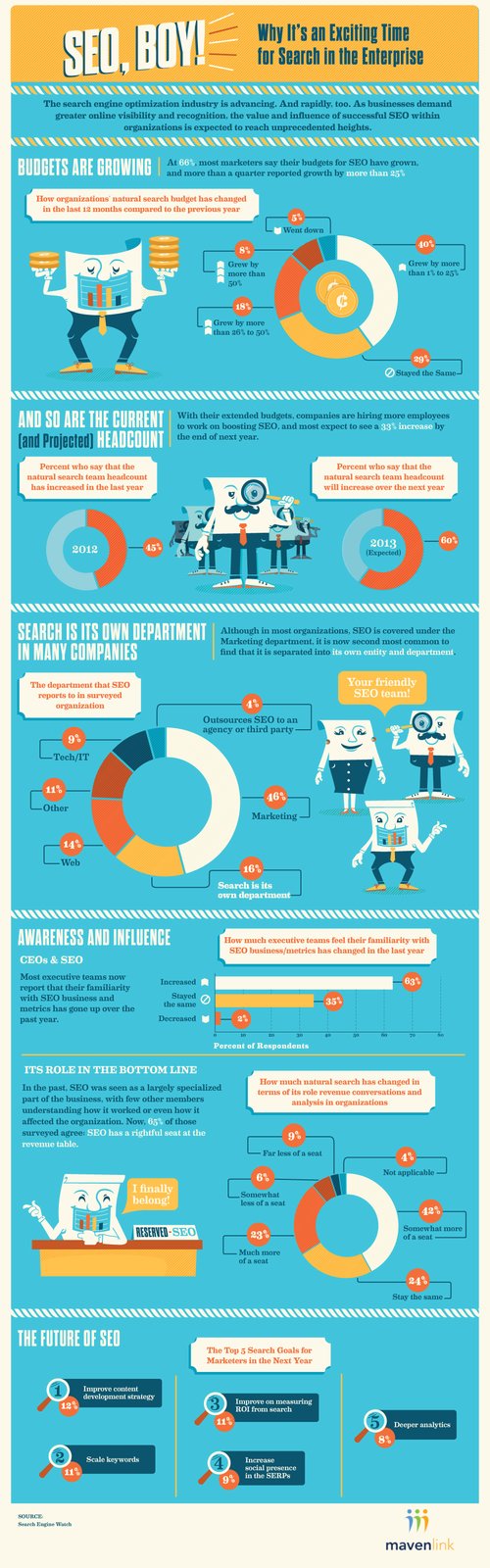
As the year draws to a close, everyone of course looks to what the past year indicates for the one coming up. I’ve already covered one article of year end analysis, and now Search Engine Watch and Mavenlink have made an infographic covering what SEO professionals are saying about the state of SEO in 2012.

What is notable about both of these year-end opinions is that they are both extremely optimistic about the future of SEO. As the internet becomes somehow even more pervasive in our every day life, more and more opportunities for SEO to grow become apparent, and there is no sign of it slowing down.

Budgets are growing, companies are paying more attention, and SEO teams are getting bigger. SEO is finally even beginning to be seen as an entity seperate from regular marketing. Before long, SEO might be really known outside of the marketing community.

If you are doing a ton of SEO audits, or just doing audits on sites with lots of big data, you probably have been itching to find any way to make your process more efficient without impacting the quality of your work.

Alan Bleiweiss, writer for Search Engine Journal, had that problem. With Google fighting unnatural links, we all have felt a heightened need to be examining inbound link profiles. These two things combined have caused Bleiweiss to bring together a set of techniques he uses to speed up his audits.

No one wants to spend their entire life doing audits, but theres no need to lower your bar for quality just to save some speed.


Have you ever wondered how Google handles web spam in other languages or other countries? According to Matt Cutts, head of Google’s webspam team,  they have people placed on the ground across the globe to handle markets for their native countries.

Cutts, was responding to a question asked online, when he said, “If an algorithm misses something, they are there to find the spam. They know the lay of the land, they know who the big players are, and they’re really quite expert. So if there’s some really unique kind of link spam going on in Poland, for example, there’s a person there.”

The video is below. The question was poorly phrased (Europe is smaller than the US? Really?), but it helps illustrate just how international of a company Google is trying to be. I’ve heard European countries use Google less than the US, but clearly Google is still trying to offer the same experience across the globe.


Content creation has long been at the top of SEO, but it is leaking from the internet into the real world. One of the front runners of this change in real-life marketing is Red Bull, who has begun publishing their own magazine, The Red Bulletin, which paints a picture of a world where there are no limits.

This isn’t an isolated case. According to a recent survey, 90% of marketers believe that content marketing will only become more essential in the next year. Ronn Torossian has predictions and other instances of how companies are using content creation to reach out to their customers directly, all at Search Engine Journal.


While people have been fretting about Google penalizing innocent site holders, it appears outside groups have been abusing Google’s DMCA algorithm to try to get legal content about films taken offline.

For those who aren’t familiar with the DMCA related algorithm, known commonly as Google’s Pirate Update, it basically referenced valid DMCA takedown requests as part of a sites rankings. If a site has been frequently hit with valid takedown requests, its ranking is penalized.

However, TorrentFreak has uncovered that a company who has been issuing DMCA requests on behalf of multiple movie companies has been issuing requests for the removal of legal content such as listings for legal copies of the movie on Amazon and iTunes, as well as Wikipedia pages about several movies and television shows.

Most of these requests were ignored by Google, but it is a worrisome matter that these companies are clearly using DMCA requests without discretion, and these invalid  requests could plausibly be missed by algorithms sorting out the mess.

Search Engine Land posits that the motivation of the mysterious organization, known as “Yes It Is – No Piracy” could be to bump up their own pages of content for specific listings while lowering legitimate sites, but for now, the motive is unclear.

Not a Google Panda

Look at the most recent SEO article you can find about Google Panda. You can even look at some I’ve written. In general, the mood among those articles is not positive. Whatever positive changes for users that Panda offered, it drastically changed how SEO is run, and well, people don’t tend to react well to change.

However, in all the hubbub about the negative impact Google’s changes may have had on smaller businesses, we forgot that Google Panda did make some very important changes that made their search engine perform markedly better.

Ruth Burr, head of SEO at SEOMoz, didn’t forget this because she is a constant user of Google search. I won’t repeat her anecdote here, but she does recall a time when using Google could easily lead you to vapid, not useful websites trying to hide that their “articles” were really just ads for their own business.

The biggest point she raises is very true. Google’s goals are not to “foster small or local business growth in the U.S. and abroad.” While there are ways for local or small businesses to take advantage of search engines, Google’s main aim is to simply provide the best search engine performance possible. There’s little denying Panda wasn’t a step in the right direction in that regard.

If you aren’t convinced of Panda’s positive features, or just want to see more pictures of cute pandas, check out Burr’s article. She makes some strong points.