

rsz_john_muellerThere is a misconception amongst a small few that Google only wants the absolute best websites and they don’t index websites they think aren’t worth their time or space in their index. In reality, this is far from the truth.

Google is always indexing content and they index pretty much anything they can find. Supposedly, the only thing they don’t index is spam.

SEO Roundtable pointed out that Google’s John Mueller commented in a Google Webmaster Help thread recently saying “unless the content is primarily spam (eg spun / rewritten / scraped content), we’d try to at least have it indexed.”

He was responding to a question about a site bot being fully indexed over a prolonged period of time, which he believes is the result of a bug, though he didn’t have any definite answers until it is shown to the indexing team.

Before anyone gets up in arms, that statement is a little misleading on the aspect of spam. Everyone knows Google still indexes their fair share of spam, and in some cases they even get ranked. Mueller’s comments instead show how Google tries to avoid adding spam to their index, but we it is obvious that they don’t succeed in avoiding indexing all of the junk.

Getting indexed isn’t the same as ranking, but to have any chance of being ranked you have to be indexed.

Bing Ads is the clear runner-up in to AdWords in the search engine advertising game, but they’ve seen a way to set themselves apart and give users something AdWords is not. Recently, Bing jumped on AdWords introduction of ‘Enhanced Campaigns’ and, more importantly, the vocal concerns of some users. The general manager of the search network, David Pann, announced that Bing would not be bundling mobile, desktop and tablet advertising together and would give users the flexibility to control their own campaigns.

Not only is this a clever step by Bing to promote itself while putting down Google, but it also gives advertisers an alternative to ‘Enhanced Campaigns’. There’s never been much of a difference between Bing and AdWords, but now you can trade one for the other based on your preferences. Of course, one still comes with a fairly significantly larger audience.

Read more about Bings recent announcements, including some planned changes and the future direction of the product at Search Engine Land.

Many website owners and SEOs have seen it happen. Your website is getting going, and Google is responding to your content with decent initial rankings. Everything seems fine, then gradually your ranking starts plummeting with no explanation.

You could time every day checking your rankings watching for this to happen  but that is a waste of time, as Search Engine Journal explains. Checking rankings isn’t an income generating activity, and your time is simply better spent elsewhere, like creating content or networking.

So then what is there to do about this mystery fall in the rankings? First, we have to understand what is happening, which Matt Cutts so helpfully explains in one of his latest YouTube videos.

Cutts uses an analogy of an earthquake to get to the heart of what is occurring. When an earthquake hits, the news about it is pretty broad. We know where it happened, but not many more details. Similarly, when content is posted, Google’s initial read of it is pretty wide. It is a best guess about where your content should rank.

As time goes by after an earthquake, we learn more and more. You will find out how much damage is caused, how many people died, how many aftershocks there were, and much more. As Google learns more about your content, it adjusts rankings. It contextualizes your content within the broader scope and repositions as needed.

So what can be done if you see your site drop in the ratings like this? Change up your practice. Most likely, your content is appearing to be quality at first, but Google is gradually peeling back the facade and seeing what your website really is, and it doesn’t like it.

Source: Hannes Grobe

Source: Hannes Grobe

Compared to Panda’s regular changes, Google’s Penguin algorithm has been relatively static. Since its first introduction in April of last year, Penguin has only been refreshed twice, but there is an update coming soon and it appears this “next generation” of Penguin will have a major impact.

The first big Penguin update took the SEO world by surprise. It was originally referred to as the Web Spam Algorithm Update, and impacted over 3 percent of English searches. This change has the possibility of affecting just as many pages.

When the original update came out by surprise, many SEO experts and website owners claimed they were penalized unfairly, though the more done by the community the more it appears many of those were using questionable tactics. There were likely a very small number of site owners unjustly hurt, but the majority were simply erring on the wrong side of the line.

The possibility of having your website penalized has many in the community concerned about the new Penguin update, and while we don’t know too much about what the update holds for us, plenty of SEO writers are making predictions and suggestions to try to keep innocent site owners safe.

Search Engine Watch analyzed the types of data Google has been gathering and what the company has learned from the past year of spam filtering and through tools like the Link Disavow Tool.

Google’s new update is likely to be a more efficient, intelligent, and thorough algorithm to fight spam. As always, the best way to be sure you will be safe when Penguin rolls around is to be following Google’s Webmaster Guidelines and best practices for SEO. If you think you may be in the gray area, you can use Search Engine Watch’s analysis to see how to judge your site before Google judges it for you.

Unfortunately, there’s no magic equation that can turn any company’s AdWords campaigns into efficient, low-cost, money makers. There are so many variables that you simply have to do your own leg work to find what works and what doesn’t. But, you aren’t completely on your own. There are some tips and tricks that will help you find your way and Lisa Raehsler has a handful of them for you at Clickz.

As you may have noticed, you’ll want to focus on keywords and ad scheduling to make the most productive impact on your campaigns. You can save money and deliver a more focused audience by simply paying attention to the details in these two areas.

You may also want to toy with the automatic bidding option to reduce your cost-per-click. Whatever you do, don’t settle. Continue to tinker and improve.

You have probably already seen the statistic that states Google accounts for two-thirds of the world’s search queries. So where do the other one-third go? That would be the Yahoo Bing Network. Gregg Hamilton, at Search Engine Watch, jumped from this realization to investigating the pros and cons of the two dominant PPC platforms: AdWords and YBN.

The conclusion seems to be essentially what you’d assume, AdWords is superior. But, YBN has some merit. Though you’ll get less exposure, you’ll also get less competition. And with that, you’ll see a lower cost-per-click. You likely won’t get as much traffic and you’ll see a lower click-through-rate, but if you’re on a budget, YBN may be of interest to you.

Did you know you can become “AdWords Certified”? It’s news to many people, but there is actually a licensure exam of sorts to test your expertise and acumen.

Bill McCaffrey went through the process and wrote about his experience at Business2Community. While he doesn’t go into much detail about what exactly the exam covers, your interest may be piqued enough to look into it yourself. Having the title, “AdWords Certified”, after your name may not make much of a difference to you, but having the knowledge that comes with it could enable you to better understand PPC advertising. At the very least, you may be able to ask more informed questions of those who handle your online marketing campaigns.

Did you know there are more than 700-thousand mobile apps for Android or iPhone? How about that the mobile app industry was valued at an estimated $30-billion in 2012? Those are pretty astounding numbers and they suggest that, if you haven’t already gotten into the app game, you should do so soon.

Now, Google is making it easy to find and download your app too with the introduction of a “click to download” ad template in AdWords. It’s part of the “Enhanced Campaigns” you’ve been hearing so much about. Mobile users can download an app with a single click from search listings. iPhone and Android users only, however, as currently, Blackberry and Microsoft are being left out.

Head over to Business2Community where Larry Kim has the particulars on how to set up your mobile app ad in AdWords.

Screen-Shot-2013-03-19-at-2.26.52-PMWhile everyone in SEO collectively yells every time a Google Panda update rolls around, announced or unannounced, Google’s spam fighting algorithm Penguin may be of more concern for many website owners.

Though Google’s estimates say less than four percent of websites have been affected by Penguin, a new study by Portent suggests that Penguin will eventually be a concern for SEOs everywhere, if it continues to follow its trend.

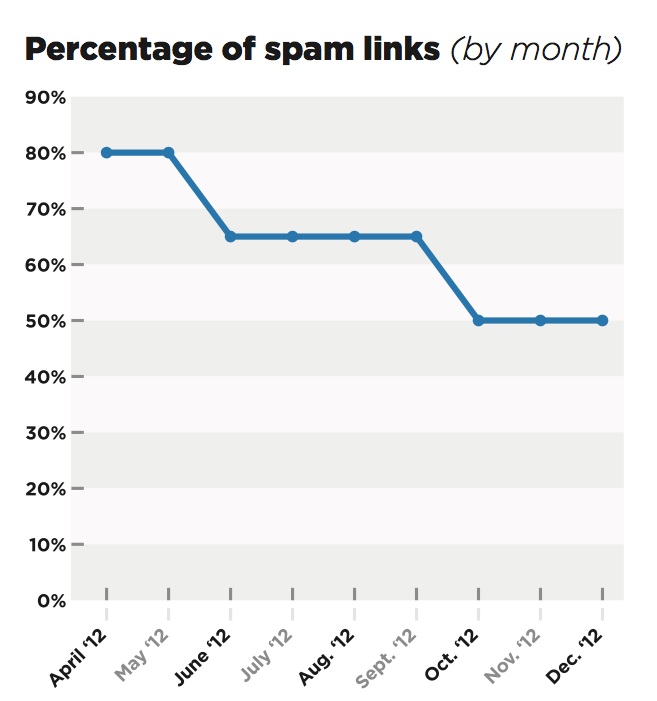
Since the reveal of Penguin, Google appears to have become less tolerant of spammy links. The study looked at 500,000 links which show that Google has been steadily reducing its webspam tolerance, and increasing the likelihood of site penalties over time.

This isn’t an issue for most legitimate site owners, as it takes roughly 50-percent spammy backlinks in your profile to trigger a Penguin site penalty, but when Penguin came out, a site needed to have 80-percent of it’s backlinks classified as spam to attract the attention of Google.

Still, a site with 50-percent spammy links isn’t watching their profile all that carefully, and is probably engaging in some pretty questionable strategies. The concern is where Google will draw the line. Will they keep tightening their grip until only 5-percent of backlinks are allowed to be “spammy”? We won’t have any idea until another Penguin update appears.

AdWords recently introduced a new feature capable of showing your ads to more users, while also delivering a highly targeted audience. It sounds too good to be true, but, as Jeremy Decker reports for Search Engine Journal, the ‘similar audience’ feature makes it a reality.

The new feature picks up where remarketing leaves off. Now, not only will prevous visitors of your site be shown your ads, but also other users who have a similar search history as those users. This means that those who may be interested in your product but have not yet found your site will be shown your message and, hopefully, driven to your site.