Jon Diorio and the Google+ account for Google Ads announced today that a new feature is available in Adwords that will allow you to get a better look at your data. It is a small addition, but many advertisers will find it very useful.
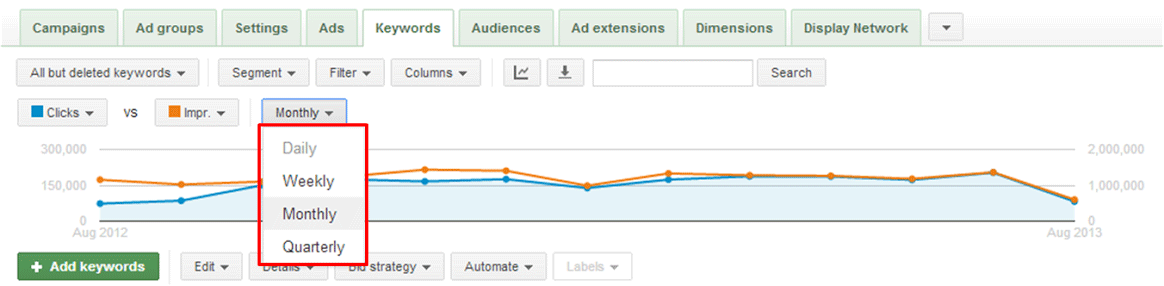
Beginning today, you can control the time aggregation on Adwords charts to show data down to a day-by-day view. You can also view it by week, month, or quarter. This way, you can see the big and small pictures with just a couple clicks, and keep track of the smaller level trends.
The announcement read:
Today, we’re making it easier and faster to get a customized view of how your performance is trending with a new button right above your chart in AdWords that lets you toggle between Daily, Weekly, Monthly, or Quarterly data (shown below). We hope this will save you time and make you more efficient while optimizing your search campaigns.
00TMOhttps://www.tulsamarketingonline.com/wp-content/uploads/2018/07/TMO-Logo.pngTMO2013-08-20 14:29:232013-08-20 14:29:23Google Adds Time Aggregation to AdWords
How fast does your website load on mobile devices? Under five seconds? If you said yes to the second question, you are probably pretty happy with your answer. What about under one second? Probably not. But that is how fast Google says sites should load, according to their newest guidelines for mobile phones.
Before you start freaking out at the suggestion their site is supposed to load in under a second, it should be clear that Google isn’t mandating an insane guideline. They don’t actually expect most websites to completely load that quickly. Instead, they are focusing on the “above the fold” content. They think users should be able to get started playing with your page quickly, while the rest can progressively load.
It is probably a wise insight, considering most mobile users say they are more likely to leave a site the longer it takes to load. On smartphones, every second really counts, and if you can get the above the fold content loaded within a second, most users will be happy to wait for the rest of the content while they start exploring.
“…the whole page doesn’t have to render within this budget, instead, we must deliver and render the above the fold (ATF) content in under one second, which allows the user to begin interacting with the page as soon as possible. Then, while the user is interpreting the first page of contents, the rest of the page can be delivered progressively in the background.”
To match with the new guidelines, Google also updated its PageSpeed Insights Tool to focus more on mobile scoring and suggestions over the desktop scoring. They also updated scoring and ranking criteria to reflect the guideline changes.
00TMOhttps://www.tulsamarketingonline.com/wp-content/uploads/2018/07/TMO-Logo.pngTMO2013-08-15 11:18:102013-08-15 11:18:10Google Updates Mobile Guidelines With Focus On Loading Times
Recently, Google updated the link schemes web page that gives examples of what Google considers to be spammy backlinks. The additions are pretty notable as article marketing or guest posting campaigns with keyword rich anchor text have been included. Advertorials with paid links and links with optimized anchor text in press releases or articles were also added.
With all the new additions, it can be hard to keep up to date with what Google is labeling spammy backlinks or backlink schemes. But, Free-SEO-News’ recent newsletter simply and efficiently lays out the 11 things that Google doesn’t like to see in backlink campaigns.
Paid Links – Buying or selling links that pass PageRank has been frowned upon for a long time. This includes exchanging money for links or posts that contain links, sending ‘free’ products in exchange for favors or links, or direct exchange of services for links. It is pretty simple, buying links in any way will get you in trouble.
Excessive Link Exchanges – While exchanging links with relevant other websites in your industry is absolutely normal for websites, over-using those links or cross-linking to irrelevant topics is a big sign of unnatural linking. Simple common sense will keep you from getting in trouble, just don’t try to trick the system.
Large-Scale Article Marketing or Guest Posting Campaigns – Similar to the last scheme, posting your articles and guest posts on other websites it perfectly normal. However, doing it in bulk or posting the same articles to numerous websites will appear to be blogspam to Google. Also, if you do guest posts just to get keyword rich backlinks, you will see similar penalties. Only publish on other websites when it makes sense and offers value.
Automated Programs or Services to Create Backlinks – There are tons of ads for tools and services that promise hundreds or thousands of backlinks for a low price and very little work. While they may do what they say, Google also easily spots these tools and won’t hesitate to ban a site using them.
Text Ads That Pass PageRank – If you’re running a text ad on another website, you have to make sure to use the rel=nofollow attribute, otherwise it appears to be a manipulative backlink.
Advertorials That Include Links That Pass PageRank – If you pay for an article or ad, always use the rel=nofollow attribute. Simply put, if you paid for an ad or article, it won’t do you any good and can bring a lot of damage if you don’t use the attribute.
Links with Optimized Anchor Text in Articles or Press Releases – Stuffing articles and press releases with optimized anchor text has been a strategy for a long time, but Google has shut it down recently. If your page has a link every four to five words, you’re probably looking at some penalties.
Links From Low Quality Directories or Bookmark Sites – Submitting your site to hundreds of internet directories is an utter waste of time. Most links won’t ever get you a single visitor and won’t help your rankings. Instead, only focus on directories that realistically could get you visitors.
Widely Distributed Links in the Footers of Various Websites – Another older trick that Google has put the squash on was to put tons of keyword rich links to other websites in the footer. These links are always paid links and are an obvious sign of link schemes.
Links Embedded in Widgets – It isn’t uncommon for widget developers to offer free widgets that contain links to other sites. It also isn’t uncommon for these developers to reach out to site owners and offer to advertise through these widgets. However, Google hates these links and considers them a scheme. I’d suggest against it, but if you do advertise through these widgets, use the nofollow attribute.
Forum Comments With Optimized Links in the Post – It is very easy to get a tool that automatically posts to forums and include links to websites. It is a pretty blatant form of spam which won’t get any actual visibility on the forums and the links are more likely to get you banned than draw a single visitor.
There’s a pretty obvious underlying trend in all of these tactics that Google fights. They all attempt to create artificial links, usually in bulk. Google can tell the quality of a link and all of these schemes are easily identifiable. Instead, focus on building legitimate quality links, and use respected tools such as SEOprofiler. It will take longer, but you’re site will do much better.
https://www.tulsamarketingonline.com/wp-content/uploads/2018/07/TMO-Logo.png00TMOhttps://www.tulsamarketingonline.com/wp-content/uploads/2018/07/TMO-Logo.pngTMO2013-08-09 14:24:022013-08-09 14:24:02Breaking Down Link Schemes Google Hates
Google is great for searching for quick and concise information, such as what you might find on Wikipedia or IMDB. If you have a simple question with an objective answer, the biggest search engine is the perfect tool. But, as anyone who has tried to do actual research for academics or work will tell you, Google is not so great with providing lots of in-depth content.
You might find news, or maybe a couple books and articles on Google Scholar, but the main search results on Google can be limiting. You are getting the results for the people with the best short answers for your questions. Now, Google is trying to change that as they recognize roughly 10% of searches and people (their estimate) are looking for more comprehensive information.
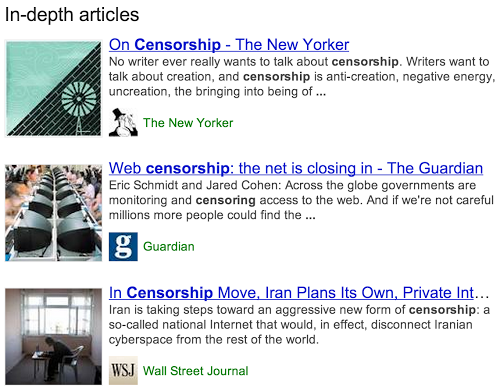
Google has announced that over the next few days they will be rolling out “in-depth articles” within the main search results. Now, when searching for broader topics that warrant more information such as stem cell research or abstract topics such as happiness or love, Google will feature a block of results in the middle of the page like below.
Source: The Official Google Search Blog
This is yet another way Google is forming results intuitively tailored to fit the type of information you are searching for. As a Google spokesperson told Search Engine Land, “Our goal is to surface the best in-depth articles from the entire web. In general, our algorithms are looking for the highest quality in-depth articles, and if that’s on a local newspaper website or a personal blog, we’d like to surface it.”
It has always been a little unclear how Google handles their international market. We know they have engineers across the world, but anyone that has tried to search from outside the US knows the results can seem like what Americans would see five years ago: a few good options mixed with a lot of spam. That’s a little bit of a hyperbole, but Matt Cutts says we can expect to see it continue to get better moving forward.
According to Cutts’ recent Webmaster Help video, Google does fight spam globally using algorithms and manual actions taken by Google employees stationed in over 40 different regions and languages around the world. In addition, they also try to ensure all of their algorithms will work in all languages, rather than just English.
SEO Roundtable points out you could see the international attention to Google’s algorithms when Penguin originally rolled out. At first it was only affecting English queries, but was released for other languages quickly after. With Penguin’s release however, all countries saw the release on the same day.
Matt Cutts did concede that English language queries in Google do receive more attention, which has always been fairly obvious and understandable. There are far more searchers there and that is the native language of the majority of engineers working for the company.
https://www.tulsamarketingonline.com/wp-content/uploads/2018/07/TMO-Logo.png00TMOhttps://www.tulsamarketingonline.com/wp-content/uploads/2018/07/TMO-Logo.pngTMO2013-08-06 12:05:442013-08-06 12:05:44Google Focuses on English Queries, But Fights Spam Globally
By now, the hacker craze of the 90’s and early 2000’s has died down quite a bit. Most people don’t worry about hackers all that much, so long as you use some solid anti-virus and keep your router protected. Big businesses may have to worry about Anonymous’ hi jinks, but the common person don’t tend to concern themselves with the issue. Hacking especially doesn’t seem like that big of an issue for SEO, at first.
But, hackers can actually do your site some damage, and can even get your site entirely dropped from the Google search index. Sites get blacklisted when hackers inject malicious code onto servers, as Google seeks to protects searchers’ computers from any sort of compromising.
While Google doesn’t immediately drop sites from their index, being blacklisted leads to a complete drop in organic traffic and can be a crisis for SEO. Blacklisting starts as a warning to searchers that a site may be compromised, and few will continue past that alarm.
This has become a rather significant problem for Google. To help provide wide support for the increasing number of webmasters dealing with compromised servers, Google has launched the ‘Webmasters Help for Hacked Sites‘ support center. They give detailed information on how to clean and repair your server and prevent your site from getting entirely dropped from the Google index.
If you think this sort of hacking isn’t a big deal, check out the charts below. They show just how frequent this type of malicious activity has become. It isn’t just banks and large corporations dealing with it. Small businesses are just as at risk as international franchises. The most common form of attack is an automated set of processes that indiscriminately discover and exploit vulnerabilities on servers, which are often left completely unprotected.
Search Engine Journal recently explored the issue more in depth, unpacking why the issue is such a large concern to Google and webmasters alike. Compromised sites can destroy a search engine’s credibility just as your own, so the problem has to be taken very seriously.
https://www.tulsamarketingonline.com/wp-content/uploads/2018/07/TMO-Logo.png00TMOhttps://www.tulsamarketingonline.com/wp-content/uploads/2018/07/TMO-Logo.pngTMO2013-08-05 11:14:082013-08-05 11:14:08Can Hacking Get You Blacklisted by Google?
Everyone working in SEO knows that Google has a multitude of factors they use to determine the order of search engine results, and the majority of these ranking factors are based on either the content of the webpage or signs of authenticity or reputability. That was the case for the longest time, but since 2010, Google has made significant shifts towards a focus on usability, and the harbinger of this change was the inclusion of website speed to ranking factors.
The problem is, website speed and other usability issues aren’t exactly objectively defined. What exactly is a slow loading site? What is the cutoff? No one has gotten a definitive answer from Google, but in June Matt Cutts explicitly stated that slow loading sites, especially on mobile platforms will begin seeing search rank penalties soon.
Obviously these changes are good for searchers. Searchers want sites that load quickly, offer quality user experience, and deliver great content. And, the emphasis on speed is certainly highlighted on mobile platforms where on-the-go users are likely to go back to the results if the site takes too long for their liking. The issue we face as search optimization professionals is trying to figure out exactly what Google is measuring and how that information is being used.
Matt Peters from Moz decided to break through Google’s intentionally vague information to figure out exactly how site speed affects rankings with the help of Zoompf. They can’t explicitly disprove causation between site speed and rankings, due to the number of other algorithmic ranking factors that complicate the study. But, their results did show very little to no correlation between page load time and ranking.
I wouldn’t take this information as gospel, but it does suggest that loading time isn’t a huge consideration into long tail searches and doesn’t need to be worried about too much. If your site is loading quickly enough to please the people coming to it, your site will also likely pass Google’s expectations.
00TMOhttps://www.tulsamarketingonline.com/wp-content/uploads/2018/07/TMO-Logo.pngTMO2013-08-01 11:13:562013-08-01 11:13:56How Does Site Speed Really Affect Search Rankings?
Internet security and privacy has been at the forefront of many people’s minds with the recent headlines about the NSA keeping data on the public’s online activity, and the issue has had subtle affects on search engines. We’ve seen a small group of searchers migrating to search engines with stricter privacy policies. Of course, those who are truly outraged by the NSA news would expect to see a pretty large shift, but so far the change has been slow. But, it is picking up momentum.
More and more people are learning about how Google actually decides which results to show you, as an individual, and many are a little concerned. While Google sees the decision to collect data on users as an attempt to individually tailor results, a few raise their eyebrows at the idea that a search engine and huge corporation is keeping fairly detailed tabs on the internet activities of users. The internet comes with an assumption that our activity is at least fairly private, though that notion is getting chipped away at daily. But, there is still the widespread assumption that our e-mails or simple search habits are our business alone, an assumption that is also being proved wrong.
These privacy issues have a fair number of people looking for search engines that keep our searches completely anonymous and don’t run data collection processes. The most notable solution people seem to be moving to is DuckDuckGo.com, a search engine whose privacy policy claims will not retain any personal information or share that information with other sites. The search engine has been seeing a traffic rise by close to 2 million searches per day since the NSA scandal broke.
There are numerous debates surrounding these issues. Political discourse focuses on the legality and ethical aspects of the government and large corporations working together to collect information on every citizen of the United States (other companies included in the NSA story include Yahoo, Facebook, and Microsoft). But, as SEO professionals, the bigger question is the ethical and practical reality of individually tailored results which rely entirely on data collection.
If you’ve ever taken a look at the ads on the edges of websites, you’ve probably noticed that the ads are loosely based on your personal information. The ads reflect your gender, age, location, and sometimes loose search histories. The ads you are shown are chosen based on information your computer relays to almost every site you access. Google acts the same way, but they collect this data and combine it extended data of your search history to deliver search results they believe are more relevant to you.
There is a practicality to this. We all have fine tuned personal tastes, and innately we desire for search engines to show us exactly what we want with the first search result, every time. While poll responses say that the majority of people don’t want personalized search results, are online actions belie our true desires for efficient search. The best way to do this is to gather data and use the data to fine-tune results. On a broad scale, we don’t want results for a grocery store in Los Angeles when we are physically situated in Oklahoma. On a smaller scale, we don’t want Google showing us sites we never go to when our favorite resource for a topic is a few results down the page.
In this respect, the move towards search engines like DuckDuckGo is actually a step back. These privacy-focused search engines are essentially acting how Google used to. They use no personal information, and simply try to show the best results for a specific search. It is a trade of privacy for functionality, and this could possibly explain the slow uptake or migration to these types of search engines. But, people are moving.
The longer the NSA story stays in the news, the more searches DuckDuckGo receives, and this could potentially have a significant affect on the search market in the future. The question is, do we want to sacrifice personal privacy and assumed online anonymity for searches that match our lives? Andrew Lazaunikas recently wrote an article on the debate for Search Engine Journal. He admits DuckDuckGo delivers excellent, unbiased results, but in the end, “when I want to know the best pizza place or car dealer in my area, the local results that Google and Bing shows are superior.”
Lazaunikas isn’t deterred by the aspect, and notes, “I can still get the information I need from DuckDuckGo by modifying my search.” He ends his statement by vowing to use DuckDuckGo more in the future, but the question is whether the public at large will follow. For the moment, it seems as though most people prefer quick easy searches and familiarity to trying out these new search engines.
00TMOhttps://www.tulsamarketingonline.com/wp-content/uploads/2018/07/TMO-Logo.pngTMO2013-07-31 11:41:292013-07-31 11:41:29Will You Alter Your Searches After The Internet Privacy Scandal?
After two fairly explicit warnings about advertorials this year, Google has added advertorials to their webmaster guidelines, as well as other popular spammy linking techniques in the Link Schemes help document.
Google Continues To Downplay Links
The biggest change is the removal of the entire first paragraph from the help article, which addressed how incoming links influence rankings. Search Engine Journal says the removed paragraph read:
Your site’s ranking in Google search results is partly based on analysis of those sites that link to you. The quantity, quality, and relevance of links influences your ranking. The sites that link to you can provide context about the subject matter of your site, and can indicate its quality and popularity.
Links have been steadily falling out of favor throughout the past few years, and it appears we are finally reaching a tipping point for Google’s reduction of linking’s role in search algorithms. Or, as Google has been advising, high-quality sites matter much more than links of any quality.
Keyword-Rich/Optimized Anchor Text Links
Google also tackled heavily-optimized anchor text used in press releases that are usually distributed across other sites. The technique has enjoyed a quick rise in highly competitive markets, and Google appears to finally be putting the squash on the practice. They did note that guest posting is still a popular practice, which can be valuable when done correctly. However, sites that accept guest blogging have been using nofollow or an optimized URL link to avoid issues.
Advertorials
And of course, the final change is the addition of advertorials as an example of unnatural links that violate Google guidelines.
Advertorials or native advertising where payment is received for articles that include links that pass PageRank.
Google has been making swift changes to linking policy and practice, so it is highly likely changes like this will keep occurring. Links can still be a strong weapon in your SEO strategy, but you have to tread carefully, and they maybe shouldn’t be your highest priority when optimizing.
https://www.tulsamarketingonline.com/wp-content/uploads/2018/07/TMO-Logo.png00TMOhttps://www.tulsamarketingonline.com/wp-content/uploads/2018/07/TMO-Logo.pngTMO2013-07-30 13:39:112013-07-30 13:39:11Google Makes Changes To Their Link Schemes Help Document
Google has begun the process of pushing over the last few stragglers to Adwords Enhanced, and to reflect the big changes taking place, they’ve also been updating just about everything related to AdWords. Over the past week, they’ve redesigned the AdWords Help Center, as well as making some changes to how AdWords quality scores are reported.
AdWords Help Center Redesign
The AdWords Help Center has always been an important resource for both new and old PPC campaign managers. Just as Google offers best practices for SEO, the help center for AdWords helps break down exactly how managing ads works and the best suggestions for those just getting started. The new redesign came with three major updates aimed to improve how the help center works and update the information contained within.
Improved Navigation – To start out, Google has made the site much easier to get around, making the information more readily available. From the main navigation, you can now find portals to information on setting up and basic AdWords info, managing ads, community resources, and guides to success.
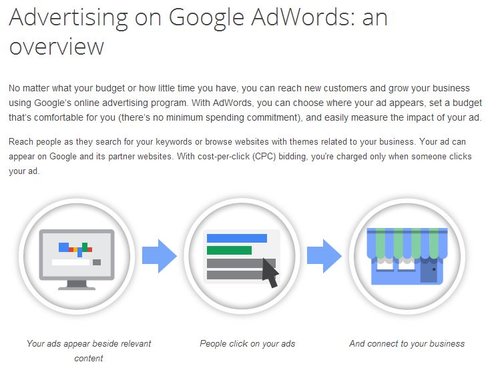
More Visual Help – Google has openly said they will be making the Help Center more visual by filling it with infographics and screenshots. But, the Search Engine Journal report on the update found very little visual additions from the update. It is possible these additions are taking longer to implement, or that they have stepped away from this addition, but there are some new graphics to help explain AdWords, such as the one above.
Guides to Success – Google has added a collection of instructional guides and tips to help get greener PPC managers started with their AdWords campaigns, but the information can also provide a helpful refresher for AdWords veterans who might not have checked up on Google’s latest suggestions.
Quality Score Reporting Revisions
The more functional change Google has made is an update to how the AdWords quality scores are reported within accounts. The company says these changes are aimed at making it easier for advertisers to adjust and revise any ads based on quality score, and to make it easier for users to gain more information on what is and isn’t working.
As part of our ongoing efforts to help improve the quality of our ads, we’re announcing an update that changes how each keyword’s 1-10 numeric Quality Score is reported in AdWords. Under the hood, this reporting update will tie your 1-10 numeric Quality Score more closely to its three key sub factors — expected clickthrough rate, ad relevance, and landing page experience. We expect this update to reach all advertisers globally within the next several days.
We’re making this change so that the Quality Score in your reports more closely reflects the factors that influence the visibility and expected performance of your ads. We hope that providing you more transparency into your 1-10 Quality Score will help you improve the quality of your ads.
The way Google is calculating quality scores hasn’t changed at all, so there isn’t a great need to suddenly change how you’re running your campaigns, but they are simply changing the way these scores are reported to us and expanding on the information available.
However, advertisers using quality scores as part of automated rules will need to change or correct how the rules are interfacing with the new display methods.
00TMOhttps://www.tulsamarketingonline.com/wp-content/uploads/2018/07/TMO-Logo.pngTMO2013-07-29 14:03:432020-08-08 22:24:13Google Makes Changes To AdWords Help Center and Quality Score Reports