Google AdWords allows you to automate a great deal of your campaign management. One particularly helpful aspect to automate is keyword bidding. Joel Chudleigh has a great rundown at Business2Community of how to set rules in AdWords to ideally bid for and pause keywords, but I’ll give you a quick summary.

When setting your rules, simply consider what an optimal keyword performance for your campaign is. A keyword that gains clicks but no conversions would likely need to be paused, so set a rule that does so after a certain number of clicks without conversions.

What’s an acceptable average cost per conversion? Set up a rule that bids up any keyword that exceeds that average. You can also bid down keywords that are out of your price range and in less than optimal position.

I think the key here is to put some real thought into setting your rules and make sure to keep checking on the campaign’s progress, even after automation.
Though it isn’t a groundbreaking update, Facebook has made their ad tool a little more seamless by allowing users to create a new post without leaving the ad center.

This isn’t a development that will improve your ad performance or get you a bigger audience, but it might make your life just a little easier. Head over to Inside Facebook for Brittany Darwell’s article on the details.

There’s been an interesting development with Google’s AdWords Express, which is marketed as a headache-free alternative for small businesses. Recently, Google announced that you could use the ads Google sets up for you with your budget in AdWords Express to drive users to your Google+ page. However, Google+ itself is an ad-free zone and you are unable to even set parameters so only Google+ users will be shown the ads.

For small businesses with no website, this could still be a valuable tool to create some sort of web presence. Google had been offering AdWords Express users with no site of their own the ability to create a free site, but with the included option of using a company’s Google+ page, that may be a thing of the past.

However, there are also some obvious glitches in this AdWords Express, Google+ relationship. For one, Google is essentially allocating your AdWords budget to promote Google+. Read more about the sketchy side of this deal in Greg Finn’s article at Marketing Land.

Regardless of you company’s current social media standing, you could probably benefit from the advice of a consultant. NBC Chicago recently published some free advice from a Chicago-based social media expert, Tim Schraeder.

Be sure to read through the article to get advice on how to create conversations with your audience, how to make the most of each post and how to measure success.

Recently, I wrote about the dangers of trusting the wrong, essentially superficial, metrics when diagnosing your social media strategy. Today, let’s talk specifically about the great battle of social media vs. email marketing.

Errol Apostolopoulos reports for BostInno that “unique impressions delivered via Facebook’s sponsored posts average out to be 18x more cost-effective than those delivered via traditional email acquisition methods.” When you add in that you can use standard posts to reach a wider, if less concentrated, audience, Facebook, and other social media sites, really set themselves apart. 

Does this mean you should completely forsake your old pal email marketing? Heck no. It still has an important role to play. Pairing email and social media can lower your cost per acquisition on both platforms. 

INFOGRAPHIC

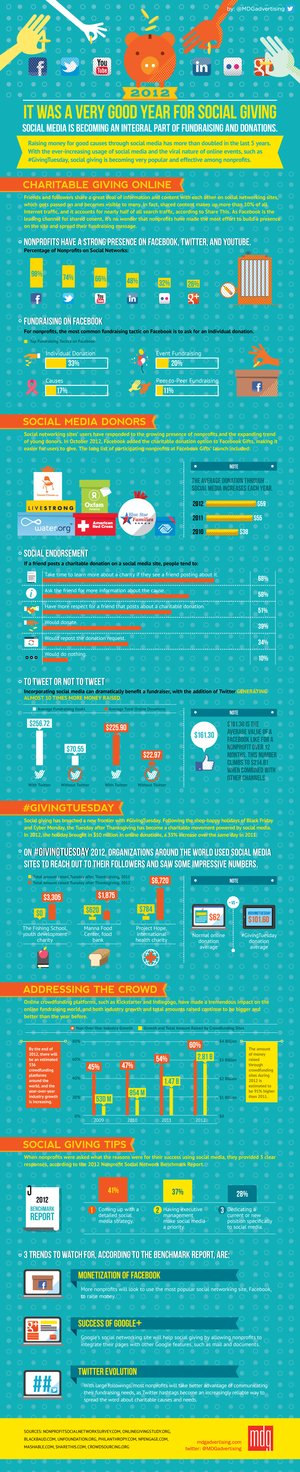
In 2012, even nonprofits were utilizing social media. MDG Advertising looked into this developing trend and found that the inclusion of social media marketing meant more exposure and more donations for these organizations, as reported by The Huffington Post.

The innovation of ‘Giving Tuesday’, which grew over social media, is a glowing example of what is possible when online marketing is utilized properly. The model used by nonprofits is not revolutionary. Rather, it is simply a testament to why putting the time and effort into social media marketing is necessary.

While you browse the included infographic, think about how you can increase your conversions through a better social media strategy.

As with any business, you not only need to keep up with current trends and updates in online marketing, but you also need to be looking ahead to attempt to predict some of the changes ahead.

To help with this task, Business2Community presents their predictions for the 2013 landscape of social media and search engine marketing. If you’ve stayed current with the trends of the past year, there aren’t any big surprises here. But, it’s nice to see a succinct list of things to keep an eye out for in the coming year.

If you’re like me, you do as much of your holiday shopping online as possible. Juding by statistics, there are plenty of people out there like me. Google searches for retail products jump up as much as 500-percent during December.

Conversely, the service industry sees a major dip in activity through the holidays. Obviously, December is a different landscape than the other 11-months and what was previously working for your business may need to be tweaked for the holidays.

Jeremy Decker, of Search Engine Journal, has some suggestions to make the most of this changing terrain. By pulling the right strings, you can have a very, merry holiday season.

The reality of online marketing is that advertisers must find a way to reach users on a variety of different devices. AdWords recently made that difficult task a little easier with a new tool that allows you to convert ads using Flash to HTML5.

Since many tablets do not support Flash, this tool could help your business reach thousands of additional users. And converting takes just a couple of mouse clicks, no expert knowledge is needed.

To find out more, check out Chris Crum’s article at Web Pro News.

It’s easy to get caught taking metrics at face value and not really interpreting what they mean. Benny Blum, for Search Engine Land, makes a valuable point about how time affects how you value your channels’ performances. You have to be wary of making changes too soon and effectively destroying what would have eventually been a great platform.

Obviously, there are difficult choices to make about where to allocate your ad budget across options like PPC, email, social media and organic search. However, if you looking at your click and conversion rates over an optimal amount of time, you might be overreacting to perceived underperformance.