
Tag Archive for: News

Color Wheel


Have you ever seen the old “optical illusion” that makes one color appear to be two entirely different colors? If you’ll excuse the MS Paint quality image (is there a rule that all optical illusions have to have been designed before 1997?) the one below makes two spirals appear to be blue and green, when the stripes making the spirals are actually the same color. Its the same principle at play as when you look at a color in a design and it just doesn’t seem to work right. When placed next to specific hues, certain colors can take on the visual characteristics of their neighboring color. Making this even more tricky, the human eye perceives color in different ways depending on if it is in the background or foreground.

Optical Illusion


The specific colors that can take on other characteristics are referred to as recessive colors, while those who always look the same are called dominant colors. Many pure colors such as cyan maintain their hue even when mixed or paired with other colors. No matter what color is mixed with a dominant color, the original color will still remain at least partially visible.

Dominant colors also tend to “push through” the design, or powerfully assert themselves within the composition. While recessive colors easily fade into the background, it is hard to make a dominant color sit far in the background. Pure hues are naturally dominant, though primary colors are more dominant than the others, because red, blue, and yellow literally can’t be created by mixing other colors.

Recessive colors, on the other hand, naturally fade into the background. They also easily take on the properties of any surrounding color. Recessive colors act as a neutral in a palette which help the more dominant colors maintain their emphasis and focal attention. As Carrie Cousins puts it, “recessive colors are the blurry or muted tones behind the focal point of an image or the pattern that appears behind something you’re supposed to be looking at.”

Cousins explored the relationships between dominant and recessive colors exhaustively at Design Shack. Not only does she delve into the scientific basis for why we perceive these colors the way we do, she also explains how these ideas can be adapted to design of all kinds, including web design.
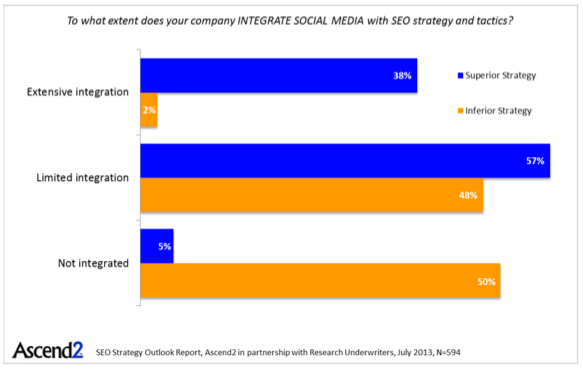

What makes one SEO company successful and another fail? There could be a multitude of factors, but according to a recent study by Ascend2, chances are social integration is the key. Successful SEO companies integrate social media into their SEO plans and strategies far more than companies who report they are struggling.

Ascend2, a popular research agency, surveyed nearly 600 businesses and marketing professionals from around the world and asked the participants to rate their own companies’ SEO success. The survey then compared the answers from the 15 percent who rated their companies as “very successful” with SEO and the 18 percent who reported being “not successful.” This creates a relatively small sample size, but the findings are still interesting, and as Matt McGee from Search Engine Land suggests, would appear to hold up to larger samples.

By far the biggest difference between the companies is their use of social media within their SEO strategy. Their charts show that 38 percent of those reporting “very successful” with SEO are doing extensive social integration, while only two percent of the “not successful” companies say they are. On top of that, a full 50 percent of the “not successful” companies report doing no social media integration at all. Frighteningly, when looking at the results of all those surveyed, almost a quarter of the companies said they were not integrating social media into their SEO strategies.

Ascend2 Chart

The full report is available for free, though you do have to give your contact information. You would think at this point most SEO professionals would be aware of how important social media is to your SEO strategies. These results however show just how many companies are working with strategies that are behind the times and dragging their companies down.

Wednesday, Google, Gmail, YouTube, and all the other similar services went unresponsive for roughly an hour in many parts of the United States. The problem was quickly resolved, but not before Twitter freaked out and the story reached many news outlets.

Now, Google’s head of Webspam used his Webmaster Chat to answer the big question that site owners who have gone through similar experiences have often wondered. If your site goes down temporarily, does it affect your rankings?

According to Cutts, having a site go offline shouldn’t negatively impact your rankings, so long as you fix the problem quickly. Obviously, Google wants to be directing searchers to sites that are working, so if a site has been offline for days, it makes sense for Google to replace it with a working relevant site. But, Google isn’t so quick to cut out an offline site.

Once Google notices your site is offline, they will attempt to notify those registered with Google Webmaster Tools that their site is unreachable. The messages generally say something along the lines of GoogleBot not being able to access the site.

Then, roughly 24 hours after Google has noticed your site isn’t working, they will come back to check the status of your site. This means that sites can be offline for roughly a full day or more before you can expect any negative affects from the search engines. However, if you’re site has been down for 48 hours or more, chances are Google is going to delist the site, at least temporarily.

Search Engine Land pointed out that there are also other tools available to monitor sites for you and alert webmasters if their site becomes unavailable. They suggest the free service Pingdom, though there are also plenty others to choose from.

Minimalism has been all the rage in web design lately. Flat design is currently one of the most popular design trends around, and it relies strongly on minimalist design principles. If done correctly, minimalism can achieve an experience that will stick in the minds of visitors for some time while doing away with all the sound and fury normally associated with the web.

Obviously, minimalist design techniques require sites that can be parsed down to just a few pages of information, but that has the added benefits of making your site automatically more friendly for mobile loading speeds and making your site easier to read. It can also cut your maintenance time down to a fraction of what is necessary for other larger sites. But, if you have a site that aims to comprehensively cover a topic or multiple topics, minimalism might not be right for your site.

One of the best aspects of great minimalist websites, and one of the biggest reasons flat design is taking off, is that every good minimalist site is built on a unique wireframe and a quality gridding system. When done right, that means your site will be easily made responsive, making the move to a mobile friendly site even easier than ever before.

Flat design is already beginning to branch out and apply more depth to sites that retain their minimalist principles, so it makes sense to get to know the ideas behind the broader style of design being co-opted for the new mobile-friendly internet. Mohammed Shakeri took the task of exploring how minimalism functions, some of its history (including Ludwig Mies van der Rohe’s famous “less is more”), and he even helps explain how to begin the transition to a minimalist website.

If you’ve been considering hopping on the latest trend to streamline sites, but haven’t been able to figure out what all the fuss is about, it’s never to late to find out. Or, as Frank Rossitano sings, “It’s never too late for now.”

Bing LogoWhen companies take the leap to establishing their brand’s reputation online, the focus is always on taking advantage of every opportunity Google gives you to try to connect with potential consumers.

However, any SEO or online business who is only paying attention to Google isn’t completely controlling their online reputation. Online reputation management requires understanding a complex ecosystem of sites where users are able to connect with your brand, and those include other search engines, social media, local search platforms such as Yelp, and business accreditation sites like those for the Better Business Bureau.

Of course, taking control of the first page of Google is the best first step for a company hoping to take the reigns on their online brand, but it isn’t the only step. Google controls roughly two thirds of all search traffic, but that also means you’re missing out on a third of all of the marketplace.

The second most popular search engine is Bing, and they’ve been making notable gains lately, rising to 17.4 percent of the market share from 13 percent last year. Microsoft has been marketing Bing rather strongly and it is clear the search engine will only keep gaining ground for the near future. Once you’ve taken control of the first page of Google, George Fischer suggests trying to capitalize on the often forgotten market of Bing, and he explains how you can do so in his article for Search Engine Watch.

Image Courtesy of Martin Pettitt

Image Courtesy of Martin Pettitt

It has been well over a month since Penguin 2.0 was unleashed upon the world and the search industry is still reeling from the results of the algorithm update aimed at link profiles, low quality backlinks, and over-optimized anchor texts.

The average estimate says that Penguin 2.0 affected over 2-percent of all English queries. That doesn’t sound like much, but when SEO Roundtable took a poll in late May over half their readers say they had been hit by the changes.

First, it should be said that some portion of those may have been affected by a separate algorithm update released shortly before the new version of Penguin, but that update was aimed at typically spammy sectors like payday loans and pornography.

The majority of those saying they were affected by Penguin however were most likely correct about their recent drop in rankings or loss of traffic. It is either that, or far too many involved were misreading their data or somehow unaware that their payday loan site might be targeted by Google. Let’s assume that’s not the case, because that option sounds highly unlikely.

But, time has passed since Penguin came out. I’ve seen at least 10 articles detailing how to recover from Penguin, and numerous others focused on all the areas Penguin targeted. We should all be getting back to normal, right?

According to the recent poll from SEO Roundtable on the topic, that is not the case. Over 60 percent of those responding have said they haven’t recovered from the algorithm update, with only 7.5-percent saying they have fully recovered.

What does this mean? Well the respondents are clearly SEO informed people who keep up to date with the latest blogs, since they responded to one of the more reputable sites available on the issue. One major issue is that full recovery from Penguin isn’t possible for many of those affected until the next refresh. It is hard to know when that refresh could happen, though it may not be until the next update is announced.

The other issue is simply that those articles telling SEOs how to recover from Penguin range from completely valid to “how to try to cheat the new system” which can be confusing for inexperienced or uninformed SEOs. The best suggestion for solving this problem is playing close attention to what sites you are reading and always take the more conservative advice.

Graphic design may be one of the most in demand jobs out there right now, especially within the art field. But, as any designer can tell you, competition for work is tough, and designers looking for full-time employment rather than freelance work have bad odd working against them. Employers are looking for designers for diverse projects that can vary wildly depending on who hires you, but they expect you to have just as versatile skills to cover anything they will ask of you.

With such a tough marketplace, it is obviously very important for designers to have a great CV or resume that will make employers want to hire you. That doesn’t mean they want it to be over-styled and decorated. Employers obviously want professional looking resumes that gives them the impression you are equally professional and business-minded. What makes the real difference to prospective designer employers is the skills you have. The jobs may vary wildly, but almost all design jobs require the same 10 skills or proficiencies.

Amy Edwards took the time to go through over 100 design jobs advertised on Bubble to see exactly what employers are looking for, and the results were even more homogeneous than you would expect. Needless to say, those Photoshop and Illustrator skills should be maintained, and you should be get getting experience in all the other programs and design techniques coming out are also hugely important in climbing the career ladder.

Ranking PodiumA WebmasterWorld thread from roughly a month ago brings up an interesting question for us SEO professionals. While we focus on the algorithms we know about such as Penguin or Panda, it has long been suggested that Google could also be using different ranking factors depending on the industry a site fits within. In other words, sites for roofing companies would be being reviewed and ranked according to different standards than sites for tech companies.

Well, Matt Cutts, the head of Google’s Webspam team and trusted engineer, took to that thread to dispel all the rumors. He doesn’t deny that Google has “looked at topic-specific ranking.” Instead, he says scaling was the issue. In his answer, Cutts explains, “We have looked at topic-specific ranking. The problem is it’s not scalable. There’s a limited amount of that stuff going on — you might have a very spammy area, where you say, do some different scoring.”

He continued, “What we’re doing better is figuring out who the authorities are in a given category, like health. If we can figure that out, those sites can rank higher.”

While Google says they aren’t using different algorithms for different industries, it has been announced that Google uses Subject Specific Authority Ranking, which helps authorities in varying topics to be selected as the most reputable on that subject.

Of course, looking at the comments from SEO Roundtable, who reported on the WebmasterWorld thread, it is clear many don’t necessarily believe Cutts’ statement. Some say they have “always seen a difference in industry types,” while others argue that different industries necessitate using different ranking factors or algorithms due to lack of specific resources available to that industry. For example, industrial companies don’t tend to run blogs, which means creating new content through blogging shouldn’t be as honored as it is on other topics like health and tech with a lot of news constantly coming out.

For now, all we have to go on is Cutts’ word and our own experiences. Do you think Google is using different algorithms depending on industry? Do you think they should be?

Color is one of the most important aspects of graphic design as well as branding and advertising. It can be used to give emphasis, depth, and even motion to a design but it also helps establish the overall feel or atmosphere of the design.

As designers, we do more than just create nice looking compositions. We also connect and communicate to others through images, text, sites, sound, and yes, color. Color is one of the strongest tools we have as a designer, because color decides a large amount of how a viewer perceives a design. It can set off emotional or visual cues, or it can be used simply to pull viewers in.

One of the most important parts of learning how to use color in your designs is learning the understandings and meanings of different colors. They don’t just set the mood, but colors can actually mean quite a lot about companies, sites, and even people. You The Designer recently created the infographic seen below which details “The Psychology of Color” for designers and they lead into it with an insight about color from American stage director Vincent Minnelli who once said, “I use colors to bring fine points of story and character.”

We don’t tend to work much with characters as graphic designers, but in some ways we do tell stories through our sites. Our clients want their websites to represent their company or brand as a whole, including its history and reputability. We weave these stories through our websites through imagery that supports the brand story they want to tell. Color plays a big role in this through making connections to preconceptions we already have. If you’ve ever seen a green logo for a health food store, or a red fast food sign, you’ve already seen the principle in action.

AColorGuideForDesigners_51087f68f22e5_w587


As always, there are a lot of different opinions about link building across the web. There are still those who offer ways to “dominate” links with schemes that push the boundaries of what Google allows and some who are beginning to completely write off link building as a practice.

It is a bit hasty to completely do away with your linking efforts, as they are certainly still a consideration by the search engines. But, we also live in an entirely different linking climate than that of just a couple years (or months) ago. Moderation and quality are the key words in the link building discussion these days, and it is important to know when someone is giving bad advice.

If only you explicitly knew what link building tactics you should just not do, right? Erin Everhart from Search Engine Land offers just that with her article from last week laying out exactly what linking techniques we can just cut out of our routines, and how to pinpoint when people are trying to give you bad advice.

Of course, it all starts with discussing that special word “quality,” which is now the most important factor in all your link building efforts. Google no longer cares if you have countless links to your site, if none of them are reputable. Actually, they do care. They will penalize your site for trying to use bad links to boost your profile. Natural, quality links from sites people actually read are the only way to get positive results from your link building, and anything else is just as likely to hurt you.

In the vein of quality over quantity, mass article submission is almost as bad as farming huge numbers of shoddy links. Its the obvious successor to the new “content is king” mantra everyone is espousing now, as those who were directly gaining scores of low quality links turned to submitting the same weak article to hundreds of different sites.

Of course, there are other link problems aside from link farming in various manners. Though it has become less popular after Penguin, there are still backlink profiles out there with higher exact-match anchor text percentages than their company name. Anchor text is still very important, but there is no reasonable scenario in which you should end up with that high of a percentage. You need way fewer exact-match links than you did a couple years ago, so just follow the rule of moderation.

Guest blogging is even becoming a problem. There are so many sites hiring “article writers” who churn out 10 to 15 articles a day that the tactic has become yet another link building scheme. Instead of outright buying links, they are buying writers to build them cheap links. Guest blogging can be great when done correctly, but you have to take the time to ensure they know a lot about the industry they represent and will provide value to your site.

There are even more link building tactics still happening right now despite Google’s best efforts to shut down the more spammy efforts. Everhart covers a few more in her article, but the main point is that any good-natured SEO tactic can be corrupted and used to try to trick the search engines, the problem is Google and Bing have gotten much smarter, and they will almost always catch you if you try to outwit them. Play be the rules, and give your sites the attention they need, but don’t try to play the system.