
Tag Archive for: Google

There is more than enough talk out there about negative SEO, and how to prevent it or fight back against it, but Matt Cutts says the actual number of occurrences of people trying to use negative SEO is extremely low. He explains that Google designs their algorithms to try to ensure that they can avoid penalizing innocent sites and now that Google has added the Disavow Links tool to their repertoire, it is very easy to shut down “black hat” SEO if it does happen to you.

Cutts, the head of the Google Webspam team took to YouTube to answer the huge number of questions he has received about negative SEO, and also further explain the Disavow Links tool, clearing up any misconceptions there could be. Cutts doesn’t think negative SEO should be a concern for the vast amount of website owners out there, unless you are in extremely competitive spheres. “There’s a lot of people who talk about negative SEO, but very few people who actually try it, and fewer still who actually succeed,” he said.

The amount of talk about SEO coming from blogs and experts help make SEO one of the more discussed aspects of the internet behind the scenes. You won’t see search engine optimization coming up on the news, but just one search can lead to dozens of resources filled with writers offering their opinions and ideas.

In many ways, this is great because it keeps the community up to date with continuous changes, and delivers a wealth of free knowledge to anyone trying to get involved. However, it also creates an echo chamber where misconceptions run rampant, and there is always a need to clear up the bad information out there.

This time around, it was Eric Ward over at Search Engine Land who took it upon himself to dispel the rumors and lies surrounding linking. Links are a hugely important part of SEO, and many don’t understand exactly how they are used and evaluated. Add to this the never-ending changes to search rank signals, and bad ideas grow into monsters.

Many of these bad ideas come in the form of absolute statements, such as “anchor text will stop being used as a ranking signal altogether” in the next year. Google has done work to spot people misusing anchor texts, especially those attached to purchased links that say anything you want. But, as with most Google changes, they haven’t disavowed the practice altogether, they have only tried to punish those who take advantage and misuse the practice.

As Ward puts it, “Are you really going to tell me that if the Library Of Congress site links to Consumer Reports magazine’s site using the words “Consumer Product Reviews” that this would be a useless signal? No way.”

Another preposterous statement is that linking will no longer be the most important ranking signal, dethroned by social media signals. This concept ignores the number of Google searches done without being signed in, and not only that, Google uses tons of signals, and social media is one of them. But, relying on one user generated signal to return results to that one user doesn’t make any sense, when Google considers tons of signals as of now to return results.

The reason social signals will never be the primary signal for search engines is, quite simply, people like to do some things anonymously. They don’t want questions about body hygiene, marital issues, or personal problems being associated with their Facebook.

While linking may not be the clear-cut MVP it once was for SERPs, claiming that it is going away altogether doesn’t make any sense. It is this type of misinformation that leads to confused clients and well-intentioned but misinformed bloggers spreading the information far and wide.

Less than a year ago, Google unleashed an update called the “webspam algorithm” that seemed innocuous at first, until experts began to notice how widespread its effects were. The impact of the update was so large, Google eventually gave it an official name more in line with their other update, Panda. The “webspam algorithm” became Penguin.

The original name for the update was an accurate description for what this update did. It was aimed to demote sites violating the Webmaster Guidelines for Google, specifically sites full of webspam. These sites used manipulation to improve their rankings in the search engines, but some innocent sites were affected, and more have been affected by each subsequent update to Penguin.

These “black hat” methods such as keyword stuffing, cloaking, participating in link schemes, and purposefully using duplicate content had been around on the internet since SEO has existed (pretty much as long as the internet has been widely used), and Penguin sought to finally deal with the spammers, but with it a new set of rules for SEO were created.

Pratik Dholakiya has collected these rules into “The Definitive Guide To Penguin Friendly SEO” which explains which methods have been shunned and what new techniques are favorable for SEOs.

If you were actively using black hat techniques, you won’t find new ones to continue spamming in a different way, but for any SEO looking to legitimately improve their search performance with good content and practices, this list will help steer readers away from any bad methods.

Receiving an email from Google saying that they have noticed unnatural links associated with your website is never a good thing. The best outcome still involves losing organic search traffic from Google for at least some time, plus the email means you have work to do really quickly.

Search Engine Watch writer Chuck Price has seen webmasters respond to manual penalties and many of them actually make their problems worse, especially when they panic. Webmasters who panic when they receive a manual penalty website tend to fly into manic states running around doing the first thing they can think of to try to get the penalty fixed; thoughts like filing reconsideration requests before actually fixing the problem.

If you’ve received an email about unnatural links or manual penalties, take a minute to breath. There is no reason to panic. You have to do some work to identify the issues and fix your site’s linking problems, but panicking isn’t going to get that done any faster, and might blow your one chance to get your links reconsidered by Google in the near future.

Once you’re calm, it is time to get to work. Price has suggestions for how to get your page back in order no matter how many bad links you have. However, if you have been actively building thousands of unnatural links, you will have to make huge efforts to make up for the spamming.

Google AdWords allows you to automate a great deal of your campaign management. One particularly helpful aspect to automate is keyword bidding. Joel Chudleigh has a great rundown at Business2Community of how to set rules in AdWords to ideally bid for and pause keywords, but I’ll give you a quick summary.

When setting your rules, simply consider what an optimal keyword performance for your campaign is. A keyword that gains clicks but no conversions would likely need to be paused, so set a rule that does so after a certain number of clicks without conversions.

What’s an acceptable average cost per conversion? Set up a rule that bids up any keyword that exceeds that average. You can also bid down keywords that are out of your price range and in less than optimal position.

I think the key here is to put some real thought into setting your rules and make sure to keep checking on the campaign’s progress, even after automation.

With all of the changes Google made in the past year, it is easy to get mixed up as to what changes affected what areas of a site’s SEO information, and what was penalized by which algorithm updates. Combine that with a disavow links tool which most don’t seem to understand, and it is a wonder anyone can keep up with Google’s updates.

Pratik Dholakiya, writer for Search Engine Journal, recognized how confusing this all must be, and sought to explain which types of updates affected what, as well as all of the misconceptions surrounding these updates. He breaks them down into three basic types of updates, and each focused on different aspects of SEO.

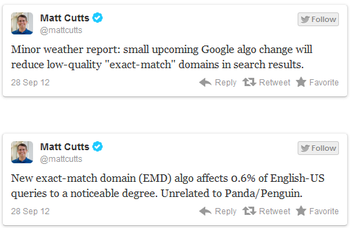
EMD Algorithm Update – The September update targeted sites with exact match domains (EMDs), or sites named after keywords instead of brands. This change didn’t so much penalize most affected as it removed a special boost they were receiving due to the name of the website.

The only people really penalized by the update were those who had over-optimized their site around the keyword. There is also a misconception the EMD updates were Panda or Penguin related, but Matt Cutts has put that idea to rest.


Panda Updates – The main area the Panda updates looked at was your on-site content. Google was trying to weed out low-quality or duplicate content, and they’ve been churning out constant new versions of Panda all year.

Penguin Updates – Despite the close association with Panda, Google’s Penguin updates are actually their own beast, formerly known as the webspam algorithm update. They are targeting all of the spammy sites out there, and unless you’re a spammer, the only penalties you may have seen from these updates were from links.

If you have seen any penalties from these updates, Dholakiya explains how to help fix the problems. The Disavow Links tool can help with that, especially if you’ve seen penalties from the Penguin updates, but it isn’t a magic solution.

SEO as a whole can be split into two different categories: on-page and off-page optimization techniques. On-page optimization is focused on everything you can do to boost your rankings directly on your webpage. Off-page SEO concerns aspects that function elsewhere, like backlink management.

Some might argue that on-page optimization has been weakened by Google updates that have sought to weed out pages using methods like keyword stuffing. While this is kind of true, it does not fully discredit on-page methods.

You can still take advantage of proper keyword usage, titles, and URL management, but as Matt Cutts puts it, “there’s diminishing returns.” Christian Arno from Search Engine Journal explains what still works in on-page optimization, and while some of the old techniques have been cut down, the most effective techniques are still tried and true.

After Google launched the disavow link tool in mid-October, there were a fair amount of doubters and those that claimed it doesn’t work. Dixon Jones from Majestic SEO, a well known and respected member of the SEO community posted in a Google+ thread that he used it for a site and it worked to remove a manual link penalty.

SEO Roundtable has the exact posts he made explaining the process and what happened. For Jones, the manual penalty was removed fairly efficiently, but those wanting to use it for a Penguin link penalty may need to wait for a new refresh.

The best option is of course to try to avoid link penalties or bad links, but the world isn’t perfect. If you’ve dealt with the root issue which caused the penalty, the disavow links tool may just be the solution you need.


2012 saw Google make a number of important changes and updates to AdWords. I’ve touched on most of these here, but for a nice summarized rundown you can head the iNeedHits blog.

These changes are all ways to improve your online marketing strategy and increase your audience. Plus, the article keeps it short and sweet so you won’t have to invest too much of your time.

If you are doing a ton of SEO audits, or just doing audits on sites with lots of big data, you probably have been itching to find any way to make your process more efficient without impacting the quality of your work.

Alan Bleiweiss, writer for Search Engine Journal, had that problem. With Google fighting unnatural links, we all have felt a heightened need to be examining inbound link profiles. These two things combined have caused Bleiweiss to bring together a set of techniques he uses to speed up his audits.

No one wants to spend their entire life doing audits, but theres no need to lower your bar for quality just to save some speed.