Keeping up with all of Google’s ranking algorithms and systems can be a lot. It seems like every time you turn around, the search engine has pushed out some new ranking system that brands need to be aware of if they want to reach users on the largest search engine around. 

Making matters even more complicated, Google also occasionally retires older systems as they become obsolete or redundant over the years.

Thankfully, Google has released a comprehensive guide to its many different ranking systems so you can be sure you are optimized for the most important ranking signals without investing resources into systems that are out of use. 

Ranking Systems Vs. Ranking Updates

Along with information about each ranking system and how it influences your standings on Google Search, the guide clarifies the language between ranking updates and ranking systems.

These terms have been used somewhat interchangeably but Google is finally drawing a clear line between the two.

According to the guide, a ranking system is something that is constantly operating behind the scenes – such as RankBrain or the helpful content system.

On the other hand, a ranking update is a one-time change to the ranking systems. For example, Google regularly rolls out updates to its spam detection systems.

Active Google Ranking Systems

Here are Google’s currently active ranking systems in alphabetical order:

  • BERT: BERT (or Bidirectional Encoder Representations from Transformers) is an AI system that allows Google to understand how combinations of words may change meanings and intent
  • Crisis Information Systems: This is a system Google has in place to handle important information during times of crisis – both personal and public. For example, the system helps intervene when users search for content related to potentially dangerous personal crises, such as suicide, sexual assault, or poison ingestion.
  • Deduplication Systems: This is used to help Google avoid delivering search results with duplicate or nearly identical content.
  • Exact Match Domain System: A system is used to balance the importance of ranking brands highly for searches containing their exact business name without giving too much credit to sites with domain names that exactly match broader queries.
  • Freshness Systems: Google’s freshness systems work to show newer content more prominently for queries where it would be expected.
  • Helpful Content System: The relatively new Helpful Content System guarantees that users see original content written with their needs in mind, rather than content crafted specifically to rank well.
  • Link Analysis Systems and PageRank: These systems determine what content is about and what pages may be most helpful for specific queries based on how pages across the web are linked together.
  • Local News Systems: Google uses this to highlight information from local news sources when they will be the best resource for a query.
  • Neural Matching: This lets Google understand representations of concepts in queries and match them with the most relevant pages.
  • Original Content Systems: Google’s Original Content Systems help identify the original source of content and highlight them above those who simply cite it.
  • Removal-Based Demotion Systems: The system responsible for demoting or removing content with a high volume of content removal requests.
  • Page Experience System: The Page Experience System is designed to assess which sites will provide the best user experience.
  • Passage Ranking System: Passage ranking is an AI system used to identify specific sections of content which may be most relevant for search.
  • Product Reviews System: As part of Google’s shopping tools in search, Google uses the Product Reviews System to reward highly reviewed products and to showcase reviews that contain the most insightful or relevant information.
  • RankBrain: RankBrain is an AI system crucial to the search engine’s ability to understand how words and concepts are related and return more relevant content – even when all the exact words in a search may not be present.
  • Reliable Information Systems: These are a number of systems that ensure Google’s search results prioritize information from reliable sources.
  • Site Diversity System: The Site Diversity System prevents Google from showing more than two specific pages from the same domain in the top results for a query.
  • Spam Detection Systems: The Spam Detection Systems identify content and behaviors which violate Google’s spam policies and deal with them appropriately by demoting or delisting them.

Retired Google Ranking Systems

  • Hummingbird: Originally rolled out in 2013, Hummingbird was a broad overhaul to Google’s ranking systems. Since then, Google’s recent systems have evolved past the need for this system.
  • Mobile-Friendly Ranking System: This system rewarded sites that were optimized to render well on mobile devices. Since then, it has been absorbed into the Page Experience System.
  • Page Speed System: Initially a standalone system that highlighted sites that loaded quickly on mobile devices, this system has since been incorporated into the Page Experience System.
  • The Panda System: Panda was released in 2011 with the purpose of surfacing high-quality, original content. Since 2015, it has been part of Google’s core ranking systems.
  • The Penguin System: The “cousin” to Panda, Penguin demoted websites that used spammy linkbuilding strategies to rank abnormally well. It has been part of the core ranking systems since 2016.
  • Secure Sites System: Originally, it gave a small boost to sites that adopted HTTPS security protocols when it was less commonly used across the web. Though HTTPS sites are much more common these days, the system is still in use as part of Google’s Page Experience System.

Google is rolling out several new updates and features for Google Search aimed at making it easier for users to find the content they are looking for.

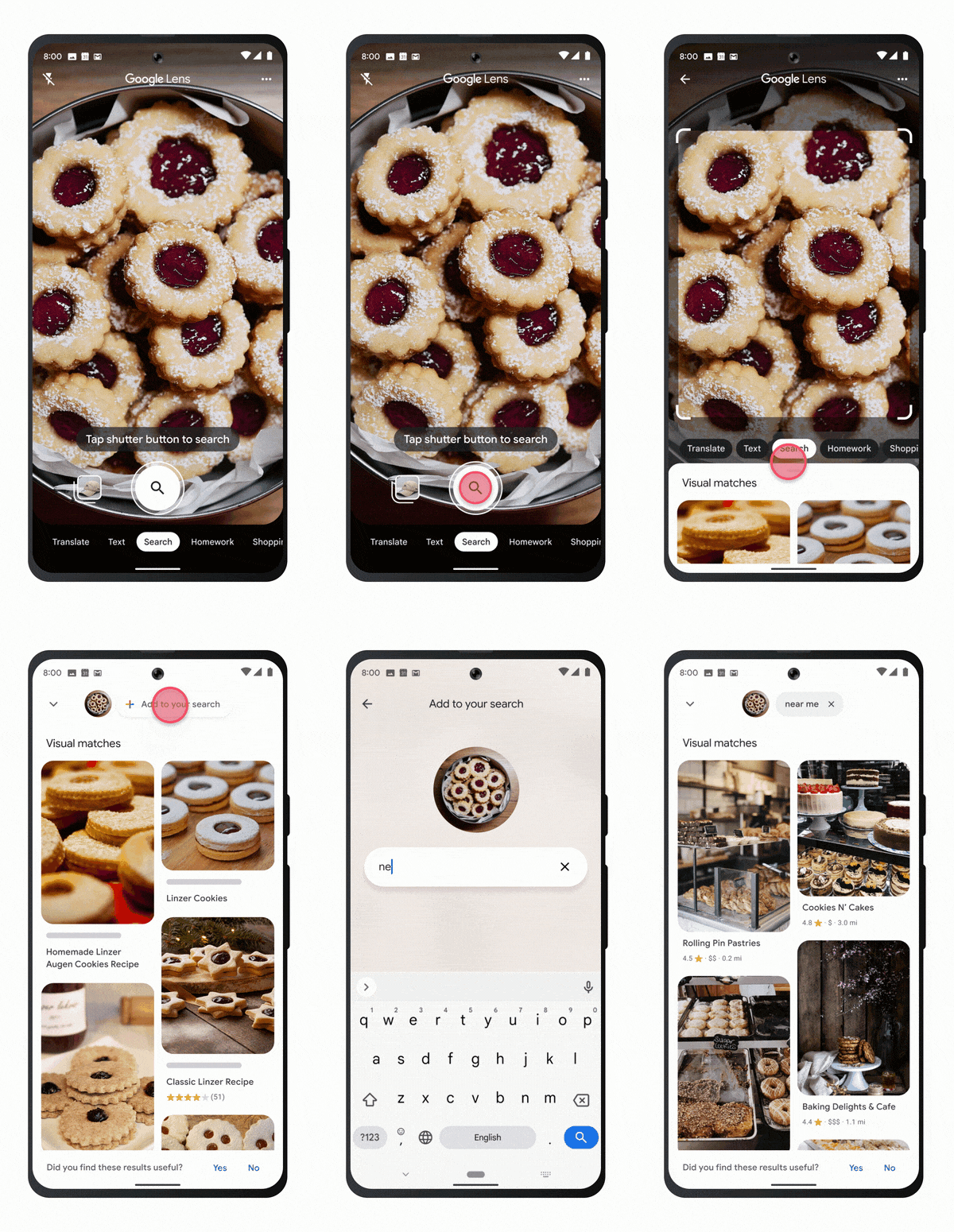
Among the announcements, the search engine revealed new ways to use augmented reality (AR) and Google Lens to shop for products and find information like how to get a dish you’ve been craving from a nearby restaurant. 

Below, we will go over the announcements one by one to break down the details and when you can start using these tools to help users find your products and services.

Introducing Multisearch For Food

Google is working to unite its search tools including Google Lens and Maps so that users can seamlessly combine types of searches into one powerful search.

For example, using multisearch, you can now take a picture of a meal in Google Lens and add a text modifier such as “near me” to discover what restaurants serve that meal.

“This new way of searching will help me find local businesses in my community, so I can more easily support neighborhood shops during the holidays,” said Cindy Huynh, Product Manager of Google Lens.

This feature is rolling out for all English-language U.S. users today.

Search For Specific Dishes

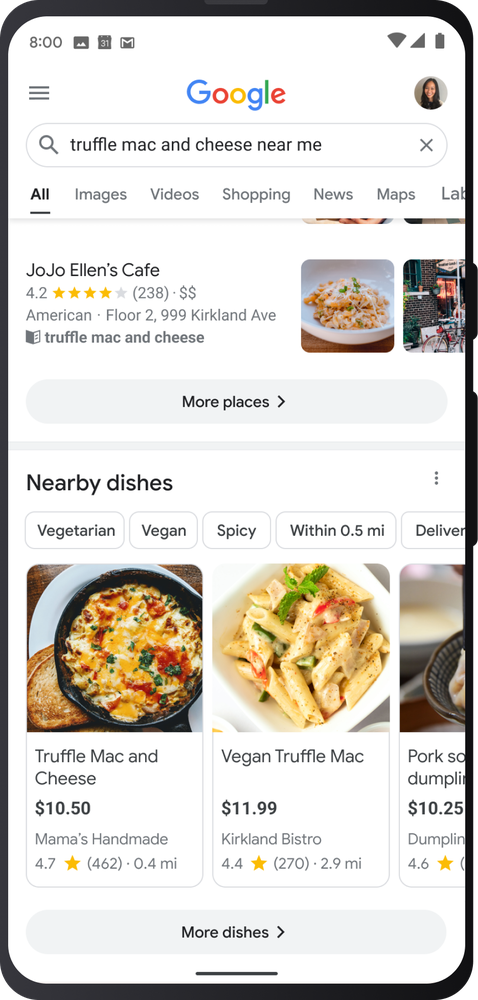
Along with the announcement above, Google revealed that users can also simply search for specific dishes by name to find information including who serves this dish, pricing, ingredients, and more

As Google’s Sophia Lin says:

“I often crave comfort food this time of year — like truffle mac and cheese — but I don’t always know where to find it. Lucky for foodies, starting today, you can now search for the exact dish you’re craving and see all the places near you that serve it.”

AR Shopping Tools for Shoes and Makeup

Seeing how new products will look once you leave the store has always been difficult for consumers, but Google is using augmented reality to visualize potential product purchases before you buy.

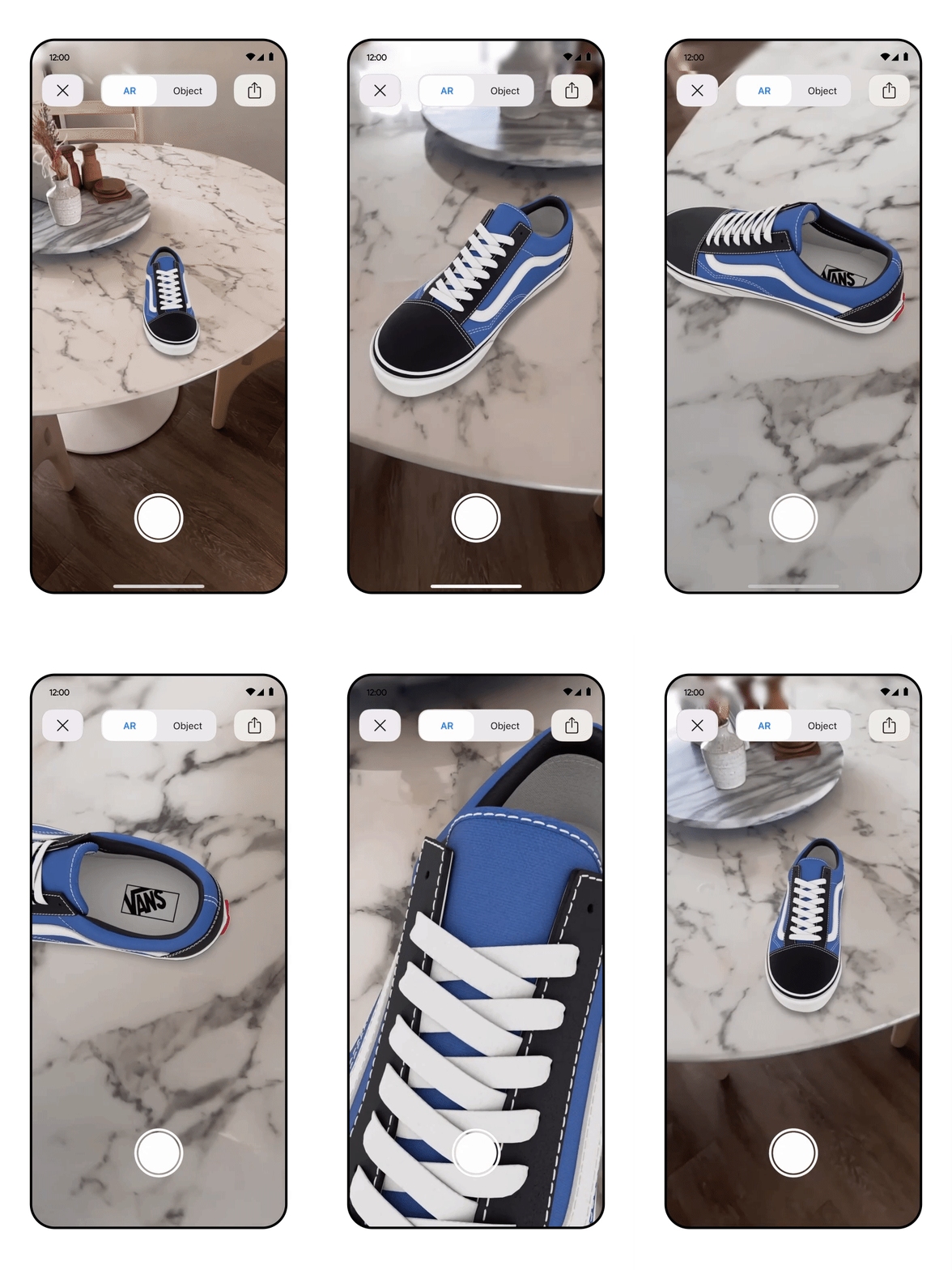
The first way Google is doing this is by allowing you to see potential show purchases in your living space. 

Starting today, shoppers can not only see high-quality 3D models of shoes. They can spin them around, zoom in on details, and even see the shoes as they would look in your typical surroundings.

Importantly, this is available for any brand with 3D assets of their shoes or home goods.

Additionally, Google has upgraded its AR shopping tools for makeup to include a broader range of skin tones and models with a more diverse set of features. 

The search engine has added over 150 new models with a diverse spectrum of skin tones, ages, genders, face shapes, ethnicities, and skin tones to test cosmetics on.

Google is officially rolling out frequency targeting controls for video ads on YouTube according to a new blog post from the company.

With this move, advertisers can now take control and set limits for how often individuals see their ads.

In the past, the only way to do this was through connected TV campaigns in Google Display & Video 360 – more advanced advertising tools and features.

What Is Frequency Targeting For Ads?

Frequency targeting lets advertisers set a target number of times their ad will be shown to specific users.

This helps make the most of ad budgets by preventing ads from being repeatedly displayed to unreceptive audiences.

As the announcement for the feature explains:

“This will help advertisers optimize towards more precise reach and frequency, while ensuring that we continue to provide a suitable advertising experience for viewers. Target frequency allows advertisers to select a frequency goal of up to four per week and our systems will optimize towards a maximum unique reach at that desired frequency.”

Why Set a Frequency Target For Your Ads

Though there may be times when repeatedly seeing the same ad may be beneficial to motivate potential customers, there is a limit. Most studies indicate that repeatedly seeing ads is much more likely to contribute to diminishing returns and bad will with consumers.

For example, one Google-commissioned study found that TV advertisers see a decrease in ROI of 41% when the frequency of their ads was more than 6 views per week. Based on the data, more than 46% of ad impressions were above this threshold, making nearly half of ad impressions wasted.

The study says:

“Almost half of the linear TV impressions in our study were considered waste but the same study from Nielsen shows that brands can increase their average weekly frequency from one to three on YouTube with a consistent ROI.

“This is a huge opportunity for marketers to maximize their impact across the same set of people they are already reaching today.”

Final Details

Frequency targeting is now rolling out to all Google Ads users around the globe. 

Google claims that over 95% of all campaigns using frequency targeting hit their goal using the tool in testing.

A new case study from SEO researcher Joy Hawkins at Sterling Sky seems to finally debunk a myth that has lingered around Google reviews – that keyword-rich reviews could help a site’s ranking in search results.

The idea does make a certain amount of sense. Reviews can help spotlight specialties or unique services that companies offer and could provide a valuable signal to determine the most relevant results for specific searches.

Based on their findings, however, Sterling Sky says having customers put] keywords into local reviews on a business listing “does not improve rankings.”

It is important to note that the test is definitely limited. 

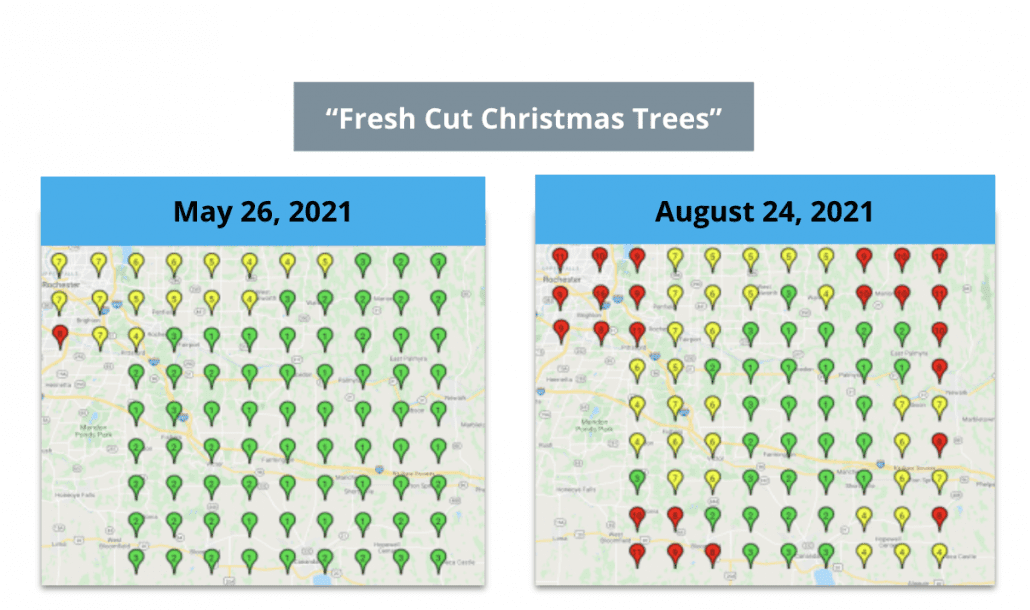
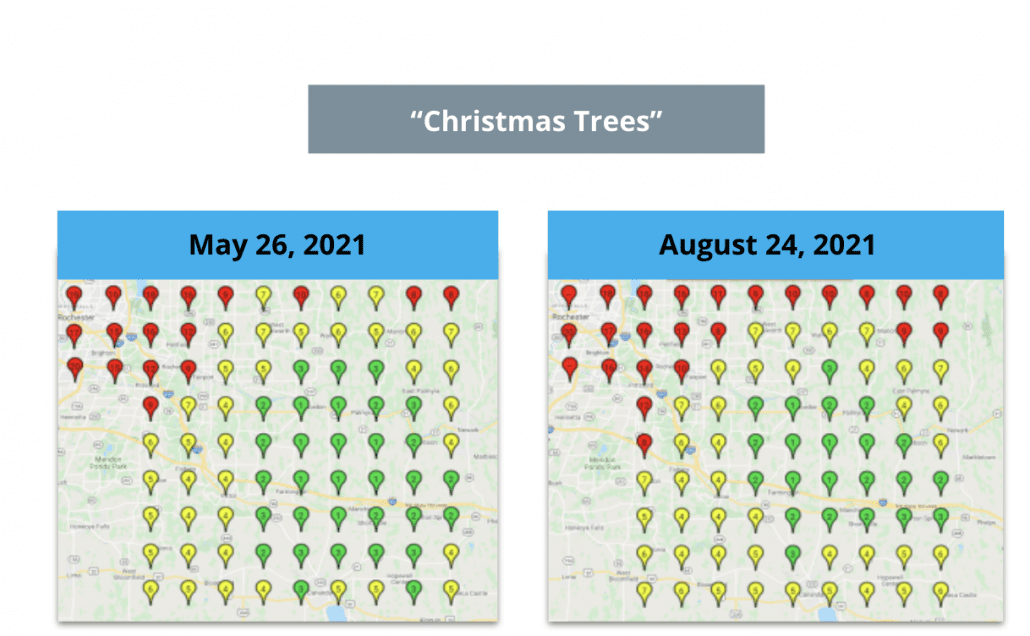
For the study, the team gradually added product ratings including the phrases “fresh cut Christmas trees” and “Christmas trees” for a small Christmas tree seller with minimal online presence, rankings, or SEO efforts.

The Results

Sterling Sky says that the new keyword-rich reviews did not improve the company’s keyword rankings, even after six months.

The graphics below illustrate that the rankings did not improve for either keyword. In the case of the first phrase, rankings actually got worse by the end of the study, while rankings for the second keyword phrase remained approximately the same.

Hawkins concludes that there is no need for brands “to include certain words in their reviews.”

“First of all, this is hard to do and you often come across as weird or odd. And secondly, and most importantly, this case study shows that it does not improve rankings!

At the end of the day, Google probably focuses more on contextual information within reviews to help rank local businesses, rather than looking for exact keyword matches. Not only is this harder to abuse, it provides a more rich and more detailed understanding of a local business listing than a single keyword.

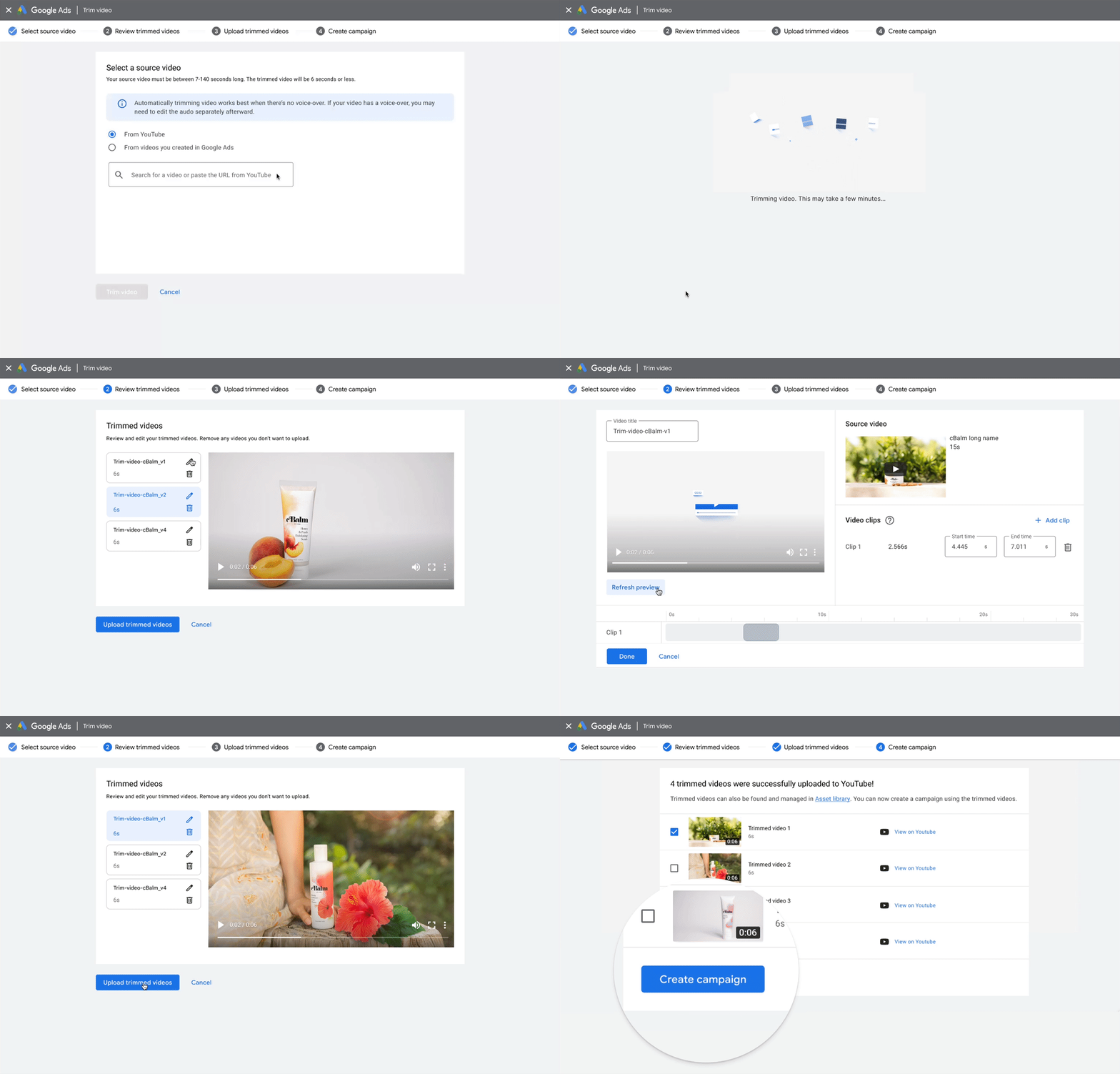
Google is officially releasing its bumper ad tool to the general public. The tool, now being called simply “trim video”, makes it easy to turn existing videos (up to 140-seconds long) into short but sweet clips that can then be used as bumper ads for video campaigns.

Though the tool has been in testing in various forms since 2019, this is the first time the general public has been given access to it for their campaigns. 

In the time the tool was in beta testing, Google says it has “helped hundreds of brands drive more reach, frequency, and efficiency by effortlessly generating 6-second bumper ads.”

The announcement of the tool describes trim video like this:

“Trim video is a video ad production tool that helps advertisers make new bumper ads from their longer video assets quickly. Trim video uses Google Machine Learning to simplify the process of bumper ad creation by identifying the most important frames in a long ad and turning them into 6-second videos. It also has simple editing features that allow advertisers to modify the final output.”

Using the tool is as simple as copying and pasting a link to one of your existing YouTube videos or your Google Ads library. From there, you’ll be given four different options you can edit further or save as a bumper ad. 

To access the trim video tool for yourself, sign into your Google Ads account and select the asset library page. Then, select the tools and settings icon and look under “Shared Library” to find “Asset Library”. Here you’ll find the trim video tool under the Video section.

For more about the trim video tool, read the full announcement or visit the Help Center article dedicated to the tool.

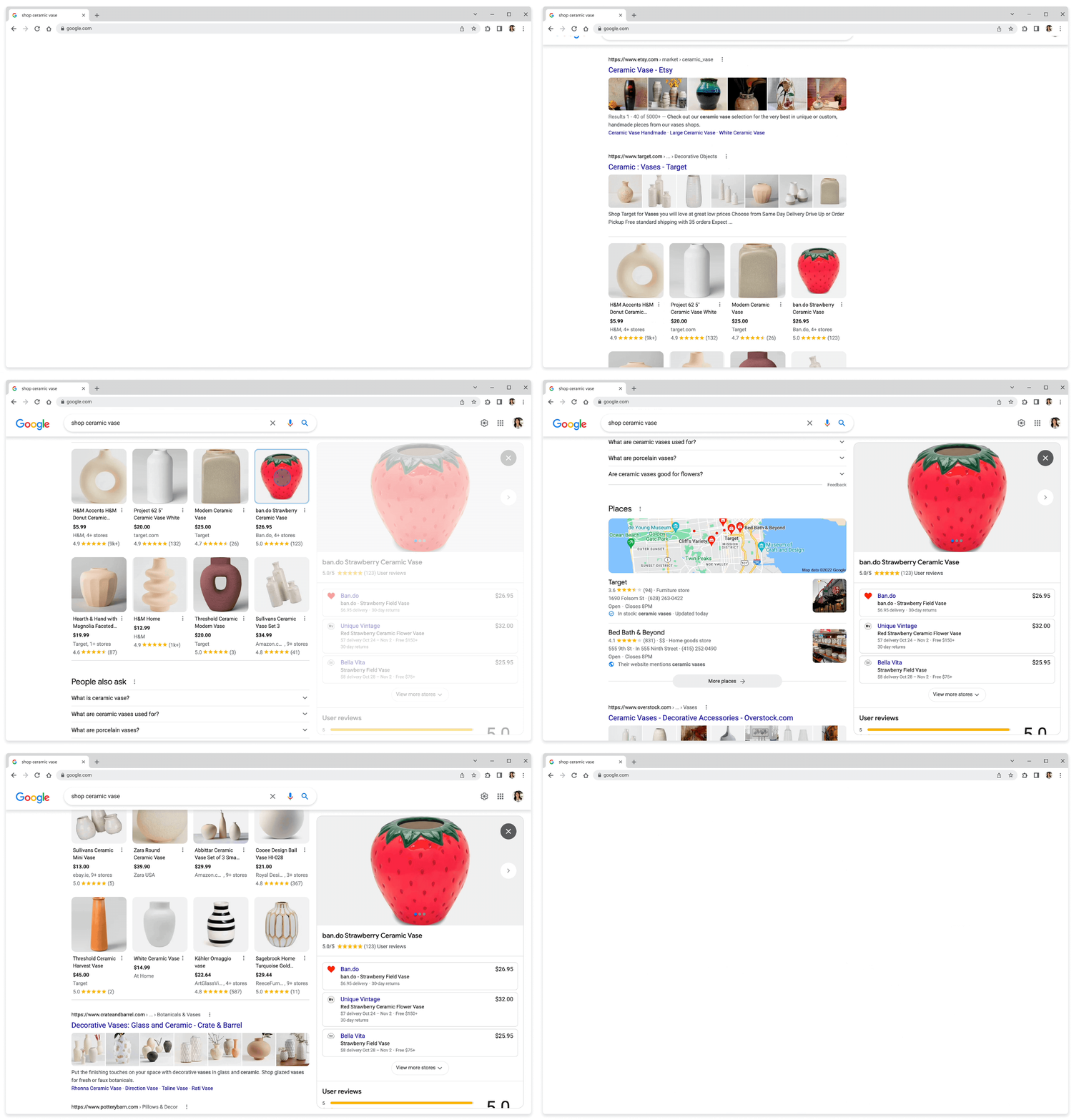
Google is updating its online shopping features on desktop with a new focus on visual elements including an increased focus on product images.

The company released a screenshot as an example so you can see how product search results start with a row of thumbnail images.

As users scroll down the page, they will also see details about pricing, user reviews, and ratings for specific products included in the result,

When clicked on, the product listings bring up a panel with more information and links to purchase the product from different retailers.

Most importantly, the panel does not interrupt your browsing process and users can immediately resume shopping from where they left off.

As before, users can also filter product results using a number of categories including brand, type, retailer, and discounted products.

The announcement says about the overhaul:

“Whether you’re looking for clothes, electronics, beauty products or home goods on desktop, you’ll see a more visual feed of shopping results that includes products, brands, articles and videos from across the web.”

Additionally, Google says these product results and search filters are all dynamic, so they will continuously be updated to include the newest products, popular retailers, and up-to-the-minute discounts.

The new Google shopping update is already rolling out to all users and should be available to everyone within the next few days.

With Halloween fast approaching, Google has updated its Frightgeist website with all the latest search trends for this year’s spooky holiday.

The Halloween Frightgeist site has tracked the biggest holiday search trends annually, with a primary focus on Halloween costumes.

Notably, the tool allows you to go beyond the national search trends to find out details for a specific city or state. 

For example, it appears fairy costumes are particularly popular this year in Tulsa, as the leading costume-related search.

As Google says about the Frightgeist page:

“Every year, trillions of searches take place on Google, and Google Trends gives us an unparalleled look at what the world is searching for.”

“With Frightgeist, we went on a hunt to find the most popular Halloween costumes of 2021. Pulling from the top 500 costume searches in the United States, Frightgeist used Google Trends to tell people what costumes were trending around them and help them find a costume that was sure to turn heads.”

Below, we are going to cover the top costume search trends both nationally and in the Tulsa area, and a little bit more of what you can do with this data.

Top National Halloween Costume Ideas in 2022

  1. Witch
  2. Spider-Man
  3. Dinosaur
  4. Stranger Things
  5. Fairy
  6. Pirate
  7. Rabbit
  8. Cheerleader
  9. Cowboy
  10. Harley Quinn
  11. Clown
  12. Vampire
  13. 1980s
  14. Hocus Pocus
  15. Pumpkin
  16. Chucky
  17. Doll
  18. Angel
  19. Batman
  20. Bear

Top Halloween Costumes In Tulsa Oklahoma for 2022

  1. Fairy
  2. 1980s
  3. Spider-Man
  4. Chucky
  5. Spider

The Frightgeist site also allows you to see more details about each trending costume idea, including where it is most popular across the country, how it has performed in past years, and more.

Lastly, the site includes a costume selection wizard you can use to brainstorm what to wear this Halloween. The costume wizard lets you adjust sliders for spookiness and uniqueness and toggle between classic and modern costumes that are trending locally or nationally.

Google has quietly revealed it will be discontinuing store visits reports from Google Analytics at the end of October.

While historical data will still be viewable on the reporting platform for the indefinite future, however, data will stop being generated by the end of the month.

The news was revealed in an update added without fanfare to the Google Analytics help page.

The update reads:

“On 10/31/2022, Store Visits reporting will be discontinued. As of this date, new Store Visits reporting will not be generated. Historical Store Visits reporting will remain available. Please reach out to your account manager if you have any questions.”

As the name suggests, Store Visits data estimates how many people have visited your physical store or business location after visiting its website.

This is done by correlating data saved from a user when they visit the website with data from phones with location history data if that device ever comes into close proximity to your store location.

This of course means the data does not track users who have location history disabled on their account.

Brands that rely on this data will be able to access it instead in Google Ads, where new data will continue to be gathered and reported. However, brands only have access to this feature if your Google Analytics account is linked to a Google Ads account. 

Other than having to switch which platform you use to access your data, store visits reporting will be otherwise uninterrupted during this switchover.

As expected, Google’s Search On conference this week brought tons of new announcements and previews of new features coming to the search engine. Though most of these features are not publicly available yet, they show that Google is intent on revamping many aspects of its search engine to make searching easier and more engaging.

Below, we are going to talk about the 5 most exciting and essential changes that both users and companies hoping to improve their online visibility should be aware of.

Google Search Shortcuts

Over the past decade, Google has steadily expanded the ways users can search for information beyond just entering a text query.

You can upload an image to find other similar images, take a pic of an equation to get help solving it, or turn on the microphone to help identify a song playing – just for a few examples.

The problem is that Google has not always done the best job of promoting these new ways to search or making them easily accessible to users.

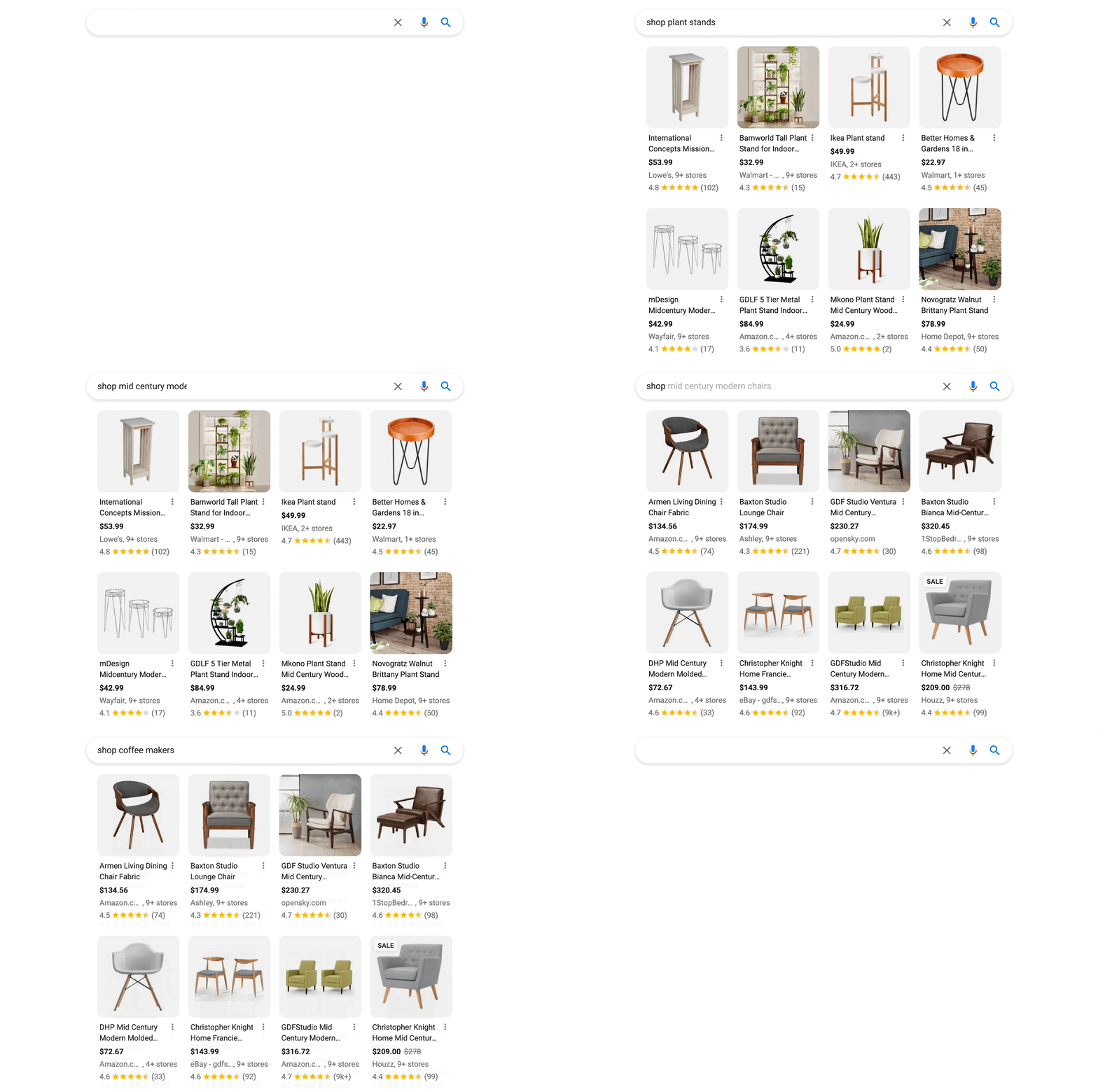
Now, that is all changing as Google is adding advanced shortcuts on the front page of the Google Search app.

You can see what this looks like in the screenshot below or, if you have an iOS device, you can see the feature for yourself by simply opening the Google app.

In-Search-Bar Results

Typically, users have to at least enter their query before they have the chance to click on a relevant result. Coming soon, however, that won’t always be the case.

Google announced that it will soon be delivering results to users even as they are still typing in the search bar.

You can see what this might look like in the example below, where Google delivered a link to a location page directly within the search bar:

For now, it appears Google will be limiting this feature to just one result in a search bar, though we will know more when it rolls out later this year.

Enhanced Query Refinements

Along with the results like described above, Google is also adding new ways to refine your search query for the most useful results.

As you are typing a query into the mobile search bar, the search engine will start populating the bar with options to make your search more specific.

For example, when searching for queries like “best Mexico cities”, Google will suggest refinements like “to visit”, “to retire”, or “for families”.

More Prominent Web Stories

Google is making web stories a bigger part of mobile search by giving them a more prominent place in mobile search results.

As the company said in an announcement:

“So we’re also making it easier to explore a subject by highlighting the most relevant and helpful information, including content from creators on the open web. For topics like cities, you may see visual stories and short videos from people who have visited, tips on how to explore the city, things to do, how to get there and other important aspects you might want to know about as you plan your travels.”

One Page For Text, Image, & Video Search Results

Instead of making users switch between web, images, or video result tabs when searching, Google is unifying them all into one endless search result feed on mobile. 

“We’re also reimagining the way we display results to better reflect the ways people explore topics. You’ll see the most relevant content, from a variety of sources, no matter what format the information comes in — whether that’s text, images or video.”

When users would typically encounter the end of a search page, they will be given the option to either show more results or continue scrolling vertically to explore a more specific search – as seen below:

Though Google has not announced exact dates to expect these updates, the company says they will be rolling out to mobile search in the coming months.

Brands across the US are increasing how much they spend on search advertising, with the overall US search ad spend predicted to reach almost $112 billion by next year. That is nearly double the amount spent in 2019, according to the new report from Insider Intelligence.

US Search Ad Spend 2019-2026 graph

This year, the data says $99 billion is being spent on search advertising. Much of this is driven by Google, which receives about 56% of the total ad spend. Google is in fact driving much of the growth in this area, outpacing all other traditional formats. 

While Microsoft remains the second-leading search ad platform, the data indicates that other platforms like Apple and Amazon may eventually overtake it. 

Data shows that Apple Search Ads will receive $5 billion dollars alone in 2022 revenue thanks to new ad and placement options which allow brands to find less competitive ad space.

Meanwhile, Amazon is gaining ground as the best platform for bottom-of-funnel customers. 

Interestingly, the report indicates that TikTok is also a growing force in search ad spending. The new data shows that up to 40% of 18- to 24-year-olds in the US already prefer to use TikTok and Instagram for their searches instead of Google. This may explain why recent studies showed that brands spent 60% more on overall advertising on the platform. 

Mobile Vs. Desktop

Unsurprisingly, mobile search advertising spend is far outpacing desktop by about two-thirds and shows no sign of slowing down. 

One indication of this is the fact that more than half of the U.S. population was reported to have used a smartphone to make an online search in 2016. By next year, that number should reach 70% by 2023. 

Privacy-Focused Platforms Lose Steam

After years of slow growth, privacy-first platforms like DuckDuckGo appear to be losing traction with US searchers. This is reflected in other recent reports, including data showing that DuckDuckGo had fallen to less than 100 million daily searches in June. 

For more findings about the current state of search advertising, download the full report from Insider Intelligence here.