While it is always important to design a website that looks pretty and makes search engines happy, it is always better to make sure users like your site. User experience is equivalent to customer satisfaction, but unfortunately some designers only test their usability at the end of the process, if at all.
Testing usability throughout every stage of the design process possible means the end design will be completely tailored to what your visitors want. Testing in different stages can tell you what you should focus on next and what can be improved overall.
Some people confuse usability testing with A/B testing, which is comparing two different versions of a web site on a wide audience and has quantitative results. Usability testing is all about subjective experience and qualitative insights.
As Jenny Shen puts it in her article at Onextrapixel, “Through A/B testing you can find out which version performs better, but usability testing helps you know the reason behind the results or why one version was preferred over the other.”
Shen also explains every step of usability testing in her article. I suggest reading it and taking notes so that you can start implementing testing on your next design. It won’t matter if you make a nice looking site if users don’t enjoy using it.
One of the problems with working in an industry few actually understand is that clients tend to come to us with requests or ideas that are wildly impractical entirely not possible, or in most cases just show a complete misunderstanding of how SEO works.
After a while of working with a good number of clients, you start to run into some of the same requests and patterns that can start to drive a person a little crazy, or at least annoy them enough to write a list like “10 Things Most SEO Consultants Hate“, which is exactly what Trond Lyngbø did.
Of course, everyone has their pet peeves and some will be more frustrated by issues like these. But you can help make your first meetings with an SEO firm a little smoother by familiarizing yourself what they don’t want to hear. You’ll understand how SEO works a little better while you’re at it.
The most common annoyance is the constant requests for a quick fix. Many website owners and small companies don’t worry about hiring an SEO until something goes wrong, in favor of saving money and streamlining their company’s efforts. For a small business, it’s a fairly savvy move, but SEO is simply not a process with immediate returns.
Lyngbø evaluates clients on a quarterly or annual basis, and though many SEO’s pay closer attention and spend their efforts fine-tuning aspects of their strategy, the fact is organic traffic is one of the cornerstones of SEO, and there is no way to rush it. Marketing and SEO campaigns take time to see results, but the patient reap the benefits.
That’s just the tip of the iceberg of patterns that can frustrate you SEO. Being the person to do any of the things on Lyngbø’s list isn’t anything to be ashamed of because SEO isn’t exactly common knowledge, but if you are working with one, it is always best to learn a little about what SEO is able to do, and how it functions.
https://www.tulsamarketingonline.com/wp-content/uploads/2018/07/TMO-Logo.png00TMOhttps://www.tulsamarketingonline.com/wp-content/uploads/2018/07/TMO-Logo.pngTMO2013-03-20 12:01:002013-03-20 12:01:00The Pet Peeves of SEOs
Everyone wants their landing page to make a splash, but how do you make an impressive header, include navigation, and not end up covering up too much of your page?
This used to be an issue solved by sidebar navigation, or other secondary navigation systems, but it seems there may be a way to show your readers a big visually stimulating header/menu bar combo that gets out of the way when viewers begin looking at your content.
Websites like This is the Brigade and All You have implemented this dynamic, animated menu that resizes as you scroll down, shrinking the navigation to let your content breathe.
It gives you the opportunity to show your brand or logo, and make a huge first impression, but then you can move the focus to what really matters to readers. Antonio Pratas has a tutorial at Web Designer Depot for anyone who wants to try this new style of header out.
https://www.tulsamarketingonline.com/wp-content/uploads/2018/07/TMO-Logo.png00TMOhttps://www.tulsamarketingonline.com/wp-content/uploads/2018/07/TMO-Logo.pngTMO2013-03-19 12:44:112013-03-19 12:44:11How To Make A Resizing Navigation Bar
Everyone involved in SEO will tell you how drastically everything has changed this past year. They’ll emphasize how Penguin and Panda “changed everything” and they will be more than happy to talk about how dramatically linkbuilding strategies have been affected, but it seems like very few are talking about what these changes mean for SEO as a whole.
John Mihalik wrote about four strategic SEO trends that he sees as important for the rest of the year, but his predictions also work as a summary of where SEO is at right now. He misses a couple things that can’t be ignored like local SEO, but remembering these four trends Mihalik points out should be enough to give you a good idea of what SEO means for website owners today.
Quality is the New Standard – To be blunt, SEOs used to be able to take any site of almost any quality, and improve performance significantly with keyword stuffing, link buying, and all sorts of other borderline spammy tactics, but Google’s algorithm’s have advanced to unbelievable levels. With their complex set of metrics to evaluate sites by, Google can pretty confidently tell if a site is low quality, and there will be no way to bring a site out of the ether until the quality problem is solved.
Social is Important – Social signals are just now beginning to affect search results, but Google has made it more than clear they are implementing social signals into their algorithms and Facebook is working on improving their own search engine relying almost entirely on social data. Aside from questionable privacy practices, implementing social data into search makes sense. Interests, friend circles, location, and even internet habits can help search engines deliver results more tailored for individual people.
You Aren’t Mobile Friendly Yet? – At this point, any website without a responsive or mobile friendly version is beyond behind the times. More and more people are doing their searches on their phones and tablets. You can’t just throw together a low quality mobile portal either. Search engines look for the same quality signatures they do on desktop sites, and you won’t be getting any more traffic with a shoddy mobile page.
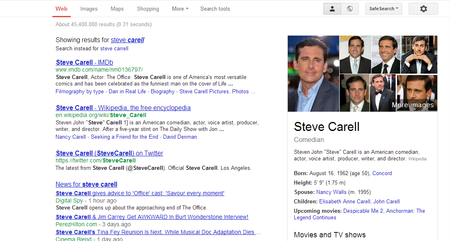
The Knowledge Graph – Google’s knowledge graph, or that box of information in the top-right corner of your screen when you search for a celebrity or prominent brand, has been slowly becoming more common on SERPs over the past year. Mihalik also believes it offers an opportunity for brands to optimize their web presence and gain a little added performance for direct searches.
I question to efficiency or importance of the last one. The knowledge graph information does allow searchers to easily find concise information, but for a brand to appear on a SERP, the user has to search directly for that brand. If there is another company somewhere with the same name as yours, you could use the knowledge graph to gain a foot up on them, but otherwise I don’t see the knowledge graph becoming a cornerstone of SEO. Every other trend mentioned is pretty much a certainty at this point, however.
There are so many articles out there fawning over the design of Apple’s products. Starting with the third or fourth version of the iPod, every new product has gotten nothing but love for their revolutionary design, all the way up to the iPad. Every part of the iPad’s design, including the interface, have been broken down and critiqued.
There is one aspect of the iPad that Apple can’t control, however. Apple designs a few apps, but the vast majority are made by other companies. Sure, a good amount of them are cheaply designed, but there are also high quality apps made by designers that care, and it is in those apps that you can learn some of the best rules for modern design. Carrie Cousins collected ten things she learned from iPad apps at Design Shack, and they can be transferred over to any other medium today.
It all begins with an emphasis on simplicity, and Cousins pinpoints one of the most undeniable reasons why web design has taken a turn towards minimalism. Too much on a small screen can overwhelm the user, and simple, easy to use designs help the on-the-go user access what they want, when they want it.
Almost every major trend in web design is also observable through iPad apps. Simple color schemes, and flat designs are all the rage right now, reflecting the continued push towards simplicity on these small screens and it is hard to deny how effective the design changes are. Apple has never been a proponent of flat design, but recent redesigns by CNN and Facebook show that flat design looks great on tablet screens.
The unforgiving Retina Display of the iPad will also teach any lazy web designer a good lesson very quickly. You can’t cut corners on any visual aspect of an app. One low quality icon will stick out like a sore thumb on an otherwise crisp and clear interface, and one small shoddy image will destroy the value of your content just like a crack in the foundation of a house will one day destroy that home.
There are plenty more lessons to learn from iPad apps. Cousins has a few more in her article, but if you are critical of iPad apps as you use them, you’ll learn even more. The best part is, because apps are constantly updating their designs, and new innovative apps are coming out every day, you will be able to keep up to date with design so long as you keep killing time on your tablet.
Last week the internet felt tremors that were very similar to the shock waves unleashed by Google’s Panda Updates, but something was different this time. Google didn’t announce or confirm the update, and they say they won’t confirm any updates in the future.
At this point, it is widely assumed the small shakeup last week was the Panda Update that Google’s Web Spam guru Matt Cutts said would be coming sometime soon at SMX West early on last week. But, as Search Engine Land reports, while he was talking, Cutts also said that Google’s Panda Updates would no longer be unveiled in big monthly changes. From now on, Panda’s changes will occur gradually.
The shift from big abrupt changes to a more fluid update system means that sites hit for low-quality content may not be able to diagnose their issue as easily. Site owners can’t look at their Analytics and see a big drop correlated with a confirmed update around that time period. However, Danny Goodwin says it may mean a faster recovery.
Site owners who have done their proper due diligence will no longer have to wait for the next update to roll around to see if Google has viewed their work favorably.
Google confirmed 24 of the Panda Updates, and the 25th is believed to have occurred late last week, but from now on, there won’t be any big announcements or confirmations. Just like everything else at Google, their web spam algorithms will be constantly changing over time rather than abruptly transforming.
00TMOhttps://www.tulsamarketingonline.com/wp-content/uploads/2018/07/TMO-Logo.pngTMO2013-03-18 12:54:252013-03-18 12:54:25Panda Update May Have Happened, But Don’t Expect Google To Say So
They say a picture is wort a thousand words. Every designer knows how tired that cliche statement is, and just how true it is when you use the right pictures. But, sometimes designers don’t have access to a quality staff photographer or a subscription to Getty Images or a similar stock photo collection website. How is a designer supposed to find quality images to use?
Some designers will settle for using lower quality images they find elsewhere, or using a confusing stock photo with little connection to the content. Neither actually improves content or web designs. Thankfully, there are collections of great free stock photos designers and bloggers can use without using the little money they have.
Stephen Jeske collected ten websites which offer high-quality free stock images. I’ve used one of the sites, Stock.XCHNG, for months and you can always find photographers willing to share their images through it. It is well organized, and easy to use, but no one stock photo site will have pictures for your every need.
When using any sort of images you didn’t create yourself however, it is always essential to make sure you are following the licensing terms and attributing the creator of the image, if you can find out that information. Read the licensing terms for every image you plan to use, and if you are unsure of any details, ask the author of the image.
00TMOhttps://www.tulsamarketingonline.com/wp-content/uploads/2018/07/TMO-Logo.pngTMO2013-03-14 12:49:362013-03-14 12:49:36Great Free Resources: Stock Photos You Can Use
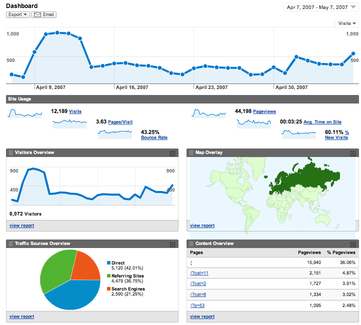
Analytics is one of the most ignored aspects of web marketing, despite the fact that everyone is concerned with their site’s statistics. Tons of SEOs check their statistics even daily, but almost everyone relies on either a set of analytics tools or the generic settings in Google Analytics rather than looking deeper, and using more focused methods like Custom Reporting.
Relying on the generic settings in Google Analytics has two downsides. One, obviously, is the lack of focus and clarity that comes with not personally directing what statistics you are watching, and how you are gathering that data. The other is that Google Analytics changes just as often as every other part of Google, and if you aren’t holding the reins, your results will probably shift, making your data inaccurate.
If you want to take on custom reporting for your analytics, you will have a better idea of how you are performing, and what aspects of your site need work. Greg Habermann suggests starting your custom reports by looking at five recent changes to Google Analytics that you can take advantage of. All you have to do is take the initiative.
00TMOhttps://www.tulsamarketingonline.com/wp-content/uploads/2018/07/TMO-Logo.pngTMO2013-03-14 10:43:492013-03-14 10:43:49Take Charge of Your Analytics
Many freelancers chose a creative career because they enjoy the ability to create art. Many of them also happen to not be the corporate shark types of people, and the process of building a portfolio of clients can be an intimidating and difficult journey. It requires a combination of throwing yourself out there, creating opportunities, and dumb luck.
For those that might be a little scared of putting themselves in the way of opportunity and fostering business relationships with strangers, there are some key areas you can focus on to attract clients. Social psychologist Robert Cialdini selects six key areas of influence everyone uses to create new relationships, and Sarah Horowitz says you can use them to build a collection of clients.
The areas are ideas that would allow anyone to create positive relationships with others. Reciprocity and the virtue of sharing opens yourself to others’ goodwill. If you put yourself out there when someone is in need, for no purpose other than sharing or helping, it is more likely someone will go out of their way to help you later. If you help one person, you open yourself to a new relationship which can grow into a great business relationship.
Similarly, if you have a focus, be consistent and show exactly what your expertise is. If you have a niche that sets you apart from others, display it for others, and be a part of anything in that field. Clients and others in the industry will begin to associate you with your special area until your expertise is well established.
There are more areas you can pay attention to in order to begin creating new business relationships and start a freelancing portfolio, but the ideas are pretty general. Be a nice person and a good friend, put yourself out there to others, and display your value, and before long people will be coming to you for your work.
There is no longer a question in analysts mind as to whether the huge growth in tablet and smartphone usage is changing how consumers behave. Mobile users are impossible to deny, and easy to actually observe. All you have to do is look outside to see the number of people with a smartphone attached to their hand as if they are glued together.
What is in question is just how consumers are using these new devices. Mobile devices change how we find businesses and services, especially locally, but they also affect how we interact socially, how we engage media, and how we organize our lives.
To try to understand how we are using mobile devices, and how they are changing the way we live, BrightLocal conducted a consumer panel survey. They investigated how consumers find local businesses, and what content is the most important to users while they are on the go. Myles Anderson broke down the result on Search Engine Land, but the most notable finding is that while mobile and tablet use is bursting through the roof, less than a third of users are regularly finding local businesses with mobile devices.
Forty percent of consumers claim the have never used their smartphone or tablet to look up local businesses. This should come as a shocker to any SEO analyst who has been keeping up with trends lately. There is a lot of discussion about mobile SEO out there, and plenty of people focus on the local capabilities of smartphones and tablet to find businesses while consumers are already out. They say “shoppers want to be able to find the store they want and buy now” or something like that.
Now, a fair percentage of mobile users are doing just that. Almost twenty percent of users have looked up local businesses at least once a week, and twenty-nine percent do so at least once a month, but the amount of users who have never looked up a local business should still be a very interesting statistic for SEOs.
00TMOhttps://www.tulsamarketingonline.com/wp-content/uploads/2018/07/TMO-Logo.pngTMO2013-03-13 10:54:412013-03-13 10:54:41Forty Percent of Mobile Users Have Never Searched For Local Businesses