
Tag Archive for: ChatGPT

OpenAI has announced that it will begin testing ads within ChatGPT soon, creating a potential new major advertising channel for brands. 

The tests could begin as soon as in a few weeks, with clearly labeled ads appearing at the bottom of chatbot responses. Additionally, the ads are said to only appear when there is a specific sponsored product of service relevant to the chat. 

Who Will See Ads In ChatGPT?

For now, OpenAI says it will be significantly limiting who is eligible to be shown ads in ChatGPT. The ads will only be shown to U.S. users over the age of 18 using the free tier or those signed up for ChatGPT Go. ChatGPT Go is OpenAI’s recently introduced lowest-cost subscription option.

Users under the age of 18 and those subscribed to ChatGPT Pro, Business, or Enterprise plans will be excluded from the upcoming ads test. 

Ads Will Not Influence ChatGPT Responses

OpenAI heavily emphasized that any potential ads will be limited to clearly marked placements that are separate from ChatGPT responses. Any advertising partnerships or placements will not influence AI answers and user conversations will not be made available to advertisers.

Additionally, ads will not be shown during conversations about sensitive or regulated topics such as health, mental health, or politics. 

OpenAI Advertising Principles

In the announcement, OpenAI laid out 5 specific advertising principles it means to follow as it begins testing ads. 

  • Mission alignment: Our mission is to ensure AGI benefits all of humanity; our pursuit of advertising is always in support of that mission and making AI more accessible.
  • Answer independence: Ads do not influence the answers ChatGPT gives you. Answers are optimized based on what’s most helpful to you. Ads are always separate and clearly labeled.
  • Conversation privacy: We keep your conversations with ChatGPT private from advertisers, and we never sell your data to advertisers.
  • Choice and control: You control how your data is used. You can turn off personalization, and you can clear the data used for ads at any time. We’ll always offer a way to not see ads in ChatGPT, including a paid tier that’s ad-free.
  • Long-term value: We do not optimize for time spent in ChatGPT. We prioritize user trust and user experience over revenue.

Why This Is Notable

The announcement from OpenAI came as a slight surprise, given that CEO Sam Altman had previously expressed hesitation. Specifically, Altman had publicly worried that ads would strain the public’s trust in ChatGPT to deliver accurate information. 

However, as recently as November, Altman had begun suggesting that ads in ChatGPT were likely “at some point.”

As AI assistant usage becomes more widespread, this could become a valuable new ad platform for brands looking to connect with a new audience. 

We expect to learn more as testing begins, but for now you can read OpenAI’s full announcement for more details.
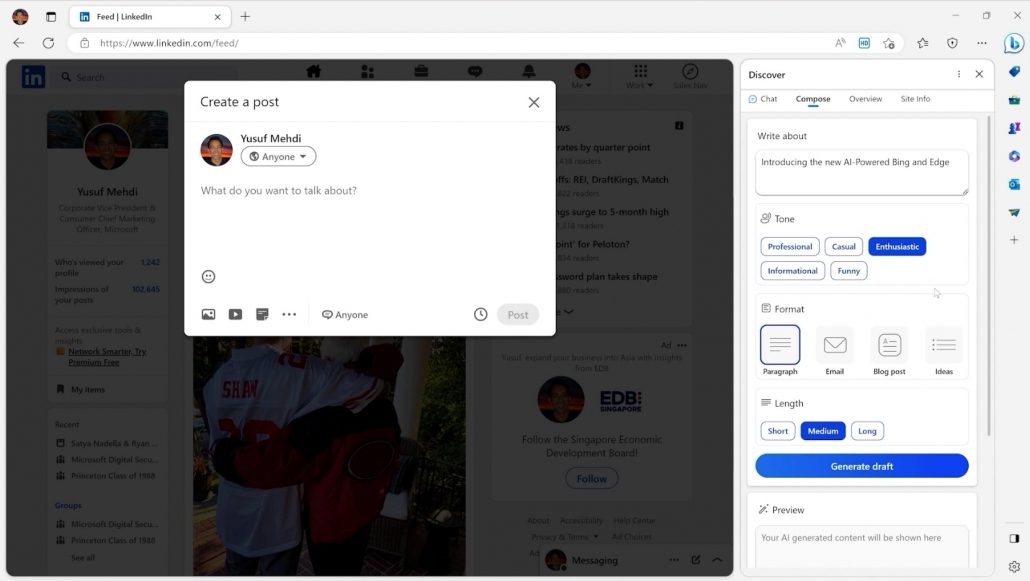
Even though the new AI-powered Bing search experience is rolling out to a limited number of users, Microsoft says it is seeing record-setting growth and engagement that may indicate a big shift is coming to the search landscape. 

Though Microsoft is still only receiving a single-digit percentage of overall search volume, these early numbers could be a sign that Google might finally have a real challenger as the new AI-powered Bing and Edge browsing experience become more widely available. 

Additionally, Microsoft reports it is now seeing more than 100 million daily active users – with around a third of those users being entirely new to Bing. 

Importantly, Microsoft says users are returning to Bing more often each day thanks to expanded uses of the Edge browser and improvements to Bing’s search result relevance.

Microsoft reported that around a third of the users with access to the AI-powered search experience are using the Chat feature every day for a wide variety of tasks including search, content creation, and more. 

While the new AI-powered search experience is likely driving much of this increased engagement and usage, long-term data shows that use of the Edge browser has also been steadily growing over the past two years.

Additionally, Microsoft says the implementation of AI-assisted search has significantly improved the relevance of search results, saying: “The second factor driving trial and usage is that our core web search ranking has taken several significant jumps in relevancy due to the introduction of the Prometheus model so our Bing search quality is at an all-time high.” 

As we are in the early days of Bing’s new AI-powered search and browser experience, it will be interesting to see whether this growth continues – especially once Google’s AI-powered tools begin to develop. 

For more, read the full report from Microsoft here.

In a closed-door presentation at the Microsoft offices, the company revealed it would be integrating ChatGPT’s AI capabilities into Bing and Microsoft web browsers. 

Introducing the new feature, Microsoft CEO reportedly told event attendees that “this technology is going to reshape pretty much every software category.”

Billed as “your AI-powered copilot for the web”, the new feature unites information from Bing with capabilities from Edge web browser and artificial intelligence. Together, users can turn to AI features to get direct answers to questions, find information in more effective ways, and recontextualize the content they find.

According to Nadella, search engines currently fail to deliver the most efficient experience up to 40% of the time, causing users to click on search results and immediately click back to search results. 

With these new capabilities, Microsoft hopes to change that radically.

How It Works

The new AI-powered Bing uses a next-generation language model from OpenAI (the creators of ChatGPT) which is reportedly even more powerful than ChatGPT.

Additionally, Microsoft is using a new model to improve the relevance of answers and keep them up to date. 

Nadella says this AI model has already been applied to Bing’s core search algorithm, causing the biggest jump in search relevance ever. 

The centerpiece of the new experience is an expanded search box that allows users to input up to 1,000 characters and a chatbot that allows users to interact with Bing in conversational language. 

Notably, this means the search engine will be able to easily follow up on previous searches and provide greater context or translate information into more understandable formats.

For example, the company demonstrated the AI’s capabilities by quickly summarizing a 15-page PDF with a single click or translating a piece of code into another programming language.

Try It Yourself

The new search experience is seeing a limited preview release on desktop devices. Starting today, anyone can try out the new experience by visiting Bing.com and conducting a series of sample searches. 

However, the feature is expected to see a complete release and mobile version soon.