
After nearly two weeks, Google has confirmed that its latest core update has finished rolling out. This means brands and sites that may have seen volatility online since March are all-clear to start assessing the impact. 

After being officially announced on March 27, the March 2026 core update finished rolling out after 12 days and 4 hours. This was just short of Google’s initial statement that the roll-out could take up to two weeks to be finalized. 

At the time that it started rolling out, the search engine said the update was “a regular update designed to better surface relevant, satisfying content for searchers from all types of sites.”

As is typical with core updates, there was no warning or further information about what to expect from the rollout. This left many site owners on the edge of their seat, anxious to see if the update would have a sizable impact on their site performance. 

Google notified the public that the update was completed via its Search Status Dashboard yesterday, April 8th, 2026. This means that sites can start accurately measuring the effect of the update and planning for future optimization. 

Were You Impacted By The Core Update?

If you were significantly impacted by the update, you should prepare for a lengthy recovery. Fallout from core updates is often long-lasting, with only gradual improvements until another major core update is released. That said, there are still steps you can take to start recovering now if the core update has led to a drop in site performance. 

In particular, Google recommends assessing your website content to ensure you are delivering quality content that provides value to real internet users and avoiding clickbait or spammy practices to over-optimize your content. To help with this, Google encourages those affected to review their guidelines for people-first content

At the same time, there may not be anything specific to fix. Google has consistently emphasized that a drop in rankings after a core update may not indicate there is anything major wrong with your site. 

As the company said as far back as 2019, “We know those with sites that experience drops will be looking for a fix, and we want to ensure they don’t try to fix the wrong things. Moreover, there might not be anything to fix at all.”

In many cases, the only way to know if you should make changes to your marketing strategies is to conduct in-depth analysis and do an honest self-assessment of your content creation approach.
Google has confirmed it has started a “small and narrow test” using AI to rewrite site headlines in search with AI without any notification to users or website managers. 

The confirmation raised eyebrows as it used strikingly similar language as the search company used last year when it confirmed it was rewriting headlines in its Discover feed before making it an official feature a month later. 

Google Confirms Rewriting Headlines With AI

According to a report from The Verge, Google has been rewriting headlines in search for several months. Notably, many of the headline rewrites led to misleading or outright unrelated headlines. For example, researchers noted an instance where the headline “I used the ‘cheat on everything’ AI tool and it didn’t help me cheat on anything” to the shorter, less-descriptive headline “‘Cheat on everything’ AI tool.” In another case, it gave an article the headline “Copilot Changes: Marketing Teams at it Again” despite that language never being used in the article. 

Sean Hollister described the practice as similar to “a bookstore ripping the covers off the books it puts on display and changing the titles.”

While the AI rewrites seemed to be used most frequently on news sites, The Verge confirmed Google has changed headlines on other types of websites as well. 

None of these changes had any notice or disclosure that the headline users were seeing was different from the original headline. 

In a statement, Google said it aims to use AI to “identify content on a page that would be a useful and relevant title to a users’ query” and to improve “matching titles to users’ queries and facilitating engagement with web content.”

A Repeating Pattern

While it is not uncommon for Google to test features like this on a limited number of sites, Matt Southern from Search Engine Journal noted that Google’s confirmation to The Verge was eerily similar to how the company addressed using AI to rewrite headlines in Discover. 

In December of last year, the company acknowledged it was using AI-generated headlines in a “small UI experiment for a subset of Discover users.”

By January, the company announced this was officially a feature for articles appearing in Discover. 

Differences With How Google Previously Rewrote Titles

This is not the first time Google has changed headlines appearing in search. In fact, one study found that more than three-quarters of title tags were changed when they appeared in search results. 

However, the new test is unique for the way it is using AI to generate entirely new headlines. In the past, Google would rewrite titles and headlines by pulling from content directly on the related page. 

With this new test, Google is moving to create titles entirely from scratch without necessarily using phrasing on webpages, risking creating misleading or unrelated headlines. 

This could cause major issues for some publishers, as users will get frustrated and mistrust sites they believe are using misleading or “clickbait” headlines. 

For more, read the full article from The Verge (requires a subscription) or Matt Southern’s coverage from Search Engine Land.

A new analysis indicates that AI tools are now generating enough sessions to be equivalent to more than half of search engine volume – highlighting the surge in artificial intelligence usage in recent times. 

According to data from Graphite.io CEO Ethan Smith, AI tools drive more than 45 billion monthly sessions worldwide, equivalent to roughly 56% of search engine volume. 

The study analyzed usage from both web traffic and mobile apps going to major artificial intelligence tools including ChatGPT, Gemini, Perplexity, Grok, and Claude.

While desktop usage accounted for a significant amount of LLM usage, the report indicates that mobile tools have been the driving force behind the major rise in AI usage.

Notably, the study found that the increased usage of AI didn’t necessarily come at the cost of traditional search engine usage. Instead, the combined use of online search and LLM tools rose 26% since 2023. 

What The Report Says

The report specifically reviewed usage of the five largest AI tools available (ChatGPT, Gemini, Perplexity, Grok, and Claude), and compared them against the largest search engines. 

It found that all the artificial intelligence platforms combined generated approximately 45 billion monthly sessions worldwide, including 5.4 billion sessions in the U.S. each month. 

Of all AI usage, 83% came from mobile apps. In the U.S., mobile apps drove 75% of artificial intelligence use. 

While other AI platforms have shown increased usage in recent months, the study shows that ChatGPT still leads the pack by a wide margin, driving 89% of global LLM usage. 

These findings are notable because this is one of the only studies to compare online search with LLM usage across both desktop sessions and mobile apps. This leads the report to suggest that most comparisons between AI use and online search usage underestimate AI use by 4-5x. 

At the same time, the findings suggest that artificial intelligence and digital search are not necessarily in competition with each other. While search may be losing some use to LLMs, Smith suggests that the increase in overall usage suggests both search and artificial intelligence may both be essential for users. Rather than AI superceding search, brands need to invest in both to maintain visibility to users. 

For more, read the full report here

While a growing number of U.S. consumers are using TikTok for search, a new survey suggests the popular social network may not be as strong of a challenger to Google as previously believed. 

A new survey from Adobe Express found that the number of people using TikTok for search has grown compared to a 2024 survey from the same company. However, the study found that fewer young users say they prefer TikTok to Google’s search engine. 

The Study

The report comes from an Adobe Express survey published earlier this month and conducted in January 2026. It surveyed over 800 consumers and 200 small businesses in the U.S. about their search habits across various platforms including Google, TikTok, and ChatGPT. 

It found that 49% of consumers report using TikTok as a search engine, an 8 point increase from 2024. However, the most notable findings were among Gen Z users. 

Gen Z and TikTok as a Search Engine

While much has been made about the number of Gen Z users favoring TikTok over Google, the study shows that number is actually falling. 

Among Gen Z users who were surveyed, those who said they were more likely to turn to TikTok for a search over Google fell from 8% in 2024 to 4% in 2026. 

This isn’t to say Gen Z is using TikTok less for search, though. In fact, 65% of Gen Z users said they use TikTok as a search engine, and 25% said they found it effective for finding information. It’s just that they don’t necessarily prefer TikTok’s search tools over Google’s. 

Instead, it seems that Gen Z is adopting a multiplatform approach to search – using the platform they feel is best or most convenient for specific searches. 

ChatGPT Shows Growth as a Search Engine

While the number of people who prefer TikTok for search over Google fell, the survey suggests more users of every age group are turning to ChatGPT for search over Google. 

According to the survey, 14% of users say they are more likely to use ChatGPT for search than Google. This was true even when broken down by age group, with 12% of Gen Z, 15% of millennials, 15% of Gen Z, and 14% of baby boomers. 

What This Means

When a significant number of younger users started reporting using TikTok over Google, it caught the notice of many brands and marketers. However, it appears the situation isn’t as simple as “TikTok will be the next big search engine”. Instead, it appears that users are using a variety of search platforms, with ChatGPT quickly growing as a significant player in search. 

It is unclear whether the sale of TikTok’s U.S. operations or changes to the platform contributed to the decrease in those who favor the platform. 

For brands looking to supplement their search marketing in the face of falling organic search traffic from Google, the answer seems to be investing in multiple platforms and ensuring they are getting picked up by AI tools – especially ChatGPT. That said, it will still likely be quite some time before any single platform dethrones Google as the biggest search engine.

For more, read the full report from Adobe Express here.

Crawling and indexing issues are one of the most damaging SEO issues a site can have. Not only do they hurt your rankings, making your business and products less visible in search results. These types of issues can completely prevent pages or entire sections of your site from being properly added to Google’s search indexes.

Now, two of Google’s most well-known representatives have shed light on the two biggest crawling issues the search engine encounters regularly

In a recent Search Off the Record podcast, Gary Illyes and Martin Splitt went into detail on the biggest crawling challenges Google faces in 2025, including the two biggest issues Google sees. 

According to Illyes and Splitt, faceted navigation and action parameters account for approximately 75% of crawling issues that Google encounters. 

Both issues create crawling problems that can overload your server, slow your site down significantly, and create infinite crawling loops. If this happens, Google’s crawlers can expend a massive amount of energy and server bandwidth that can bring your website to a screeching halt and even make your site entirely inaccessible in some cases. 

The Two Biggest Crawling Issues 

Gary Illyes says the two biggest issues account for 75% of crawl challenges.

  • Faceted Navigation – This accounts for 50% of issues according to Google. This is a navigation strategy (typically used on e-commerce sites) to allow users to filter and navigate items based on specific details like price, manufacturer, or size. The issue is that this system can generate a seemingly endless number of URL patterns if it creates a URL for every single combination of filters. Without careful management, this can lead to Google crawlers expending crawl budgets on URLs with negligible search value, duplicate content issues, and slower site performance. 
  • Action Parameters – These account for 25% of challenges. These are URL parameters used to trigger or track specific user actions, such as adding an item to a cart or saving an item to a wishlist. Importantly, these sorts of parameters don’t tend to meaningfully change page content, creating widespread duplicate content issues on your site. 

Additionally, Illyes mentioned a few other, less common crawling challenges:

  • Irrelevant Parameters – These account for 10% of issues. These problems pop up when crawlers notice strings of parameters (typically used to track session ID numbers or UTM parameters) attached to content that Google’s systems deem irrelevant to the actual navigation or page content. 
  • WordPress Plugins or Widgets – Approximately 5% of crawling issues come from WordPress plugins and other tools for sites using similar CRM’s. In some cases, these widgets may modify URLs for event tracking. Google can struggle to understand when this happens, because there is not an established system or pattern that these tools follow. 
  • “Weird Stuff”: – Lastly, Illyes attributed approximately 2% of problems to rare technical issues that pop-up. In the podcast, he cited times when URLs may be double-encoded. This means that when the crawler decodes the URL, it is still left with an unusable encoded string instead of a functional URL. 

In the discussion, Illyes and Splitt go more into detail about these issues, what causes them to arise, and how to prevent them. For more, listen to the full episode here.

A recent analysis by Datos and SparkToro highlights major changes in how people are searching, largely driven by the widespread implementation of AI across Google’s search systems. 

A new study of data from millions of real users found a significant drop in how often people in the United States are making searches on Google compared to just a year previous. 

Despite Google’s user numbers remaining stable, data indicates that individual users are performing fewer searches – a trend that has significant implications for traffic to organic results, Google ads, and discoverability on search. 

What The Study Says

According to Datos and SparkToro’s report, the average number of desktop Google searches per person has dropped by nearly 20% year-over-year for U.S. users. Notably, this phenomenon is largely limited to American users, while Europe only saw a decline of about 2-3%. 

Despite this shift, the report says that the amount of traditional searches has remained largely stable over the past year, accounting for approximately 10% of all U.S. desktop activity. 

AI Overviews Credited With Reducing Searches Per User

Based on their analysis, Datos largely credits AI with changing how people are searching. 

The primary reason behind the change is that users are increasingly getting the information they need with fewer queries. It is believed this is because AI-powered results and instant answers reduce the need for follow-up searches. 

While repeat or follow-up searches have seen significant drops, searches that don’t typically result in a click to a website remain high, indicating people are still relying on Google to find information. They are just getting the information more quickly, and largely without clicking through to websites. 

While AI is largely credited with the shifts away from repeated searches or follow-up queries, the study emphasizes that users are largely avoiding dedicated AI search tools. Dedicated AI search tools currently account for less than 1% of total desktop activity in the U.S., and the study notes that Google’s “AI Mode” accounts for a tiny percentage of overall usage. 

Other Notable Findings

The report largely focuses on the shift in searches per user, but it mentions a few other notable changes in search behavior. 

Most significantly, Datos found that users are turning to longer, more complex queries to find the information they need. Specifically, users are more frequently using longer search phrases, typically between six to nine words, when searching. This means keywords are getting longer and shows that businesses should adapt the keywords they focus on accordingly. 

The report also shows that when people do click through to a website from Google’s search results, they are increasingly going to one of a handful of websites. Instead of varying search results, the majority of clicks are going to YouTube, Reddit, Amazon, and Facebook. 

The Takeaway

The sharp decline in searches per user in the U.S. reflects a new phase in search behavior. Increasingly, AI-powered instant answers are changing how users engage with search engines, often eliminating the need for multiple searches or clicks on external sites. For businesses, this means it is more crucial than ever to diversify the channels you are marketing on, rather than relying strictly on search to drive organic traffic.

For more, read the full report from Datos here.

OpenAI has announced that it will begin testing ads within ChatGPT soon, creating a potential new major advertising channel for brands. 

The tests could begin as soon as in a few weeks, with clearly labeled ads appearing at the bottom of chatbot responses. Additionally, the ads are said to only appear when there is a specific sponsored product of service relevant to the chat. 

Who Will See Ads In ChatGPT?

For now, OpenAI says it will be significantly limiting who is eligible to be shown ads in ChatGPT. The ads will only be shown to U.S. users over the age of 18 using the free tier or those signed up for ChatGPT Go. ChatGPT Go is OpenAI’s recently introduced lowest-cost subscription option.

Users under the age of 18 and those subscribed to ChatGPT Pro, Business, or Enterprise plans will be excluded from the upcoming ads test. 

Ads Will Not Influence ChatGPT Responses

OpenAI heavily emphasized that any potential ads will be limited to clearly marked placements that are separate from ChatGPT responses. Any advertising partnerships or placements will not influence AI answers and user conversations will not be made available to advertisers.

Additionally, ads will not be shown during conversations about sensitive or regulated topics such as health, mental health, or politics. 

OpenAI Advertising Principles

In the announcement, OpenAI laid out 5 specific advertising principles it means to follow as it begins testing ads. 

  • Mission alignment: Our mission is to ensure AGI benefits all of humanity; our pursuit of advertising is always in support of that mission and making AI more accessible.
  • Answer independence: Ads do not influence the answers ChatGPT gives you. Answers are optimized based on what’s most helpful to you. Ads are always separate and clearly labeled.
  • Conversation privacy: We keep your conversations with ChatGPT private from advertisers, and we never sell your data to advertisers.
  • Choice and control: You control how your data is used. You can turn off personalization, and you can clear the data used for ads at any time. We’ll always offer a way to not see ads in ChatGPT, including a paid tier that’s ad-free.
  • Long-term value: We do not optimize for time spent in ChatGPT. We prioritize user trust and user experience over revenue.

Why This Is Notable

The announcement from OpenAI came as a slight surprise, given that CEO Sam Altman had previously expressed hesitation. Specifically, Altman had publicly worried that ads would strain the public’s trust in ChatGPT to deliver accurate information. 

However, as recently as November, Altman had begun suggesting that ads in ChatGPT were likely “at some point.”

As AI assistant usage becomes more widespread, this could become a valuable new ad platform for brands looking to connect with a new audience. 

We expect to learn more as testing begins, but for now you can read OpenAI’s full announcement for more details.

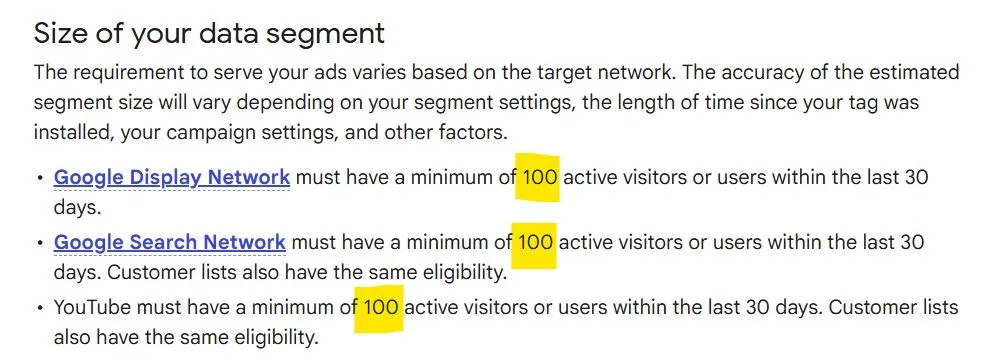
Google recently announced a major change to its ad platform that opens up some of its most powerful advertising tools for smaller businesses. The company has lowered its minimum audience size requirement to just 100 active users across all networks, including Search, Display, and YouTube. 

By decreasing the audience size from the previous minimum of 1,000 users, Google has opened the door to brands with smaller audience sizes to use remarketing and customer list targeting. 

New Minimum Limits

Now brands can use audience segments with as few as 100 users across all networks. This new limit is set across all networks and applies to both remarketing lists and customer lists, making it easier for small brands to reach more accurate audiences with their ads. 

The 100-user threshold also applies to Audience Insights, allowing brands with small audiences to better understand their performance and audience. Previously, Audience Insights could not provide reliable data for audiences with less than 1,000 people. 

Opening The Door For Smaller Advertisers

This change removes a significant barrier for smaller brands and niche advertisers. While these advertisers could use Google’s Ad platform already, they were previously locked out of many of the most effective tools and advertising methods. 

Now, smaller brands can power remarketing campaigns and personalize their ads using first-party data and in-depth insights that were not previously available to them. 

This accessibility gives businesses the ability to fine-tune their targeting, reach users who have already expressed interest, and drive better conversion rates without relying on extensive data. By delivering personalized ads to defined audience segments, brands can boost engagement and see stronger returns on their ad spend.

Limitations Due To Smaller Audiences

While Google is allowing advertisers with smaller audiences to access these tools, they caution that smaller audience sizes can still impact performance. For example, smaller audience lists may lead to less accurate insights, slower delivery, or limited reach. 

It is crucial for advertisers to closely watch their ad performance to ensure their ads are performing properly and reaching the correct audience. 

Additionally, Google notes that advertisers using smaller audience segments must take care to ensure their data collection and usage does not run afoul of today’s modern privacy regulations including GDPR and CCPA. 

For more about this change and how audience segments function, explore the Google Ads Help page on the topic here.