
Tag Archive for: AI

Google has confirmed it has started a “small and narrow test” using AI to rewrite site headlines in search with AI without any notification to users or website managers. 

The confirmation raised eyebrows as it used strikingly similar language as the search company used last year when it confirmed it was rewriting headlines in its Discover feed before making it an official feature a month later. 

Google Confirms Rewriting Headlines With AI

According to a report from The Verge, Google has been rewriting headlines in search for several months. Notably, many of the headline rewrites led to misleading or outright unrelated headlines. For example, researchers noted an instance where the headline “I used the ‘cheat on everything’ AI tool and it didn’t help me cheat on anything” to the shorter, less-descriptive headline “‘Cheat on everything’ AI tool.” In another case, it gave an article the headline “Copilot Changes: Marketing Teams at it Again” despite that language never being used in the article. 

Sean Hollister described the practice as similar to “a bookstore ripping the covers off the books it puts on display and changing the titles.”

While the AI rewrites seemed to be used most frequently on news sites, The Verge confirmed Google has changed headlines on other types of websites as well. 

None of these changes had any notice or disclosure that the headline users were seeing was different from the original headline. 

In a statement, Google said it aims to use AI to “identify content on a page that would be a useful and relevant title to a users’ query” and to improve “matching titles to users’ queries and facilitating engagement with web content.”

A Repeating Pattern

While it is not uncommon for Google to test features like this on a limited number of sites, Matt Southern from Search Engine Journal noted that Google’s confirmation to The Verge was eerily similar to how the company addressed using AI to rewrite headlines in Discover. 

In December of last year, the company acknowledged it was using AI-generated headlines in a “small UI experiment for a subset of Discover users.”

By January, the company announced this was officially a feature for articles appearing in Discover. 

Differences With How Google Previously Rewrote Titles

This is not the first time Google has changed headlines appearing in search. In fact, one study found that more than three-quarters of title tags were changed when they appeared in search results. 

However, the new test is unique for the way it is using AI to generate entirely new headlines. In the past, Google would rewrite titles and headlines by pulling from content directly on the related page. 

With this new test, Google is moving to create titles entirely from scratch without necessarily using phrasing on webpages, risking creating misleading or unrelated headlines. 

This could cause major issues for some publishers, as users will get frustrated and mistrust sites they believe are using misleading or “clickbait” headlines. 

For more, read the full article from The Verge (requires a subscription) or Matt Southern’s coverage from Search Engine Land.
A new analysis indicates that AI tools are now generating enough sessions to be equivalent to more than half of search engine volume – highlighting the surge in artificial intelligence usage in recent times. 

According to data from Graphite.io CEO Ethan Smith, AI tools drive more than 45 billion monthly sessions worldwide, equivalent to roughly 56% of search engine volume. 

The study analyzed usage from both web traffic and mobile apps going to major artificial intelligence tools including ChatGPT, Gemini, Perplexity, Grok, and Claude.

While desktop usage accounted for a significant amount of LLM usage, the report indicates that mobile tools have been the driving force behind the major rise in AI usage.

Notably, the study found that the increased usage of AI didn’t necessarily come at the cost of traditional search engine usage. Instead, the combined use of online search and LLM tools rose 26% since 2023. 

What The Report Says

The report specifically reviewed usage of the five largest AI tools available (ChatGPT, Gemini, Perplexity, Grok, and Claude), and compared them against the largest search engines. 

It found that all the artificial intelligence platforms combined generated approximately 45 billion monthly sessions worldwide, including 5.4 billion sessions in the U.S. each month. 

Of all AI usage, 83% came from mobile apps. In the U.S., mobile apps drove 75% of artificial intelligence use. 

While other AI platforms have shown increased usage in recent months, the study shows that ChatGPT still leads the pack by a wide margin, driving 89% of global LLM usage. 

These findings are notable because this is one of the only studies to compare online search with LLM usage across both desktop sessions and mobile apps. This leads the report to suggest that most comparisons between AI use and online search usage underestimate AI use by 4-5x. 

At the same time, the findings suggest that artificial intelligence and digital search are not necessarily in competition with each other. While search may be losing some use to LLMs, Smith suggests that the increase in overall usage suggests both search and artificial intelligence may both be essential for users. Rather than AI superceding search, brands need to invest in both to maintain visibility to users. 

For more, read the full report here

Online retailers who hate trying to come up with compelling product listings for all your products can breathe a sigh of relief. Amazon is making it easier to develop engaging and attractive product listings with a new generative AI tool. 

As was revealed at the recent Amazon Accelerate event, the new AI tool can craft product listing details including product titles, bullet points, and descriptions using large language models (LLMs). 

Retailers only need to provide a short description (it can even just be a few keywords) and the AI system will generate in-depth product details. 

As Robert Tekiela, vice president of Amazon Selection and Catalog Systems, said in the announcement:

“With our new generative AI models, we can infer, improve, and enrich product knowledge at an unprecedented scale and with dramatic improvement in quality, performance, and efficiency.

Our models learn to infer product information through the diverse sources of information, latent knowledge, and logical reasoning that they learn.

For example, they can infer a table is round if specifications list a diameter or infer the collar style of a shirt from its image.”

While early feedback for the tool is reportedly very positive, brands are still encouraged to review their product descriptions before using them in product listings.

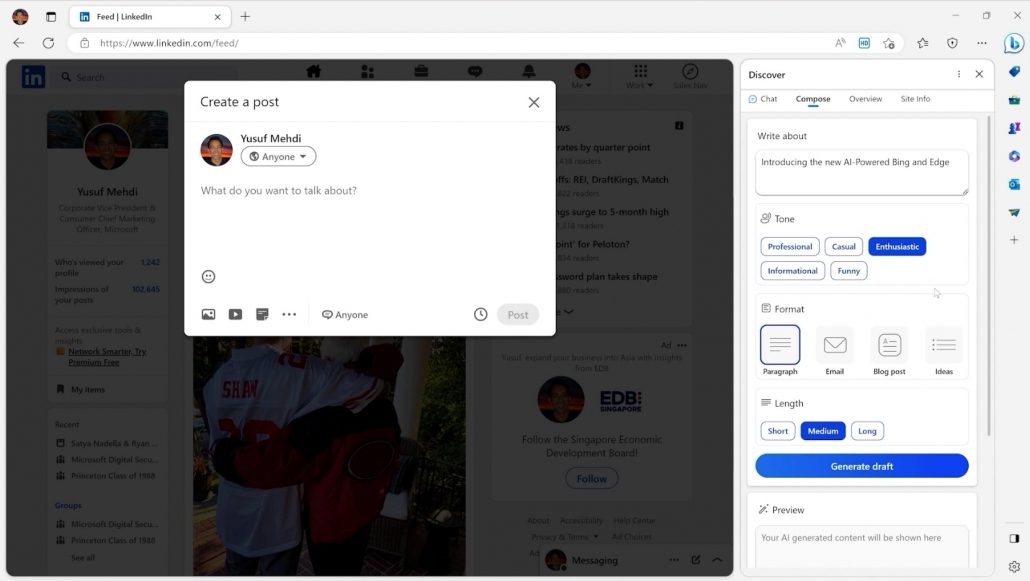
In a closed-door presentation at the Microsoft offices, the company revealed it would be integrating ChatGPT’s AI capabilities into Bing and Microsoft web browsers. 

Introducing the new feature, Microsoft CEO reportedly told event attendees that “this technology is going to reshape pretty much every software category.”

Billed as “your AI-powered copilot for the web”, the new feature unites information from Bing with capabilities from Edge web browser and artificial intelligence. Together, users can turn to AI features to get direct answers to questions, find information in more effective ways, and recontextualize the content they find.

According to Nadella, search engines currently fail to deliver the most efficient experience up to 40% of the time, causing users to click on search results and immediately click back to search results. 

With these new capabilities, Microsoft hopes to change that radically.

How It Works

The new AI-powered Bing uses a next-generation language model from OpenAI (the creators of ChatGPT) which is reportedly even more powerful than ChatGPT.

Additionally, Microsoft is using a new model to improve the relevance of answers and keep them up to date. 

Nadella says this AI model has already been applied to Bing’s core search algorithm, causing the biggest jump in search relevance ever. 

The centerpiece of the new experience is an expanded search box that allows users to input up to 1,000 characters and a chatbot that allows users to interact with Bing in conversational language. 

Notably, this means the search engine will be able to easily follow up on previous searches and provide greater context or translate information into more understandable formats.

For example, the company demonstrated the AI’s capabilities by quickly summarizing a 15-page PDF with a single click or translating a piece of code into another programming language.

Try It Yourself

The new search experience is seeing a limited preview release on desktop devices. Starting today, anyone can try out the new experience by visiting Bing.com and conducting a series of sample searches. 

However, the feature is expected to see a complete release and mobile version soon.